3.7 Operation Procedure (Audio Analyzer)
68
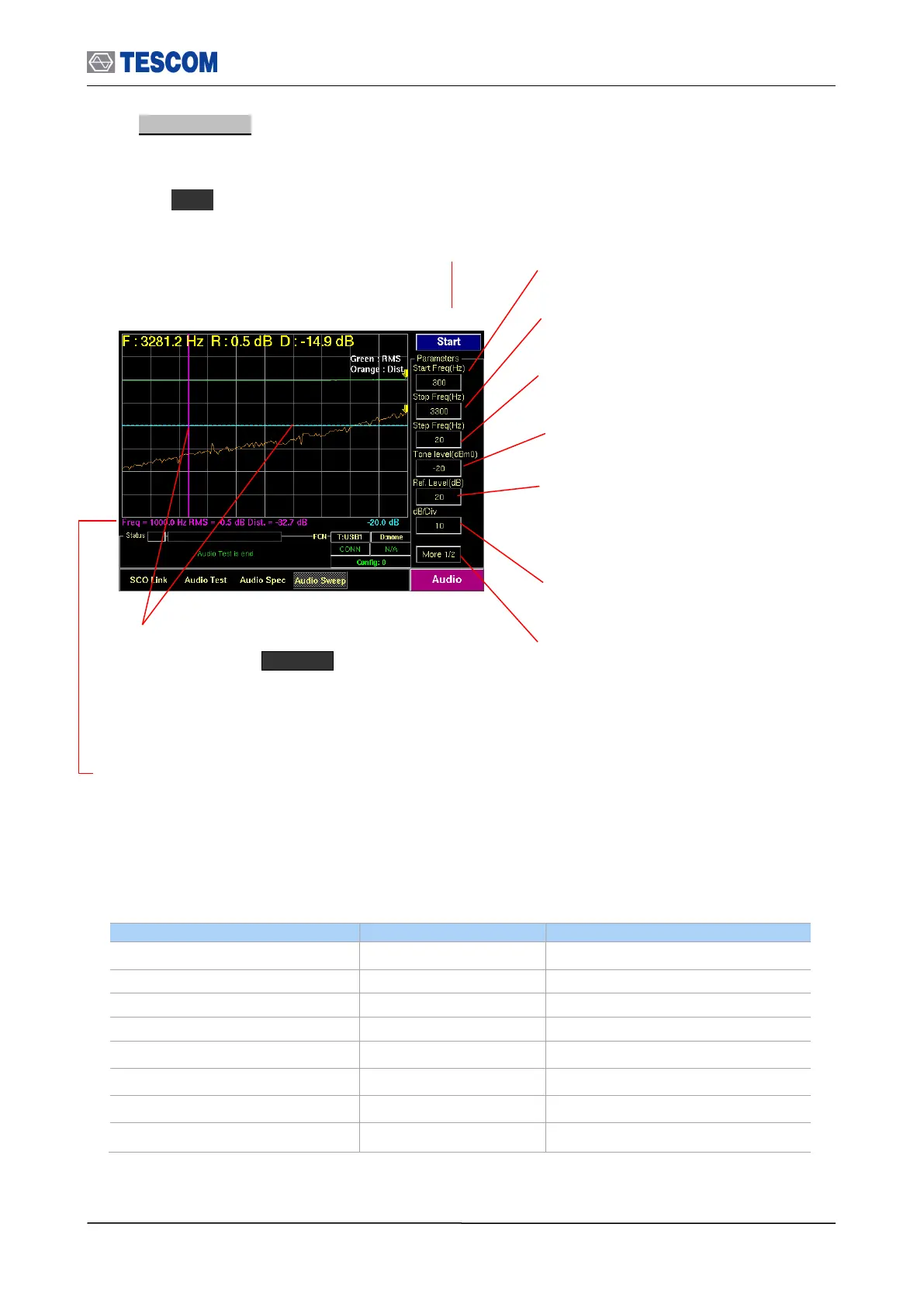
3. Audio Sweep: TC-3000C’s internal audio tone source can be set to sweep up to 3900
Hz (minimum 100 Hz step) and then return the distortion and RMS volts for each
frequency. Sweep results are displayed on the screen To access Audio spectrum screen,
press M4 soft key.
Line Markers: You can place line-shaped markers on the
screen to find the signal’s frequency and time. To activate
a maker, press the Marker key in sequence. An
activated marker changes to a solid line. Turn the knob to
place the marker at the signal.
Readouts of markers RMS, Distortion, and
frequency: The marker readouts have the same
color as the marker respectively.
Start/Stop: When this menu is pressed the tests will run
once. When pressed again while the tests are running,
the testing will stop.
Ref. Level: Specifies the amplitude reference
level. The top line of the display is the
reference level. All signals displayed are
reference to this line.
Step Freq (Hz): Specifies the frequency step
to sweep.
Start Freq (Hz): Specifies the start
frequency to sweep.
Stop Freq (Hz): Specifies the stop
frequency to sweep.
dB/Div: Sets the vertical amplitude per
division
Number of Average: Measurement Averaging.
The signal averaging improves the signal to noise
ratio. The noise, i.e., the measurement error,
decreases by 1/SQRT(N) for N averages, but the
measurement time increases by N times.
Increasing averaging will reduce the measurement
fluctuation.
Measurement Delay: Specifies the source
delay time (the time between setting the source
and taking the measurement) in milliseconds.
Tone level (dBm0): Specifies the power of
the TX audio signal.



 To Next Page