OPERATION
Carl Zeiss Illumination and Contrasting Method Axio Scope.A1
70 M60-2-0007 e 05/08
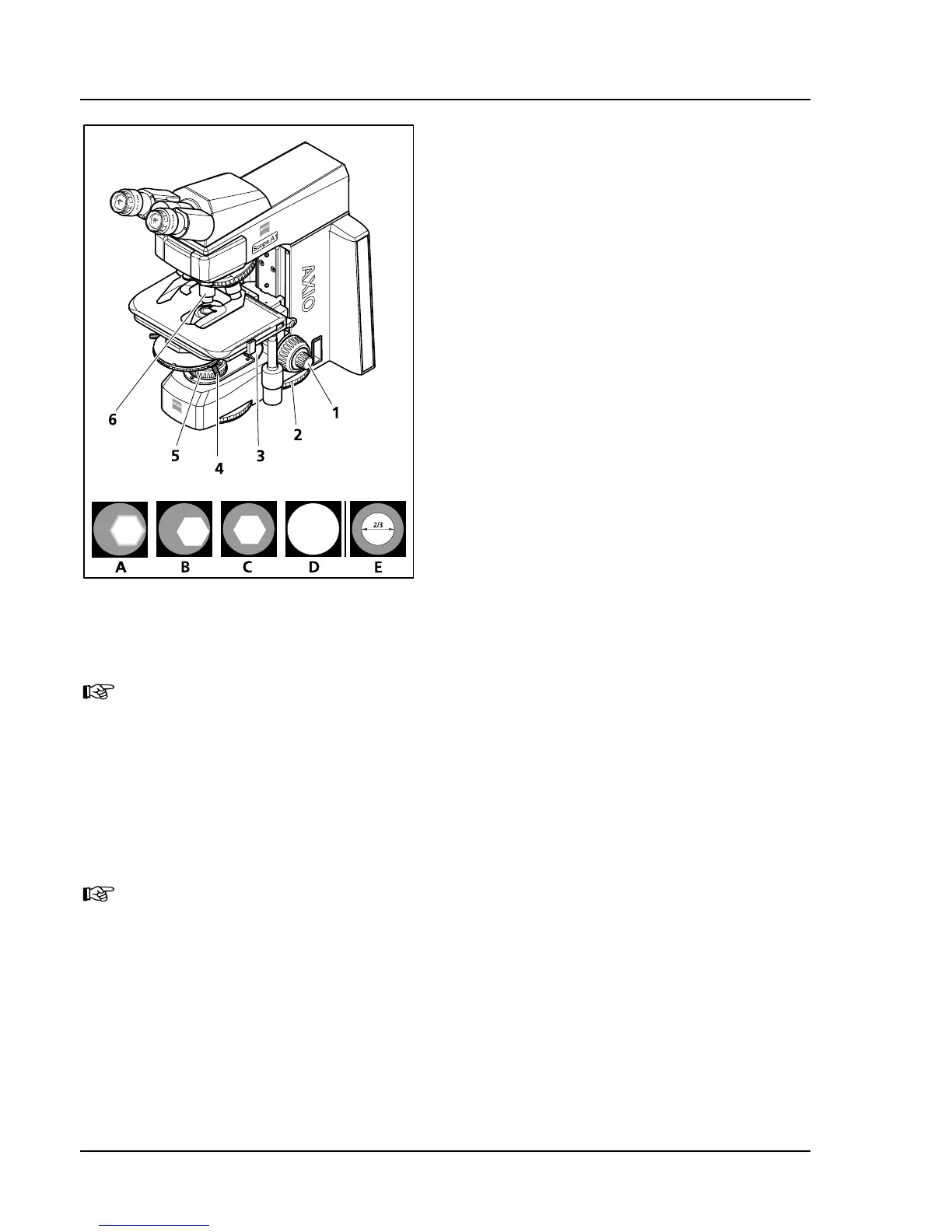
• Center the field diaphragm image with both
centering screws (
620H620HFig. 4-1/4) on the condenser
carrier (
621H621HFig. 4-1/C). Open the field diaphragm
enough to make the edge of the diaphragm
disappear from the field of view (
622H622HFig. 4-1/D).
• In order to adjust the aperture (contrast), take
an eyepiece from the tube barrel. Looking
through the barrel adjust the aperture with the
adjusting lever (
623H623HFig. 4-2/4) to the size of approx.
2/3 ... 4/5 of the diameter of the objective exit
pupil (
624H624HFig. 4-1/E). In most cases this aperture
gives the best contrast at almost full resolution
and is thus the best compromise for the human
eye.
• Replace eyepiece in tube barrel.
Each objective changes the size of the object field and the objective aperture. The centering
might also vary slightly from objective to objective, so that an adjustment of field diaphragm
and aperture might become necessary for optimal results.
When using objectives < 10x, the front lens of the condenser (if swivel-mounted) must be
folded out and the aperture opened fully. In order to achieve a better contrast, the field
diaphragm can be pulled closer when working with large object fields. To do this you must
reduce the opening by a certain range. Avoid closing it too much in order to guarantee a
consistent illumination of the field of view.
A bright-field adjustment according to KÖHLER is not possible when using transmitted light
LED.
Fig. 4-1 Microscope adjustment in
transmitted light/bright-field



 To Next Page