OPERATION
Axio Scope.A1 Illumination and Contrasting Method Carl Zeiss
M60-2-0007 e 05/08 87
4.1.9 Adjusting Reflected Light DIC and Reflected Light C-DIC
(1) Application
The reflected light DIC and the reflected light C-DIC methods (DIC = Differential Interference Contrast; C-
DIC = Differential Interference Contrast in circular polarized light) are used for the high-contrast imaging
of phase objects, i.e. objects which contrary to the amplitude objects, change predominantly the phase of
the light.
(2) Instrumentation
− Axio Scope.A1 with adjusted halogen lamp HAL 100 mounted on the reflected light barrel
− Objectives EC Epiplan-Neofluar, Epiplan with the additional label "DIC" or "Pol"
− DIC slider, fitted to the objective engraved on the top surface of the slider with amplification and
aperture or C-DIC slider 6x20 (in connection with the reflector module C DIC P&C, compensator
compartment 6x20)
(3) Reflected light DIC, preferably for objectives Epiplan 5x to 100x and LD-Epiplan 10x to 100x
• Adjust the microscope for reflected light/bright-field as described in chapter 673H673H4.1.7. Open the field
diaphragm enough so that the edge of the diaphragm lies just barely outside of the edge of the field
of view in order to avoid reflexes.
• Swing the reflector module C DIC P&C on the reflector turret/slider in the beam path.
• Swing in objective position with DIC position on the nosepiece.
• Slide the DIC slider in the compartment of the nosepiece (above the objective).
• Put down the sample, focus and turn the mechanical stage so the structure of interest is visible with
maximum contrast.
• The contrast can be optimized with the knurled button on the DIC slider.
(4) Reflected light C-DIC
• Adjust the microscope for reflected light/bright-
field.
• Switch reflector module C DIC P&C into the
beam path.
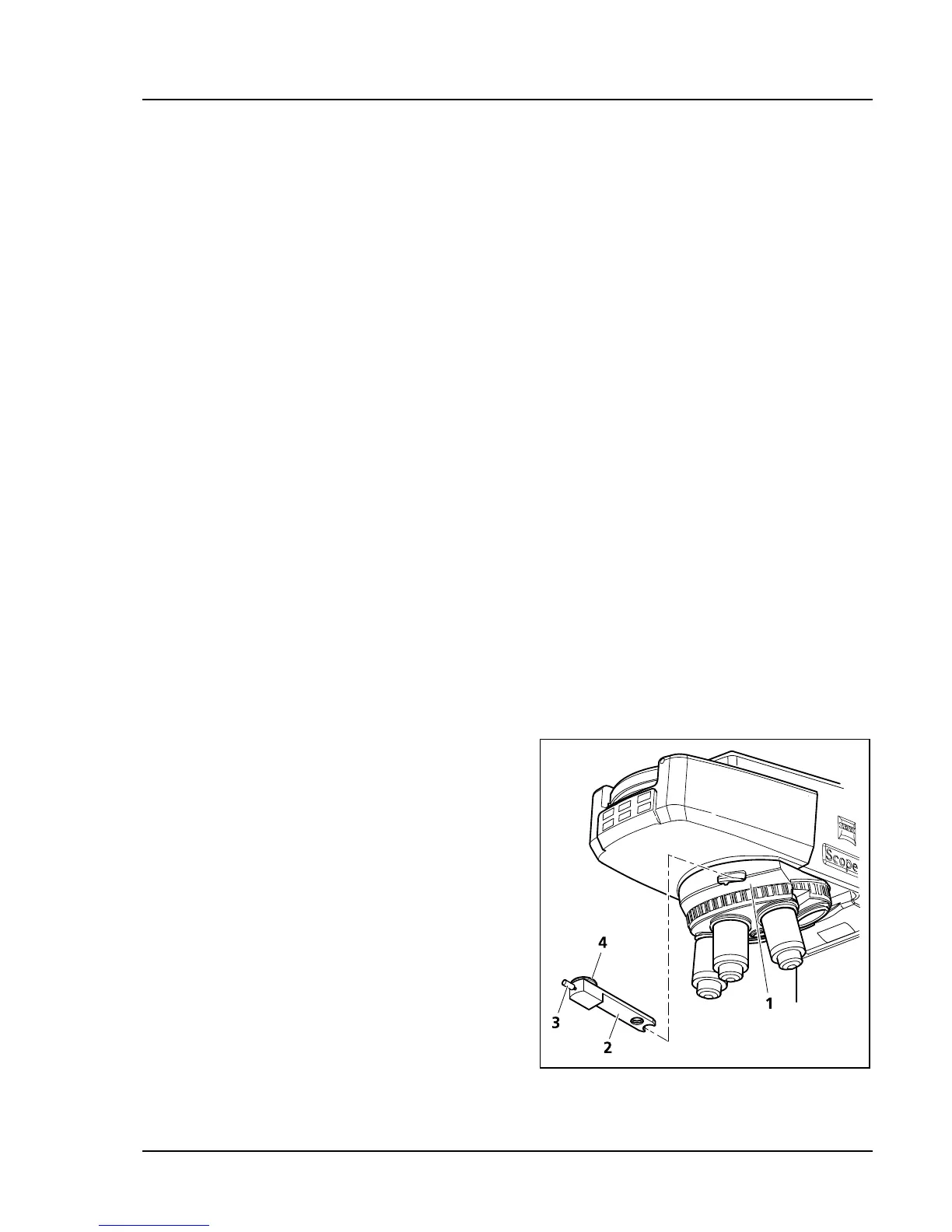
• Slide the C-DIC slider (
674H674HFig. 4-12/2) in the
compensator compartment 6x20 (
675H675HFig. 4-12/1).
• Put the sample down, focus and turn the
control knob (
676H676HFig. 4-12/4) on the C-DIC slider so
the structure of interest is visible with maximum
contrast. No further stage rotation is necessary.
• The contrast can be optimized by adjusting the
control knob (
677H677HFig. 4-12/3) on the C-DIC slider.
Fig. 4-12 Compensator compartment 6x20
with C-DIC slider 6x20



 To Next Page