OPERATION
Carl Zeiss Illumination and Contrasting Method Axio Scope.A1
94 M60-2-0007 e 05/08
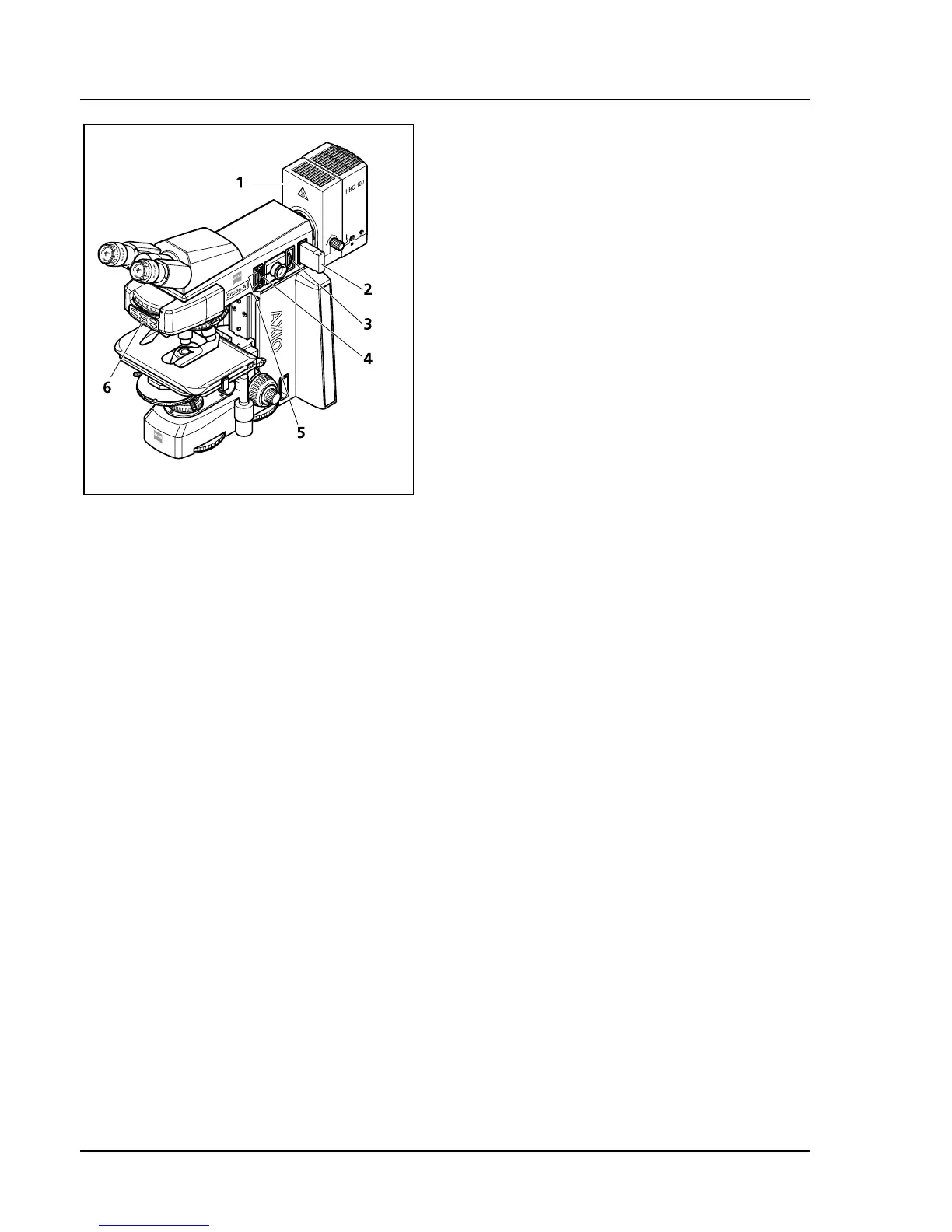
• Switch on the lamp HBO 100 or HBO 50
(
691H691HFig. 4-16/1) and let it warm up to operational
temperature for about 15 min.
• On the reflector turret/slider (
692H692HFig. 4-16/6),
choose the reflector module FL P&C with the
desired fluorescence filter combination
(depending on the excitation mode) and switch
it on.
• Now unblock the light path in the reflected
light illuminator with the filter slider reflected
light (
693H693HFig. 4-16/2).
• If necessary, adjust FL attenuator to 100 %
transmission in order to facilitate locating
fluorescence signals. Reduce the transmission
later on in order to preserve the sample.
• Take out an eyepiece from the tube and adjust
the aperture diaphragm at sight. Open the
compartment for the aperture diaphragm for
P&C (
694H694HFig. 4-16/3) enough to see the whole
objective exit pupil.
• Replace the eyepiece in the tube and close the
field diaphragm (
695H695HFig. 4-16/4) enough to make it
visible in the field of view.
• Using both centering screws (
696H696HFig. 4-16/5), center the field diaphragm on the edge of the field of view.
• Open the field diaphragm enough to make it just disappear behind the edge of the field of view, or, if
you are using a sample which might bleach out, reduce the field diaphragm into the field of view.
• Focus the sample again and optimize the collector position of the HBO 100. Adjust the collector so
that the reflector module of the short-wave excitation illuminates the field of view consistently. A
correction of the collector position is not necessary in modules with longer-wave excitation.
Fig. 4-16 Components for reflected light
fluorescence



 To Next Page