215
V2.6 | 8/30/2022 | 1120758
8.3 Inter Packet Gap (IPG)
To achieve optimal results in image transfer, several Ethernet-specic factors need to be
considered when using Baumer cameras.
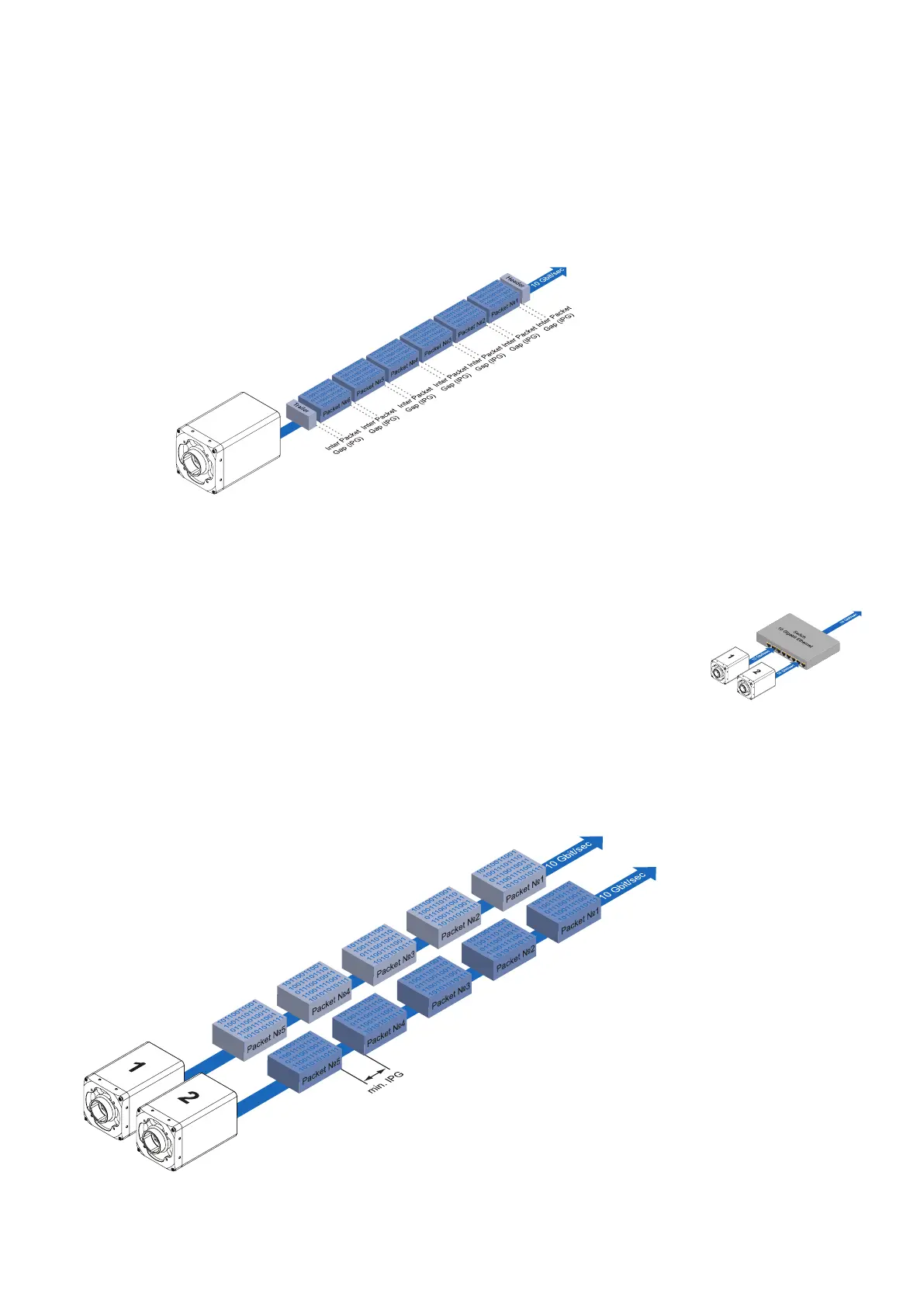
Upon starting the image transfer of a camera, the data packets are transferred at maxi-
mum transfer speed (1 Gbit/s / 10 Gbit/s). In accordance with the network standard, Bau-
mer employs a minimal separation of 12 Bytes between two packets. This separation is
called "Inter Packet Gap" (IPG). In addition to the minimal PD, the GigE Vision
®
standard
stipulates that the PD be scalable (user-dened).
8.3.1 Example 1: Multi Camera Operation – Minimal IPG
Setting the IPG to minimum means every image is transfered at maximum speed. Even
by using a frame rate of 1 fps this results in full load on the network. Such "bursts" can
lead to an overload of several network components and a loss of packets. This can occur,
especially when using several cameras.
In the case of two cameras sending images at the same time, this would theoretically
occur at a transfer rate of 2 Gbits/s. The switch has to buffer this data and transfer it at
a speed of 1 Gbit/s afterwards. Depending on the internal buffer of the switch, this oper-
ates without any problems up to n cameras (n ≥ 1). More cameras would lead to a loss of
packets. These lost packets can however be saved by employing an appropriate resend
mechanism, but this leads to additional load on the network components.
Operation of two cam-
eras employing a Eth-
ernet switch.
Data processing within
the switch is displayed
in the next two gures.


 To Next Page