Need help?
Do you have a question about the Ctera C200 and is the answer not in the manual?
The legal terms and conditions for using the CTERA software.
Details the warranty terms for the CTERA hardware product.
Information regarding the GNU General Public License versions.
Details the terms of the Apache License, Version 2.0.
Statements of compliance with regulatory standards and directives.
Explains the concept of cloud-attached storage and its benefits.
Describes the features and capabilities of the CTERA appliance.
Provides contact information for obtaining technical assistance.
Lists the items included in the CTERA C200 appliance package.
Details the connections and ports on the appliance's rear panel.
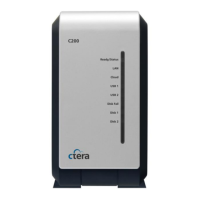
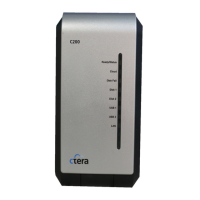
Describes the LEDs and indicators on the appliance's front panel.
Outlines the hardware and software specifications of the CTERA C200.
Lists prerequisites for installing and using the CTERA C200 appliance.
Step-by-step guide for installing the CTERA C200 appliance.
Instructions for installing and removing SATA hard drives in the CTERA C200.
Explains how to connect USB drives to the CTERA C200 appliance.
Lists the items included in the CTERA C400 appliance package.
Details the connections and ports on the appliance's rear panel.
Describes the indicators and trays on the appliance's front panel.
Outlines the hardware and software specifications of the CTERA C400.
Lists prerequisites for installing and using the CTERA C400 appliance.
Step-by-step guide for installing the CTERA C400 appliance.
Instructions for installing and removing SATA hard drives in the CTERA C400.
Explains how to connect USB drives to the CTERA C400 appliance.
Guides users on how to access the appliance's web interface.
Details the process for logging into the web interface for the first time.
Explains how to log in to the appliance's web interface regularly.
Overview of the web interface layout and navigation elements.
Explains how to use the Configuration tab for appliance settings.
Instructions on how to access the built-in help resources.
Guides users through the initial setup of the CTERA appliance.
Provides instructions on how to properly log out of the web interface.
Steps to connect the appliance to the CTERA portal for cloud services.
How to check the status of cloud services and portal connection.
Instructions for changing CTERA portal connection details.
Procedures for managing the connection to cloud services.
Guide to accessing the CTERA portal for account management.
Explains how to enable and use remote access to the appliance.
Details on synchronizing data between cloud drive and local folders.
Explains storage concepts, arrays, and different RAID types.
Outlines the process for setting up storage on the appliance.
Step-by-step guide for configuring storage using the setup wizard.
Instructions for manually configuring storage and arrays.
How to configure iSCSI targets for SAN volume access.
Procedures for installing and safely removing hard drives.
Covers hot-swapping disks and enlarging RAID arrays.
Introduces volume snapshots and defines key terms.
Outlines the process for using snapshots and scheduling them.
Explains how to configure policies for retaining snapshots.
Steps for manually taking and viewing snapshots.
Procedures for deleting snapshots and restoring data from them.
Introduces file sharing and the overall workflow.
How to create, edit, and delete network shares.
Setting up protocols like SMB, NFS, FTP, and AFP.
Features for managing user home directories and sharing via invitations.
Enables users to collaborate on files and projects.
How users can access shared network resources.
Explains the benefits and functionality of CTERA's cloud backup service.
Outlines the steps for configuring and performing cloud backups.
How to choose data for backup and create backup sets.
Configuring automatic backups, suspending, and resuming the service.
Procedures for restoring backed-up files and appliance configurations.
Introduces folder synchronization methods and workflow.
Guides on configuring clientless backup from network shares.
How to create and manage rules for folder synchronization.
Introduces CTERA Agents, licensing, and management overview.
Step-by-step guide for downloading and installing the CTERA Agent.
How to set global options and agent-specific backup configurations.
Covers manual backups, stopping operations, and disabling agents.
How to monitor agent status and view detailed information.
Procedures for monitoring agent activity and removing agents.
Explains how to add, edit, and manage user accounts.
Step-by-step instructions for creating and modifying user accounts.
How to invite users to install the CTERA Agent via email.
How to limit storage space allocated to individual users.
Procedures for removing user accounts and groups.
Steps for creating and managing user groups.
How to set up IP addresses, DNS, and gateway settings.
Adjusting Ethernet port speed, duplex, and jumbo frames.
How to check current network connection and port status.
Managing DHCP lease and configuring link aggregation for performance.
How to enable, disable, and use the file search feature.
Configuring automatic updates for the file search index.
How to manually initiate an index update for file search.
Explains the File Manager interface and how to navigate folders.
Procedures for downloading files from and uploading files to the appliance.
Basic file and folder management operations in the File Manager.
Using File Manager for projects and network share management.
How to search for files and add the appliance as a browser search provider.
Accessing and viewing previous versions of files and folders.
Provides an overview of appliance status, disk, and volume information.
Detailed information on disk drives, health, and activity.
How to configure logging settings and view system, backup, and access logs.
Setting up email alerts for important appliance events.
How to view appliance information and configure name, location, time, date, and language.
Procedures for updating firmware and managing appliance settings.
Viewing UPS info and resetting the appliance to default settings.
Steps for restarting, shutting down, and managing appliance power usage.
 General
| Processor family | - |
|---|---|
| RAID levels | 0, 1, JBOD |
| Hot-swap drive bays | Yes |
| Storage drive capacity | - GB |
| Supported file systems | ext3, FAT32, NTFS |
| Storage drive interface | Serial ATA |
| Total installed storage capacity | - TB |
| Maximum supported storage capacity | 6 TB |
| Number of storage drives supported | 2 |
| Wi-Fi | No |
| Cabling technology | 10/100/1000Base-T(X) |
| Ethernet LAN data rates | 10, 100, 1000 Mbit/s |
| Supported network protocols | CIFS, NFS, AFP, FTP, WebDAV, rsync |
| Compliance industry standards | IEEE 802.3, IEEE 802.3u, IEEE 802.3ab |
| USB 2.0 ports quantity | USB 2.0 ports have a data transmission speed of 480 Mbps, and are backwards compatible with USB 1.1 ports. You can connect all kinds of peripheral devices to them. |
| Ethernet LAN (RJ-45) ports | 1 |
| USB 3.2 Gen 1 (3.1 Gen 1) Type-A ports quantity | 0 |
| Security algorithms | 256-bit AES |
| Chassis type | Desktop |
| Product color | Black, Silver |
| Server operating systems supported | Windows Server 2003, Windows Server 2008, Windows Server 2008 R2 |
| Windows operating systems supported | Windows 7 Home Basic, Windows 7 Home Basic x64, Windows 7 Home Premium, Windows 7 Home Premium x64, Windows 7 Professional, Windows 7 Professional x64, Windows 7 Starter, Windows 7 Starter x64, Windows 7 Ultimate, Windows 7 Ultimate x64, Windows Vista Business, Windows Vista Business x64, Windows Vista Enterprise, Windows Vista Enterprise x64, Windows Vista Home Basic, Windows Vista Home Basic x64, Windows Vista Home Premium, Windows Vista Home Premium x64, Windows Vista Ultimate, Windows Vista Ultimate x64, Windows XP Home, Windows XP Home x64, Windows XP Professional, Windows XP Professional x64 |
| Sustainability certificates | RoHS |
| Certification | FCC, CE, WEEE |
 Weight and Dimensions
| Depth | 210 mm |
|---|---|
| Width | 95 mm |
| Height | 165.5 mm |
| Weight | 1100 g |

 To Next Page