Part III: Background and Concepts
The DS2831 is a True Spectrum analyzer with 80dB of dynamic range, allowing for a much more sensitive
capture and acquisition during persistence testing. The unit’s sensitivity can reach -63.5dBmV (@ 300kHz
RBW). This allows users to identify issues much sooner, potentially preventing impacts on customer services.
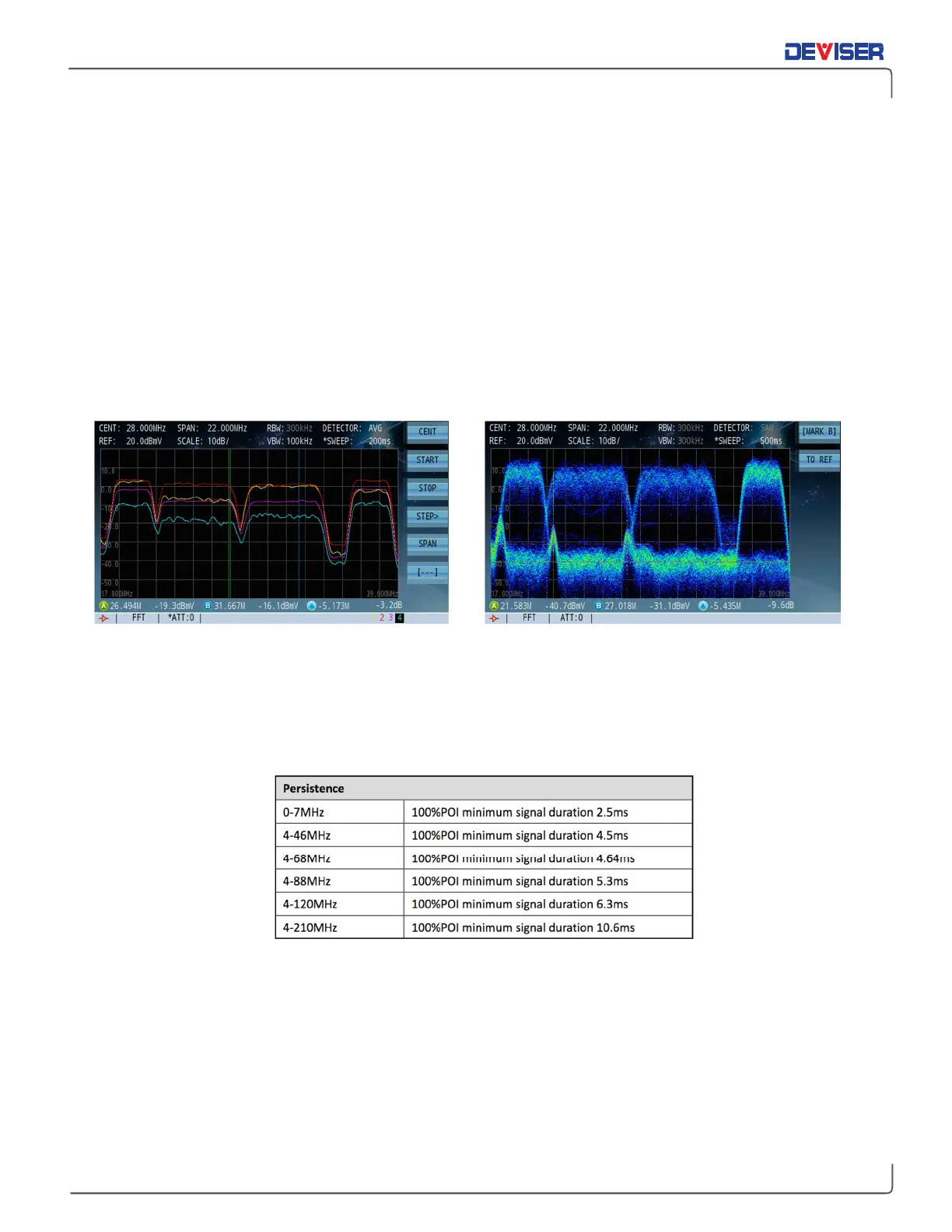
The figures below compare a typical Spectrum Analyzer screen capture, 4 simultaneous traces processed
(Peak Hold, Neg Hold, Avg & normal), to the same test frequency as seen through the DPS application. The
spectrum trace reveals no particular distortions at the Optical Upstream Receiver test point. (-20dB) In the
righthand figure, we can clearly see 3 distinct interference signals “hiding” under US signaling. We can also
confirm that the only carrier not being affected by any distortions at the moment is transmitting more data
then its close bonded neighbors.
Both instances use the following settings (except where noted):
Center frequency = 28 MHz Detector mode = Avg
Span = 22 MHz (to narrow down viewability) RBW = 300kHz
Ref level = 20dBmV Sweep time = 200ms (left), 500ms (right)
Trace display at the Upstream Optical receiver test point Persistence acquisition made at the same location and settings
To understand these results, we must first explore the DPS technology in greater depth. Notice that the
above captures were taken in FFT (Fast Fourier Transform) mode. In this mode, the DS2831 will capture
complete user-defined spans and lay each new capture over the previous ones in subsequent single
acquisitions. The following table indicates how many such FFT captures the DS2831 will make, based on
Span settings.
In the persistence spectrum example from before, the span was set to 22 MHz. Thus the DS2831 captured
each FFT in 4.5ms. The sweep took 500ms to complete, creating the image above: an accumulation of
111.11 overlaid trace.


 To Next Page