11-4.1 Normal Record
This method allows the user to freely record any useful persistence spectrum information.
To use this method, enter persistence mode and enter the following sequence:
Record
(F7),
Start
(F2),
Stop
(F2),
Next
(F7),
Save
(F1). Before you save the persistence record file, please confirm that the persistence
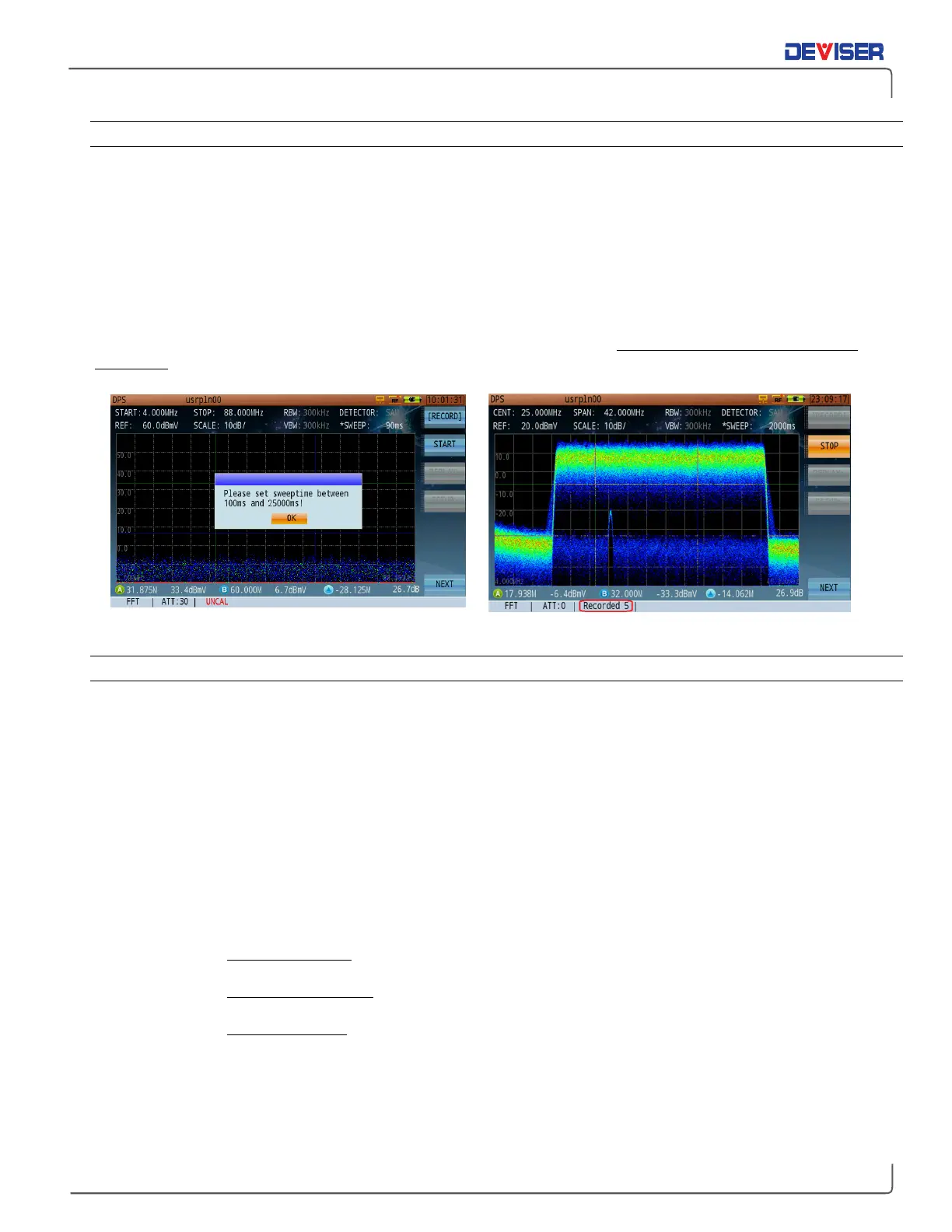
files number fewer than five. If there are more than five files, an error message will appear. To save more
records, you must delete an old one.
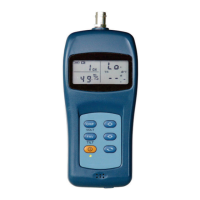
Normal persistence recording is as shown (below, right). The area outlined in red indicates the serial number
of the current recorded frame; the user may stop the recording process at any time before this number
reaches 50. Unless interrupted, the instrument will record up to 50 frames. Users must save recordings to the
hard drive, or the data will remain in temporary memory (RAM) and be lost upon instrument shutdown.
Error Caused by Invalid Sweep Time Persistence Record Frame’s Serial Number
11-4.2 Trigger Record
To use trigger recording, you will first need to define a signal pattern for the instrument to recognize. If the
received signal matches your pattern, the DS2831 will automatically begin recording. If the signal is not
recognized, no persistence recording will occur.
To set up trigger recording:
1.
In persistence mode, navigate through the following menus:
Record
(F7);
Trigger
(F1);
Setup
(F4). Set up
the trigger pattern as desired. (See “Trigger Modes” and “Setting Up The Trigger Pattern” below.)
2.
To start searching for a matching signal:
Record
(F7);
Trigger
(F1);
Start
(F2).
3.
Recorded data will be auto-saved to to DS2831’s 1GB internal hard drive.
Trigger Modes
Select your preferred recording mode in Trigger > Setup. Use F1 to cycle through modes.
RISE: Rise frame trigger. The DS2831 begins recording the instant that a signal matching the
trigger pattern is recognized.
MIDDLE: Middle frame trigger (Pre-trigger). The DS2831 begins recording at the midpoint of a
signal matching the trigger pattern.
Fall: Fall frame trigger. The DS2831 begins recording at the point when a signal matching the
trigger pattern begins to decline.


 To Next Page