17. If so equipped, cab windows should be closed,
locked and sealed and the cab door locked to
prevent vandalism and weather effects.
18. The vehicle fuel tank should be completely drained
of fuel, fogged with preservative lubricant, ("NOX-
RUST" MOTOR STOR., SAE10) and closed tightly.
All fuel filters should be replaced.
19. If at all possible, to aid those who will eventually
place the unit back in operation, all available serv-
ice publications (vehicle and engine) and a current
parts catalog should be packaged in a moisture
proof package and placed in the vehicle cab.
20. Be certain water drain holes in truck body are open.
REMOVAL FROM STORAGE
If the STORAGE preparations were conscientiously
followed in placing the vehicle into storage, getting it
back to operational status is a matter of reversing those
steps.
NOTE: Before starting the job or restoring a vehicle to
operation, obtain copies of the Operation and Mainte-
nance Manual, Service Manual, Engine Manuals
and/or the Parts Book and follow ALL special instruc-
tions regarding servicing the vehicle and its compo-
nents.
In addition to removing the storage materials, the fol-
lowing actions should be taken.
1. Inspect the entire vehicle carefully for rust and
corrosion, correct as necessary.
2. Service the engine according to the Engine Manu-
facturer’s Operation and Maintenance Manual.
3. Clean the radiator; refer Engine Manufacturer’s
Operation and Maintenance Manual.
4. The cooling system should be completely drained,
chemically flushed, and refilled with a conditioned
water/antifreeze solution suitable for the lowest
temperature anticipated. Refer to Fluid Specifi-
cations in Section "P", Lubrication and Service, of
the Komatsu
®
service manual for the proper anti-
freeze and conditioner concentrations. After refill-
ing the system, always operate the engine until the
thermostats open to circulate the solution through
the cooling system.
5. Thoroughly inspect all drive belts and hydraulic oil
lines for evidence of damage, wear or deteriora-
tion. Replace any suspected lines. Don’t take
chances on ruptures or blow-outs.
6. New hydraulic filters should be installed and the
hydraulic tank (reservoir) checked and serviced
with Type C-4 oil as specified in Section "P",
Lubrication and Service.
7. Drain on fuel tank should be opened to remove
any build up of moisture or sediment that may
have accumulated while in storage. Close drain
then fill the fuel tank with approved diesel fuel.
NEVER blend gasoline, gasohol and/or alcohol
with diesel fuel. This practice creates an extreme
FIRE HAZARD and under certain conditions may
cause an EXPLOSION.
8. Make certain that all hydraulic controls, steering
linkage and throttle linkage points are lubricated
and operate freely before engine start up.
9. All electrical connections must be clean and tight.
Check security of all ground straps and cables.
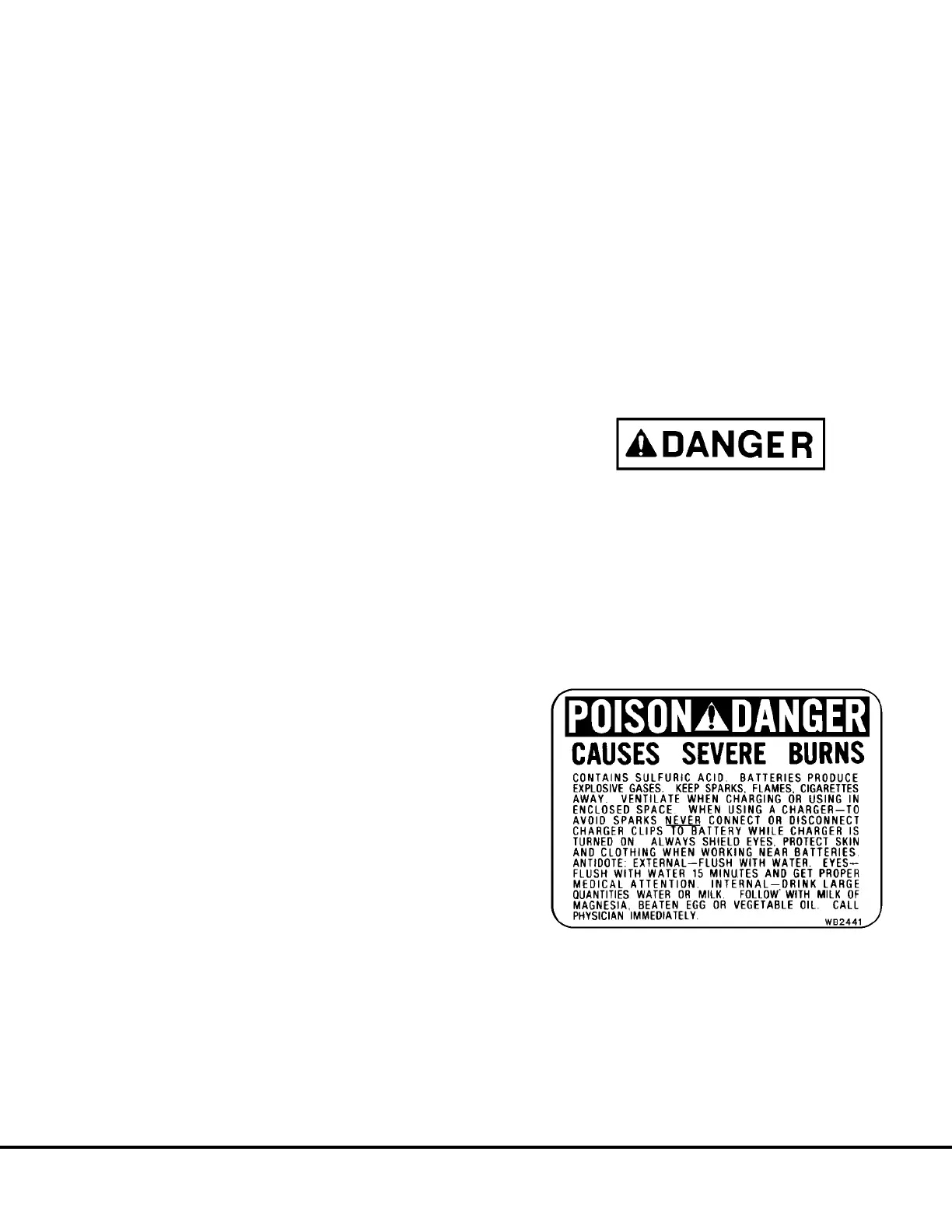
10. Install fully charged batteries in unit. Clean connec-
tors and connect battery cables. Compartment
must be free of corrosion. Secure batteries with
hold downs.
11. Check all electrical cables for weathering, cracks
and/or damage. Replace any defective cables.
A07003 Storage Procedures A7-3



 To Next Page