Milestone Srl MA245-003 – ultraWAVE 3 – User Manual
55
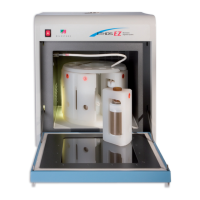
Samples tray
To keep track of samples, use the numbered plate provided. The rack can only be placed in a certain
fixed position on the plate.
When the rack is positioned, two vials lift to simplify the handling
Acid mixtures
Acids are normally used once the sample must be converted into appropriate form for further
instrumental analysis.
When working with samples containing a large quantity of organic compounds (e.g. food, API, raw
materials, biological tissues, etc.), wet digestion based or organic matter oxidation is the conventional
approach. For samples, whose constitution is inorganic (e.g. geological and metallurgical samples), a
dissolution step is generally used.
Both procedures are based on the use of oxidizing and non-oxidizing reagents as described in the table
below.
Table: Characteristics of common reagents used for wet digestion.
Nitric acid is the most common reagent for the oxidation of organic matrices. Its oxidation
potential is strongly dependent on the reaction temperature since the boiling temperature
of azeotropic mixture with water is 121 °C at atmospheric pressure, the use of closed
reactors are normally recommended to increase its oxidant power. An important feature is


 To Next Page