SVAN 948 USER MANUAL .
4 - 64
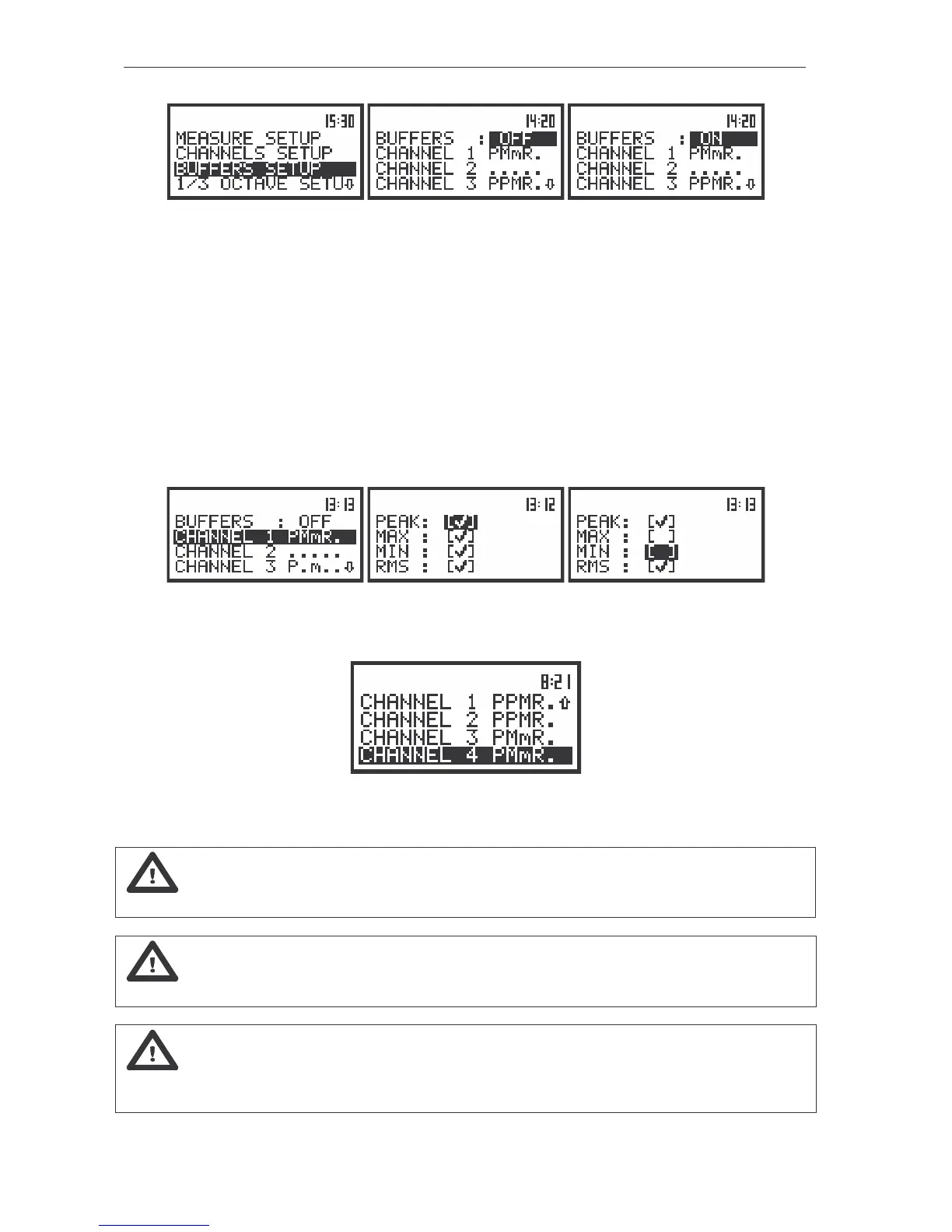
The view of the displays in the BUFFERS SETUP sub-list (path: MENU / INPUT / BUFFERS SETUP), the selection
of the BUFFER position
The user can select the following results, which can be saved: PEAK, MAX, MIN and RMS in the
case of sound measurement. The selection of the parameter from the CHANNEL x sub-list is made by
pressing the <
>, <
> push-buttons. After pressing the <ENTER> push-button any changes made in the
sub-list are confirmed and the sub-list is closed. The return to the BUFFERS SETUP sub-list ignoring any
changes made in the sub-list is made after pressing the <ESC> push-button.
In order to switch parameters in the buffer, the user has to place special character in the chosen
position; available values are: [√
√√
√] or [ ]. The selection of the required buffers parameter is made with the
<
>, <
> push-buttons. The user can pass to the selection of the next parameter from the CHANNEL x
sub-list pressing the <
>, <
> push-buttons. After pressing the <ENTER> push-button any changes
made in the sub-list are confirmed and the sub-list is closed. The return to the BUFFERS SETUP sub-list
ignoring any changes made in the sub-list is made after pressing the <ESC> push-button.
The view of the displays in the CHANNEL 1 sub-list; the selection of the parameters
to be saved in the buffer’s file
The view of the displays in the BUFFERS SETUP sub-list; the all the parameters were selected
to be saved in the buffer’s file; in CHANNEL 1 and 2 vibration and in CHANNEL 3 and 4 sound parameters
Notice: The change of the channels parameters is not possible when the
measurement is performed. The user has to finish the current measurement.
Notice: Setting BUFFER:OFF results in bypassing the storing of the given channel’s results
in the buffer’s file. It creates more space in the buffer for other channels (see Chapter 5 for details).
Notice: The buffer is updated in the time periods (steps) defined in the BUF. STEP (path:
MENU/ INPUT/ MEASURE SETUP/ BUF. STEP). The way the measurement results are stored is described
in Chapter 5.


 To Next Page