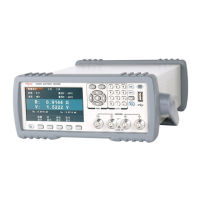
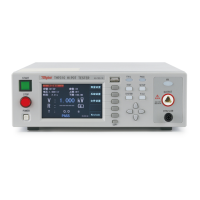
Insert the short plate (TH26010) to the test fixture.
Press MEAS SHORT to execute short correction.
5.2 Correct connection of DUT
The instrument has H
CUR
(current sampling high end Hc), L
CUR
(current sampling low end Lc), H
POT
(voltage sampling high end Hp), L
POT
(voltage sampling low end Lp) and a total of four pairs of test
terminals corresponding to the shielding end of each test terminal.
Each terminal contains shielding layer whose function is to reduce the influence of the ground stray
capacitance and the interference of the electromagnetic field. In the process of testing, Hcur, Hpot
and Lpot, Lcur should be connected with DUT lead to form a complete 4-terminal measurement,
thus reducing the effect of the lead and the connection points on the test results (especially the
dissipation measurement). When testing low-ohm components, Hpot, Lpot should be connected to
the lead terminal so as to avoid the impedance being added to the lead impedance and the
connection principle is that the Hpot and Lpot test should be the actual existed voltage on DUT.
In other words, before connecting to DUT, it is not recommended to connect Hcur, Hpot with Lpot,
Lcur, for doing this will increase test error.
If the connection point and the lead resistance R lead are far weaker than the tested impedance (for
example: R
lead
<Z
x
/1000, the accuracy error is required to be less than 0.1%), before connecting to
DUT, it is recommended to connect Hcur, Hpot and Lpot, Lcur (Two terminal test).
In the test with high accuracy requirement, using Kelvin test fixture (standard accessory) will gain
better results than using test leads. When Kelvin test lead is used under 10kHz, a better
measurement result can be obtained. However, when the frequency is higher than 10kHz, it cannot
meet the measurement demand. In high frequency, the change of the clearance between test leads
will directly change stray capacitance and inductance on test terminals and this problem is
unavoidable, because the test leads cannot be fixed in a position.
So, the use of the test fixture should be used as possible in high frequency. If the test fixture is
unavailable or cannot be used, the status of test leads should be the same in the processes of
correction and test.
No matter the standard Kelvin test fixture or Kelvin test leads or user-made fixture is used, the
following requirements should be met.
1. Distribution impedance must be reduced to the Min. especially when testing high impedance
components.
2. Contact resistance must be reduced to Min.
3. Short and open must be available between contact points. Open and short correction can easily
reduce the influence of distribution impedance of the test fixture on measurement. For open
correction, the clearance between test terminals should be the same with that when they connects
with DUT. For short correction, the short plate of low impedance should be connected between test
terminals. Another way is to directly connect Hc with Lc or Hp with Lp, then connect both.
Note: When the DUT is a polarity component, before testing, the high potential terminal should be
connected to the terminal with mark “+”, “Hc” or “Hp” and the low terminal should be connected to
the terminal with mark “-”, “Lc” or “Lp”.
Warning: Before testing, please discharge the tested polarity component so as to avoid the
damage to the instrument.


 To Next Page