Version 16.10 AF-6600 AF-5000 Series Install Manual 29
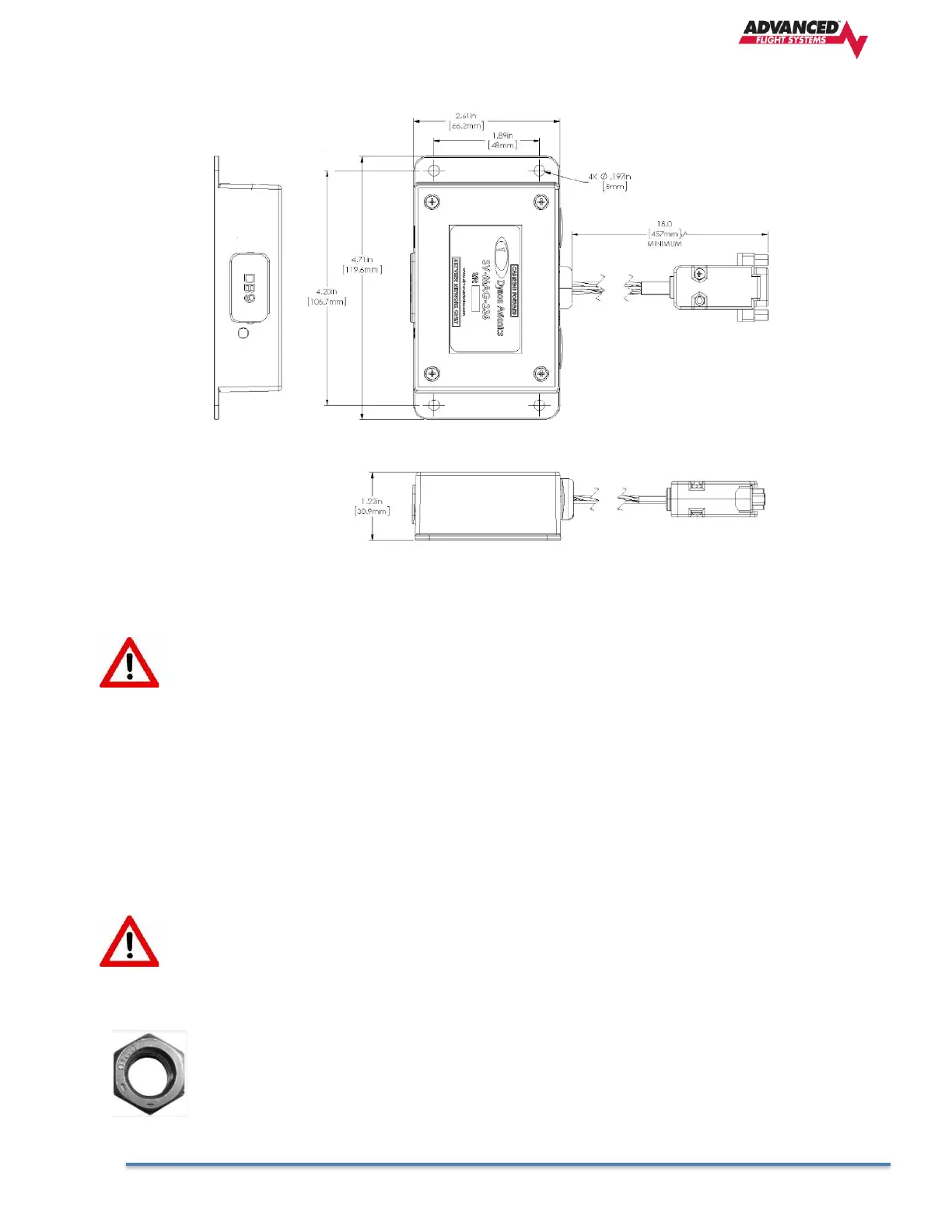
3.3 SV-MAG-236 Remote Magnetometer
The SV-MAG-236 Remote Magnetometer P/N: 72236 was developed for situations where the SV-ADAHRS-
200/201’s integrated magnetometer cannot be located in an area free of magnetic disturbances while
satisfying the other installation constraints (such as proximity to center of gravity) of the SV-ADAHRS-
200/201. The SV-MAG-236 is particularly recommended for steel-frame aircraft.
Proper installation of the Advanced-SV Magnetometer is critical. Performance is significantly linked
to a proper magnetometer installation. The installation location must meet all of the mechanical,
magnetic, orientation, and environmental requirements detailed below.
The location should be magnetically benign. Given that it may be difficult or impossible to avoid all sources of
magnetic interference, it is possible to characterize and compensate for small, static magnetic fields with
calibration. Calibration cannot, however, compensate for dynamic magnetic fields (e.g., AC currents, non-
constant DC currents, and non-stationary ferrous material such as electric turn coordinators and control
surfaces). Thus, you must avoid mounting the module close to sources of dynamic magnetic fields, avoid
wires that carry large amounts of current, and use non-magnetic fasteners for installation. AFS’s general rule
of thumb is that 1 to 2 feet between the module and sources of magnetic fields is generally good enough, but
2 or more feet is better.
Use of stainless steel mounting hardware is not recommended as it is not always non-magnetic.
If you use a magnet to test whether possible interfering materials are non-magnetic, do not actually
touch the magnet to the material you are testing, as this contact can cause the material you are
testing to become magnetized.
Move a handheld compass throughout the space surrounding your intended location to get a
rough idea of the suitability of the area. Note that this test should be done with major aircraft
systems operating (e.g., strobe lights and radios on) because some systems can cause
magnetic interference. If the compass needle deviates significantly from magnetic North or
cycles back and forth, the location is not ideal for ADAHRS installation.


 To Next Page