54 BD FACSAria User’s Guide
Longpass Filters
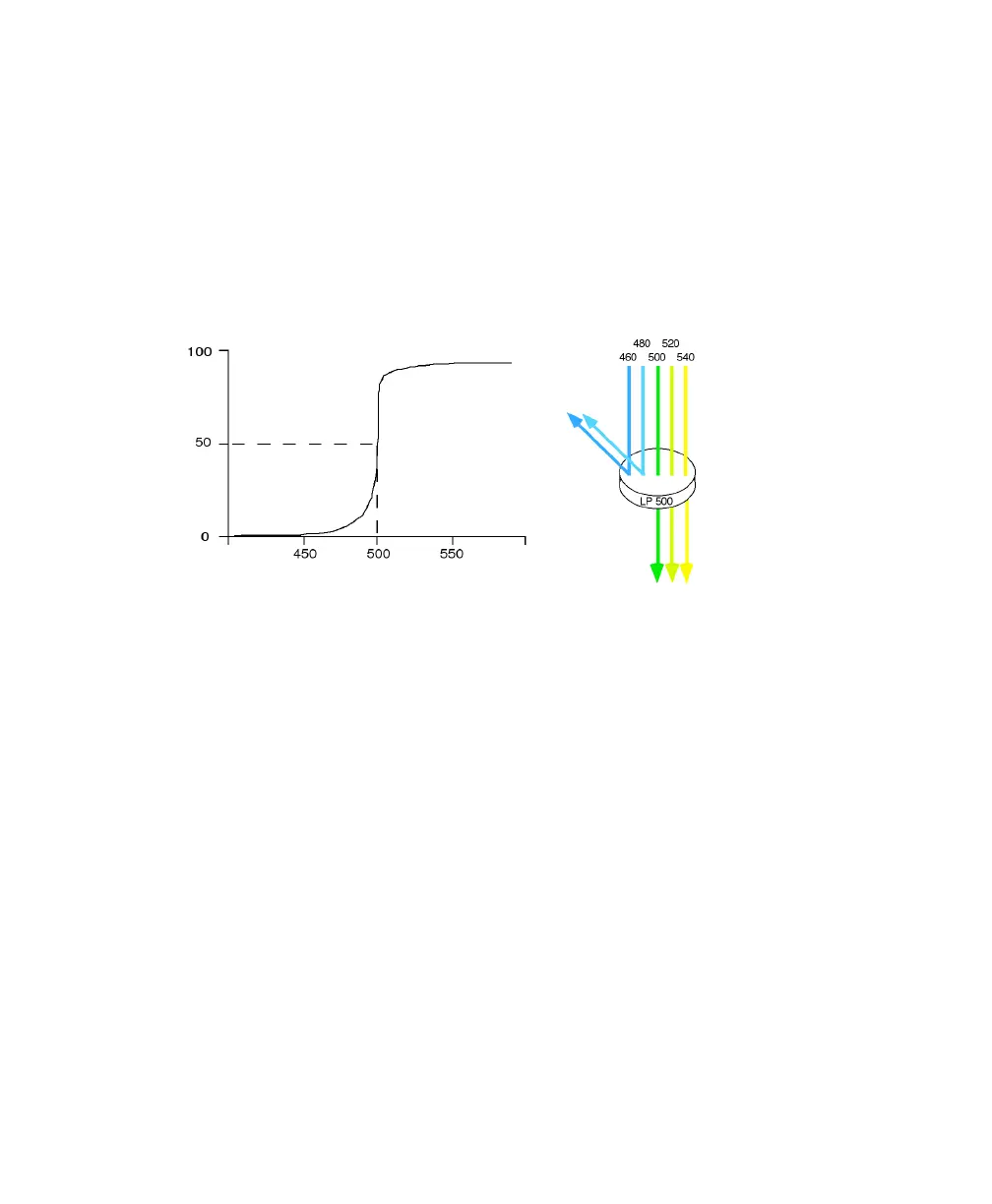
Longpass (LP) filters pass wavelengths longer than the filter rating and reflect
shorter wavelengths. For example, a 500 LP filter permits wavelengths longer than
500 nm to pass through it and reflects wavelengths shorter than 500 nm
(Figure 2-8).
Figure 2-8 Light reflection by longpass filter
Dichroic filters that are used to direct different color light signals to different
detectors are called dichroic mirrors or beam splitters.
Although dichroic mirrors have the properties of LP optical filters, you cannot
necessarily use any type of LP filter as a beam splitter. A beam splitter must have
a surface coating that reflects certain wavelengths, but many types of LP filters
are absorbance filters that do not have any specific reflective characteristics. Also,
optical filters and beam splitters are rated at a specific angle of incidence. When
used as a beam splitter, they are placed at an angle relative to the light source.
Their optical properties are therefore designed for that angle of incidence.
The detector arrays use LP dichroic mirrors to steer progressively shorter
wavelengths of light to the next PMT in the array. For example, in the octagon
array, light first passes through a 735 LP filter in the A position, followed by a
655 LP filter in the B position. Thus, wavelengths longer than 735 nm are
detected at PMT-A; all wavelengths <735 nm are reflected to PMT-B. Wavelengths
between 655 nm and 735 nm are detected at PMT-B; all wavelengths <655 nm are
reflected to PMT-C, and so on. For a list of the longpass filters used in the
detector arrays, see Table 1-1 on page 40.
wavelength (nm)
% transmission
longpass


 To Next Page