8
General Information
Safety Instructions
3. BASIC SAFETY INSTRUCTIONS
These safety instructions do not consider any contingencies or incidents which occur during installation, operation
and maintenance.
The operator is responsible for observing the location-specific safety regulations, also with reference to the
personnel.
Danger – high pressure.
▶ Before loosening the pneumatic lines and valves, turn off the pressure and vent the pneumatic lines.
Risk of electric shock.
▶ Before reaching into the device or the equipment, switch off the power supply and secure to prevent reactivation.
▶ Observe applicable accident prevention and safety regulations for electrical equipment.
Risk of burns/risk of fire if used continuously through hot device surface.
▶ Keep the device away from highly flammable substances and media and do not touch with bare hands.
General hazardous situations.
To prevent injury, ensure that:
▶ That the system cannot be activated unintentionally.
▶ Installation and repair work may be carried out by authorised technicians only and with the appropriate tools.
▶ After an interruption in the power supply or pneumatic supply, ensure that the process is restarted in a defined
or controlled manner.
▶ The device may be operated only when in perfect condition and in consideration of the operating instructions.
▶ Do not supply the supply pressure connection of the system with aggressive or flammable mediums.
▶ Do not supply the supply pressure connection with any liquids.
▶ Do not put any loads on the housing (e.g. by placing objects on it or standing on it).
▶ Do not make any external modifications to the device housings. Do not paint the housing parts or screws.
▶ The general rules of technology apply to application planning and operation of the device.
NOTE!
Electrostatic sensitive components / modules.
The device contains electronic components which react sensitively to electrostatic discharge (ESD). Contact
with electrostatically charged persons or objects is hazardous to these components. In the worst case scenario,
they will be destroyed immediately or will fail after start-up.
• Observe the requirements in accordance with EN 61340-5-1 to minimise or avoid the possibility of damage
caused by sudden electrostatic discharge.
• Also ensure that you do not touch electronic components when the operating voltage is present.
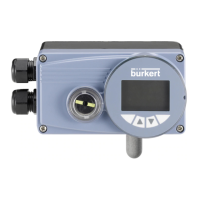
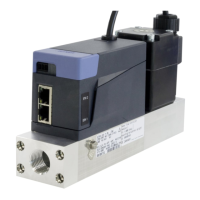
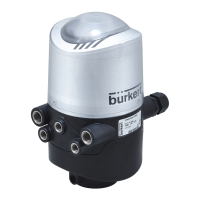
The Type 8792/8793 were developed with due consideration given to the accepted safety rules and are
state-of-the-art. Nevertheless, dangerous situations may occur.
Failure to observe this operating manual and its operating instructions as well as unauthorized tampering with
the device release us from any liability and also invalidate the warranty covering the devices and accessories.
english
Type 8792, 8793
Type 8792, 8793



 To Next Page