Need help?
Do you have a question about the GE MDS ORBIT ECR and is the answer not in the manual?
Overview of key features including security, small form factor, network interfaces, user interface, and tamper detection.
Details on the external interfaces provided by ECR and MCR units.
Description of various Network Interface Cards (NICs) supported by the Orbit MCR.
Details on the 4G LTE/CDMA modem, its supported technologies and Verizon certification.
Details on 4G LTE, HSPA+, GSM/GPRS modem for EMEA/APAC, supported technologies and GCF cert.
Details on 4G LTE, HSPA+, GSM/GPRS modem for North America, supported technologies and PTCRB cert.
Details on the 3G modem, supported technologies, and PTCRB/GCF certification.
Details on the NX915 module for 900 MHz unlicensed operation, features and benefits.
Details on LN series NIC modules for licensed narrowband operation, features and benefits.
Overview of applications where the unit provides flexibility in network communications.
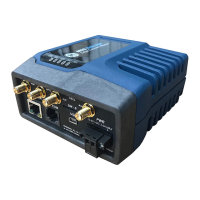
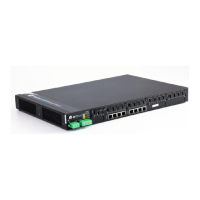
Description of front panel connectors and indicators for MCR and ECR units.
Overview of tasks for initial setup: password creation, password change, and default configuration review.
First steps after startup: create one-time passwords, change login passwords, and evaluate factory defaults.
Explanation of one-time passwords for recovery if primary password is lost; strongly encouraged.
Guidance on changing default passwords for all user roles for security purposes.
Review of cyber security capabilities and parameters to customize for enterprise security policy requirements.
Steps to configure the unit for its first use with serial console interface and terminal parameters.
Guide on using the CLI with an example for changing the device name.
Summary listing of commonly needed tasks and their corresponding CLI commands for quick reference.
Configuration parameters for Access Point mode, including Mode, Tx Power, Channel, and SSID.
Explanation of snapshots for storing and restoring unit configuration and firmware images.
Setting system clock date, time, and timezone manually or automatically via NTP.
Explanation of user accounts/roles (admin, tech, oper) and password management.
Information on periodically releasing new Orbit MCR/ECR device firmware for features and updates.
How the magnetometer detects magnetic field changes and generates alarms for tamper protection.
Configuring Ethernet port security using port-based authentication via EAP or MAB modes with RADIUS.
Forwarding IP packets between routed interfaces using user-defined network paths (static routes).
Configuring packet filters (ACL) to permit or deny incoming/outgoing traffic on an interface.
Network address translation for private IP addresses to public IP addresses for public network access.
Translation of destination IP address and port for traffic ingressing an interface for service access.
Translation of a single public IP to a private IP or subnet for network accessibility.
Overview of supported Virtual Private Network (VPN) setups: Policy-Based IPsec, GRE/IPsec, DMVPN.
Provides remote management using minimum bandwidth for managing other Orbit devices.
Features for enhancing network link reliability using Route (Layer-3) and Link (Layer-2) failover.
Method for setting up multiple routers to provide redundant routing capability using a virtual IP.
Configuring RADIUS server for 802.1X authentication and managing x509 public certificates.
Basic requirements for proper operation and checking items when troubleshooting system problems.
Process for changing configuration data in Configuration Mode, requiring making changes and committing.
Descriptions of commands available in operational mode, including commit, configure, exit, help, ping, quit.
Descriptions of commands available in configuration mode, including annotate, commit, compare, edit, exit.
Configuration of out-of-band IMA connection, similar to VPN setup with specific parameters.
Troubleshooting steps for IMA connection failure, distinguishing it from IMA evaluation failure.
Examples of port authentication configuration on Orbit using EAP mode on ETH1 and ETH2.
 General
| Category | Network Router |
|---|---|
| Manufacturer | GE |
| Model | MDS ORBIT ECR |
| Protocols | Modbus, DNP3, IEC 60870-5-101/104 |
| Interface | Ethernet, Serial |
| Operating Temperature | -40°C to +70°C (-40°F to +158°F) |
| Ethernet Ports | 1 |
| Serial Ports | 1 |
| Frequency Range | 2.4 GHz |
| Modulation | QAM, QPSK |
| Encryption | AES-256 |
| Range | Up to 30 miles (line of sight) |


 To Next Page