26 User’s Manual INNOMAR Parametric Sub-Bottom Profilers / SESWIN
26 Innomar Technologie GmbH (2023-01)
3.2 Transducer Handling and Installation
3.2.1 General
The INNOMAR SBP models are fitted with a transducer for both, HF and LF operation. The
transducer cable has a sea water resistant polyurethane sheet and is moulded non-removable to
the transducer. Make sure the cable with connector can be routed to the topside unit without
damaging anything. Cable and connector dimensions are summarized in the table below.
SBP model smart compact,
light
standard medium-xx deep-xx
Transducer S/N starts with letter
OR the S/N ends with
M
R
C
B or C
A
A
E
E
G
G
Cable diameter 12 mm 20 mm 22 mm 22 mm 22 mm
Cable bending radius (min. static
/ min. dynamic / recommended)
30 / 60 /
120 mm
60 / 120 / 240 mm
Connector dimensions
D40 mm x
L90 mm
D55 mm x L100 mm
!
Make sure to use the correct transducer model (first letter of transducer serial number
as shown in the table above); using the wrong transducer type may seriously damage
the topside electronics.
3.2.2 Transducer Handling
The active area of the transducers must be protected against mechanical damages. Don’t put the
transducer on this (blue or black) area to avoid scratches or getting the transducer punctured.
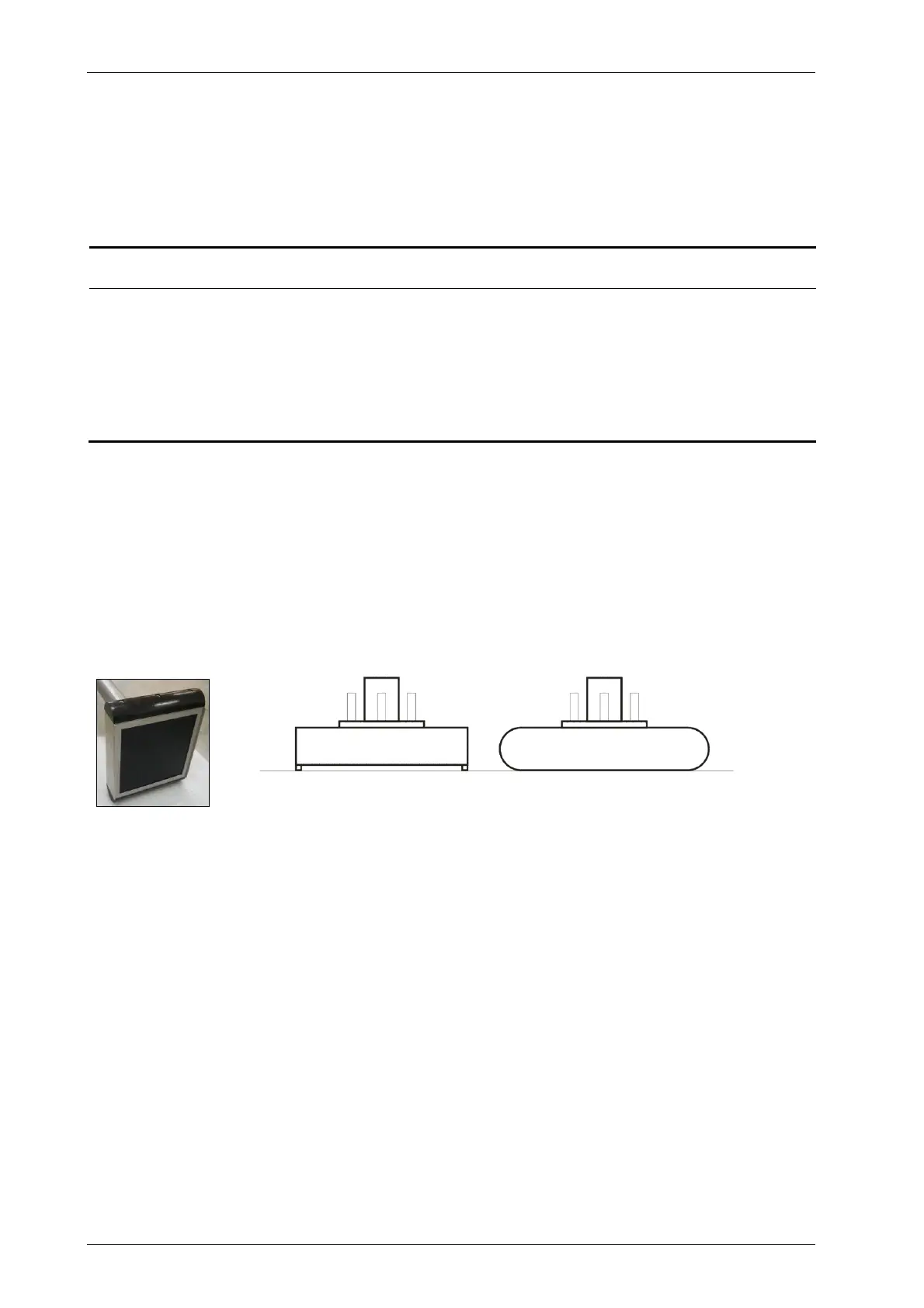
The SBP transducer has supports alongside the active area to make it possible to place the
transducer directly on flat and clean surfaces, see figure below.
INNOMAR “compact / light / standard” SBP transducer with streamlined housing
and supports to protect the active area
What to do
Gently clean the transducer after usage and in intervals if in use for a longer period.
Clean, rinse with fresh water and dry before put the transducer in store.
Protect the active area against sunlight; UV-light may affect the materials used.
Protect the active area against damages (mechanics or chemicals).
Use the INNOMAR-approved (water-based) anti-fouling to prevent bio-fouling, especially when
working in tropical waters. Hull-mounted transducers should be coated with anti-fouling.
Protect the transducer cable; take care on the bending radius and vibrations.
Protect the transducer connector against damages and water to avoid corrosion.
What to avoid
Don’t use sharp tools or chemicals for cleaning the active area.
Don’t store dirty or wet transducers; avoid corrosion and fouling.
Don’t lay the transducer “face-up” on deck; avoid sunlight on the active area.
Don’t use any chemicals to clean the transducer.
Don’t use any other paint than the INNOMAR-approved anti-fouling.
Don’t use a cable with damaged insulation; the voltages used may be lethal!
Don’t put sun-heated transducers into cold water; avoid thermal stress.



 To Next Page