User’s Manual INNOMAR Parametric Sub-Bottom Profilers / SESWIN 143
Innomar Technologie GmbH (2023-01) 143
12.3 Data acquisition
INNOMAR sub-bottom profilers exploit parametric sound generation to achieve narrow low-
frequent sound beams without side lobes and to transmit wide-band pulses to get high-resolution
data. Due to this sound generation principle to data channels are available: the primary frequency
(about 100 kHz) is used to determine the bathymetry and the secondary frequency (user
selectable frequencies; range 4 – 15 kHz) is penetrating the sea bed and is used to determine
the sub-seafloor strata.
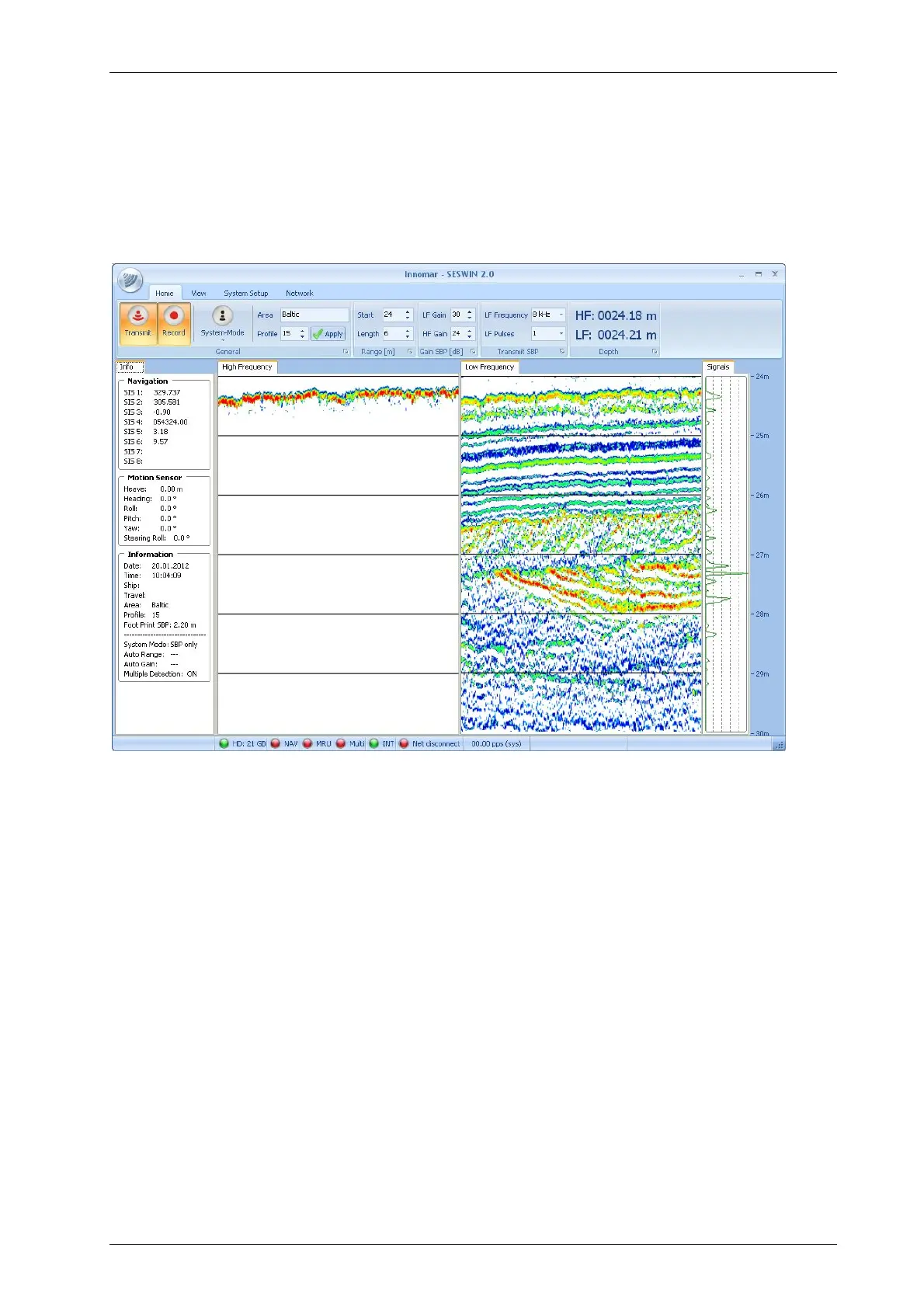
Example screen dump of INNOMAR’s SESWIN data acquisition software. Transmitter and receiver settings (top), sensor
information, high-frequency echo plot, low-frequency echo plot, amplitude of last ping (bottom, left to right)
Before the survey starts, some test lines should be done to ensure all sensors are working and
to find best SBP settings (e.g. frequency, pulse width) for the current application, vessel, survey
area and environmental conditions.
During the survey all pre-planned run lines will be sailed. Data recording should be started and
stopped at each survey line start and end, respectively. This will give one data file (*.raw / *.ses3)
for every survey line. Avoid to log data in the obsolete “*.ses” data format when using older
systems.
At any time, the status of all sensors should be observed and in case one or more sensors don’t
work properly, the run line has to be repeated after the sensors are back.
Some acquisition parameters have to be set correctly during data acquisition – they cannot be
changed during data post-processing. The main parameters for the operator to think about and
to look at are:
Frequency
Pulse length
Range
Gain
These parameters affect the achievable resolution (i.e. vertical layer to layer resolution), the
penetration (i.e. how deep can we look into the sediments), the ping rate (i.e. how many pings



 To Next Page