82 User’s Manual INNOMAR Parametric Sub-Bottom Profilers / SESWIN
82 Innomar Technologie GmbH (2023-01)
delayed ping for the triggered system (triggering on the falling edge). If, for example the external
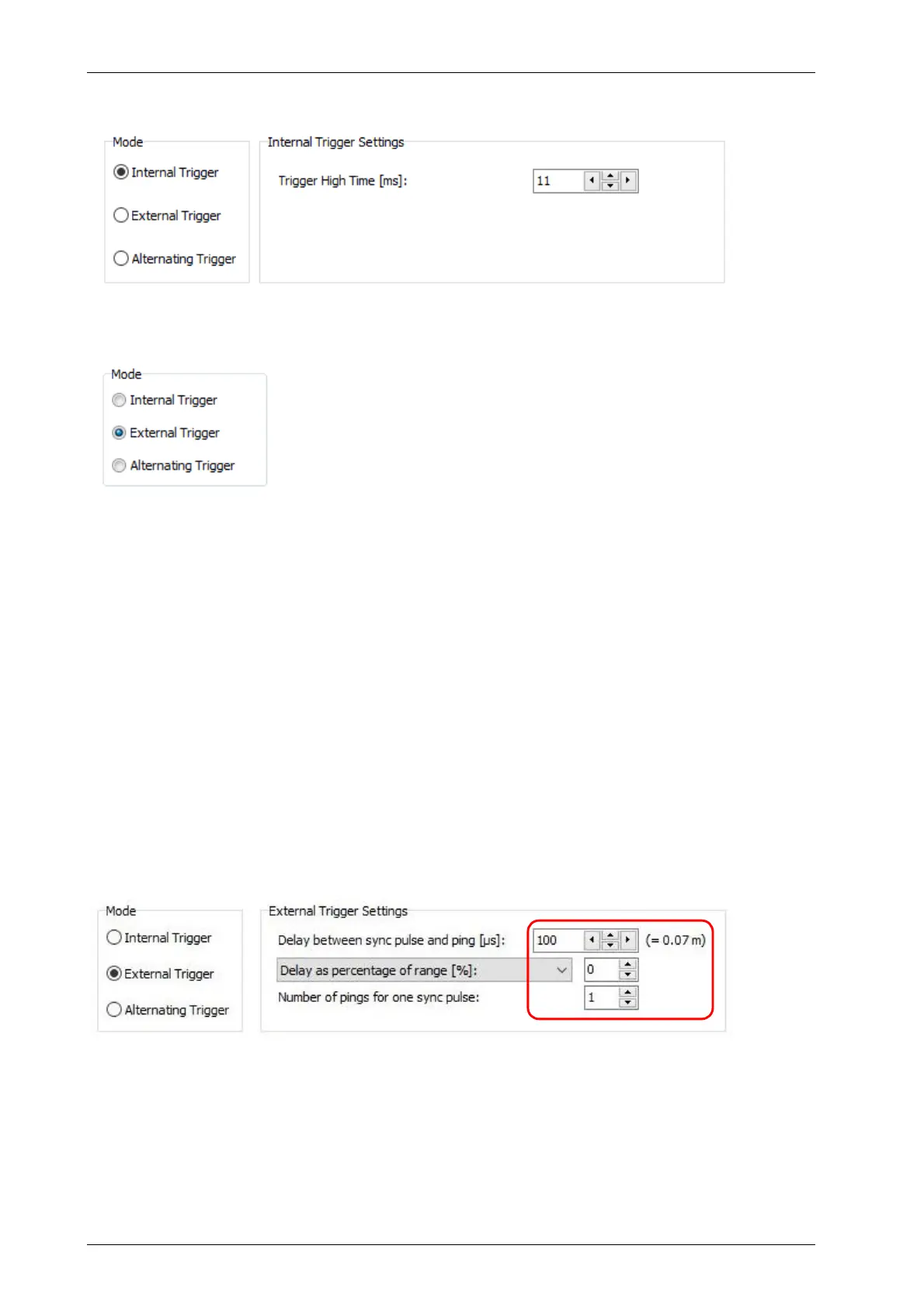
device shall be triggered 10 ms after the INNOMAR SBP, set the trigger high time to 11 ms:
6.2 External Synchronisation
For this “Synchronisation Mode” in “System Setups – General –
Synchronisation” has to be set to "External Trigger". The INNOMAR
SBP is in slave mode and waits for trigger pulses at “Sync IN”.
!
IMPORTANT: The system will not work if no trigger pulse is
detected at the “Sync IN” connector! There is no automatic
switch-back to Internal Trigger, but an error message is shown
after time-out.
The pulses fed to the “Sync IN” connector can be either TTL/CMOS or RS232 compatible. The
voltage levels applied to this input must not exceed ±15 V as higher voltage levels may destroy
the electronics.
The INNOMAR SBP is triggered by the rising edge (low to high transition) of the trigger pulse at
“Sync IN”.
There is a delay of about 1 ms between the rising edge of the Sync IN signal and the actual
INNOMAR SBP ping, see pictures in next section.
!
There are some older INNOMAR SBP systems using different settings for the external
synchronisation, like different voltage levels or using the falling edge!
6.2.1 Simple External Synchronisation
With this mode each external trigger pulse initiates one ping released by the INNOMAR SBP. To
set the SBP for simple external synchronisation the delay must be set to the lowest possible value
(“100 µs” and “0 %”) and the number of pings to “1” in the “External Trigger Settings” as shown
in the figure below.
When the external trigger signal gives a rising edge at the “Sync IN” input, this initiates a pulse
at “Sync OUT”. The ping will be released after a delay of 1 ms at the falling edge of this “Sync
OUT” pulse, as described above for “internal synchronisation”.



 To Next Page