COMMAND RANGING & TELEMETRY UNIT CORTEX
CRT QUANTUM USER'S MANUAL
Ref. DTU 100042
Is.Rev. 5.17
Date: Dec.
03, 2021Sept. 30, 2021
This document is the property of Safran Data Systems.
It cannot be duplicated or distributed without expressed written consent.
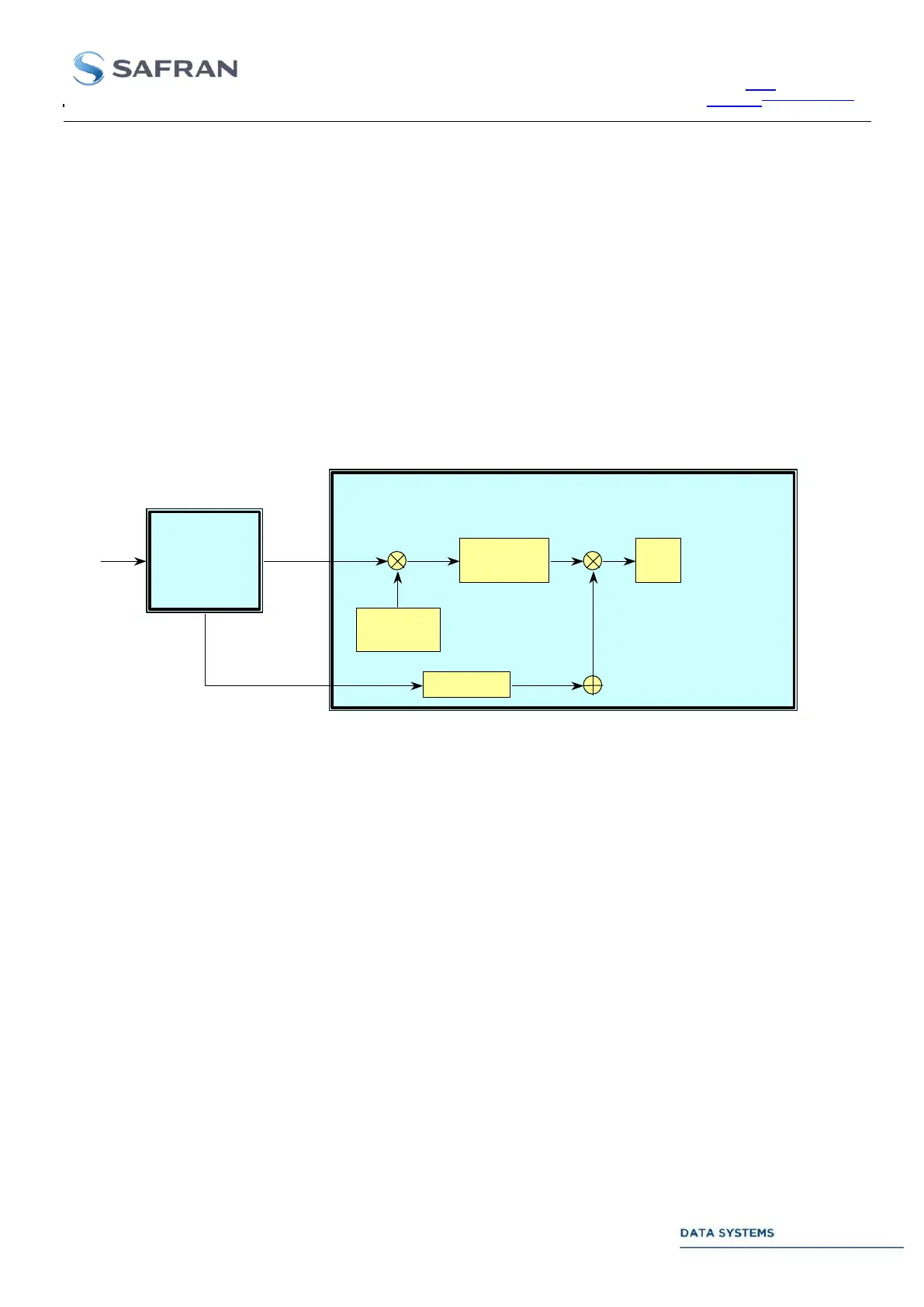
3.6.3.5.5. Doppler Aid Principle and Architecture
Available in SPS versions E4R39 and higher
This feature is available for ESA, ESA-like and USB standards only.
Under some circumstances, the Carrier Doppler is not measured with enough accuracy to allow the use of
Doppler Rate Aid. This is particularly the case when the satellite is operated in Non-Coherent mode. The bias on
the Carrier Doppler, when using Doppler Rate Aid, would induce a bias in the Major Tone frequency at the input
to the PLL and therefore would induce a Ranging measurement error. In order to cope with a large Doppler offset
at PLL acquisition time, without introducing a bias in the measurement in such situations, the PLL acquisition
capability is improved by the Doppler Aid algorithm.
The calculation of the Major Tone Doppler shift from the Carrier Doppler is performed as in the Doppler Rate Aid
algorithm. However, the Major Tone Doppler shift is used at PLL initialization only, and is not provided to the PLL
input during lock acquisition and tracking. Therefore, the Doppler Aid algorithm can be described as follows:
f
tx_tone
IF
Receiver
Ranging Major Tone PLL Initialization
S
rx
(t) X
RG_rx
(t)
Major tone
synthesizer
Rone
(t)
Low pass &
decim. filter
PLL
filter
Ratio factor
f
dop_tone
(t)
f
dop_carrier
(t)


 To Next Page