COMMAND RANGING & TELEMETRY UNIT CORTEX
CRT QUANTUM USER'S MANUAL
Ref. DTU 100042
Is.Rev. 5.17
Date: Dec.
03, 2021Sept. 30, 2021
This document is the property of Safran Data Systems.
It cannot be duplicated or distributed without expressed written consent.
3.6.12.6.Ranging Sequence
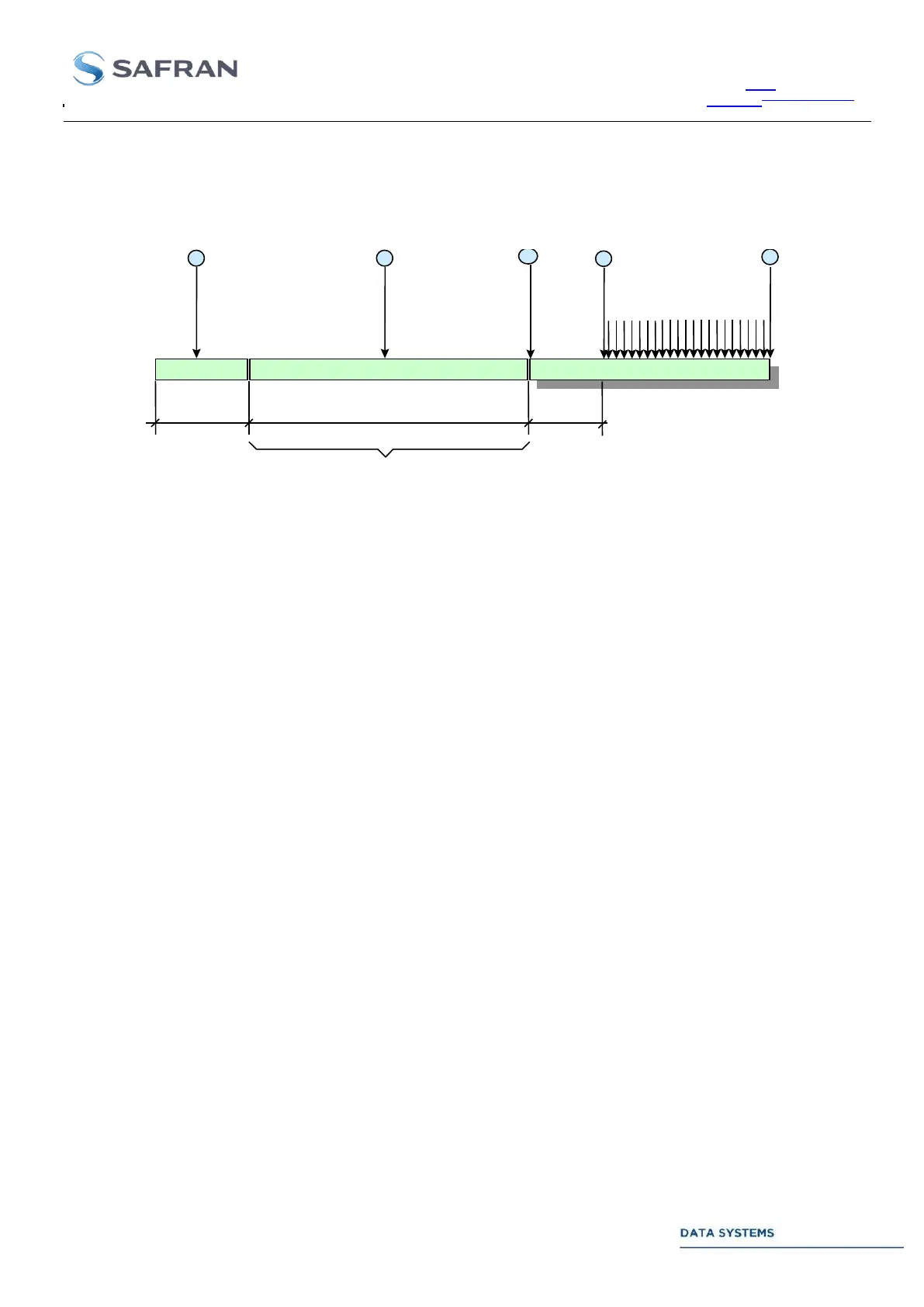
Next figure illustrates the ranging measurement sequence:
N measurements on PN Sequence
One measurement every 250 ms
Figure 83: Ranging Sequence (PN Codes Standard)
1. On reception of a ranging request from the Ranging Client, the RAU computes the tone and codes
definition tables. Then, if the computation is successful, the RAU starts generating and transmitting the
ranging sequence. Status Measurement Progress in the RAU monitoring table starts incrementing.
2. Correlation process of the received ranging sequence. The duration (parameter Integration Time) is
programmable from 0.25 s to 500 s.
3. Stabilization of the PLL during Ts seconds.
4. First phase measurement on the tone and ambiguity solving. The RAU simultaneously acquires the
current time from the Time Code Reader for further time-tagging of the ranging transaction response
message.
5. Status Measurement Progress is equal to 100. Phase and « distance » measurements are returned
to the Ranging Measurement Client(s) in a ranging transaction response message.
Phase measurements on the tone are performed at regular time interval (One measurement every 250 ms).
These measurements are corrected as described in § 3.6.3.4. For each measurement on the tone, a « distance »
is calculated in nanoseconds. The calculation takes into account (ambiguity solving) phase drift due to spacecraft
motion during tone transmission.
The total duration of the ranging sequence depends on five factors:
the tone frequency,
the measurement sampling ratio,
the integration time,
the number of measurements on the tone,
the loop bandwidth.


 To Next Page