SVAN 948 USER MANUAL
4 - 69
One Profile, 3 PROFILES and PLOT display modes are the same as for the VLM. The
SPECTRUM mode displays 1/3 OCTAVE analysis results (so-called spectrum) together with three
TOTAL RMS values measured with the weighting filters. Those filters are set in the TOTAL VALUES sub-
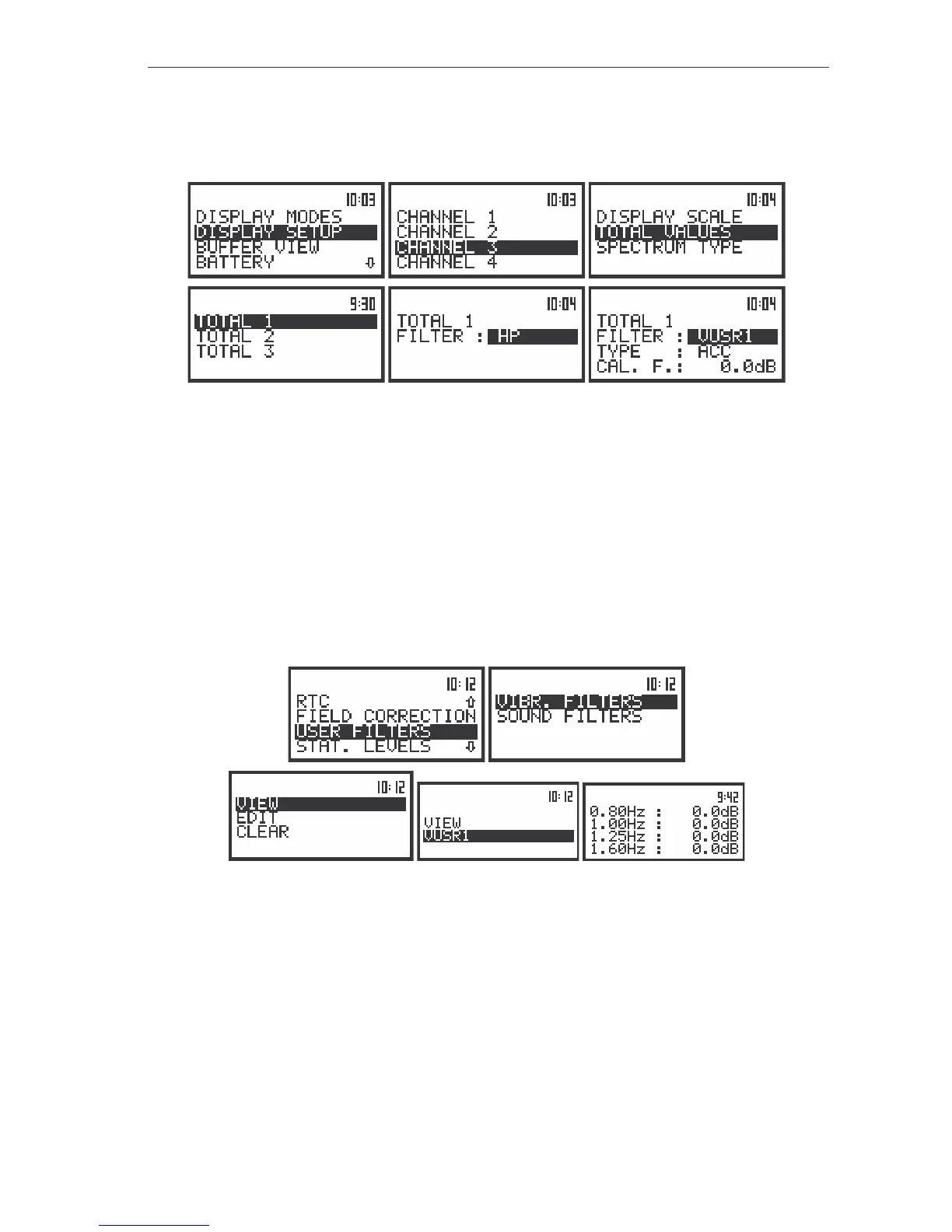
list of the DISPLAY SETUP list (path: MENU / DISPLAY / DISPLAY SETUP / CHANNEL x / TOTAL VALUES).
The displays with the settings influencing the first TOTAL value presented in the SPECTRUM mode
The first TOTAL value is measured with:
• the HP weighting filter (in this case it is true RMS value in the whole band) or
• with the filter specified as VUSR1, VUSR2, VUSR3 or
• any other filter, which name and the coefficients are sent to the unit by the interface.
The coefficients of the user defined filters are set in the VIBR. FILTERS sub-list of the SETUP list
(path: MENU / SETUP / USER FILTERS / VIBR. FILTERS). It is also possible to send the coefficients of the
filters used in the calculations by means of the serial interface from a PC (a special function is developed
for this purpose – for details see App. A). The names of the filters introduced to the unit in mentioned
above way, as well as the values of the coefficients, can be examined by means of the VIEW window from
the VIBR. FILTERS sub-list of the SETUP list (path: MENU / SETUP / USER FILTERS / VIBR. FILTERS /
VIEW).
The displays showing the possibility of the verification of the user filter names and the values of the
coefficients taken to the calculation of the TOTAL values presented in the SPECTRUM mode
The second TOTAL value is measured with the weighting filter:
• selected in the second channel (CH) or
• specified as VUSR1, VUSR2, VUSR3 or
• which name and coefficients are sent to the instrument using the unit’s interface and special functions
described in App. A.


 To Next Page