©2025 Copeland LP.
026-1803 R13 Supervisor I&O User Guide 9 - 43
9.28.1 Communication
The RLDS features full two-way communications via the
RS485 interface. MODBUS RTU is the communication
protocol standard and can be connected directly to the
Supervisory Controller.
The device default serial setup values are:
• Baud rate - 19200
• Data size - 8
• Parity - N
• Stop bits - 1
9.28.2 Supported Gases
The RLDS gas software library allows each zone to be
independently selected to monitor any commonly used
refrigerant including, but not limited to, the following: R22,
R134a, R404A, R407A, R407C, R410A, R422A, R422D, R427A,
R507, CO2, and Ammonia. For a complete gas listing, refer to
the RLDS manual P/N 026-1309.
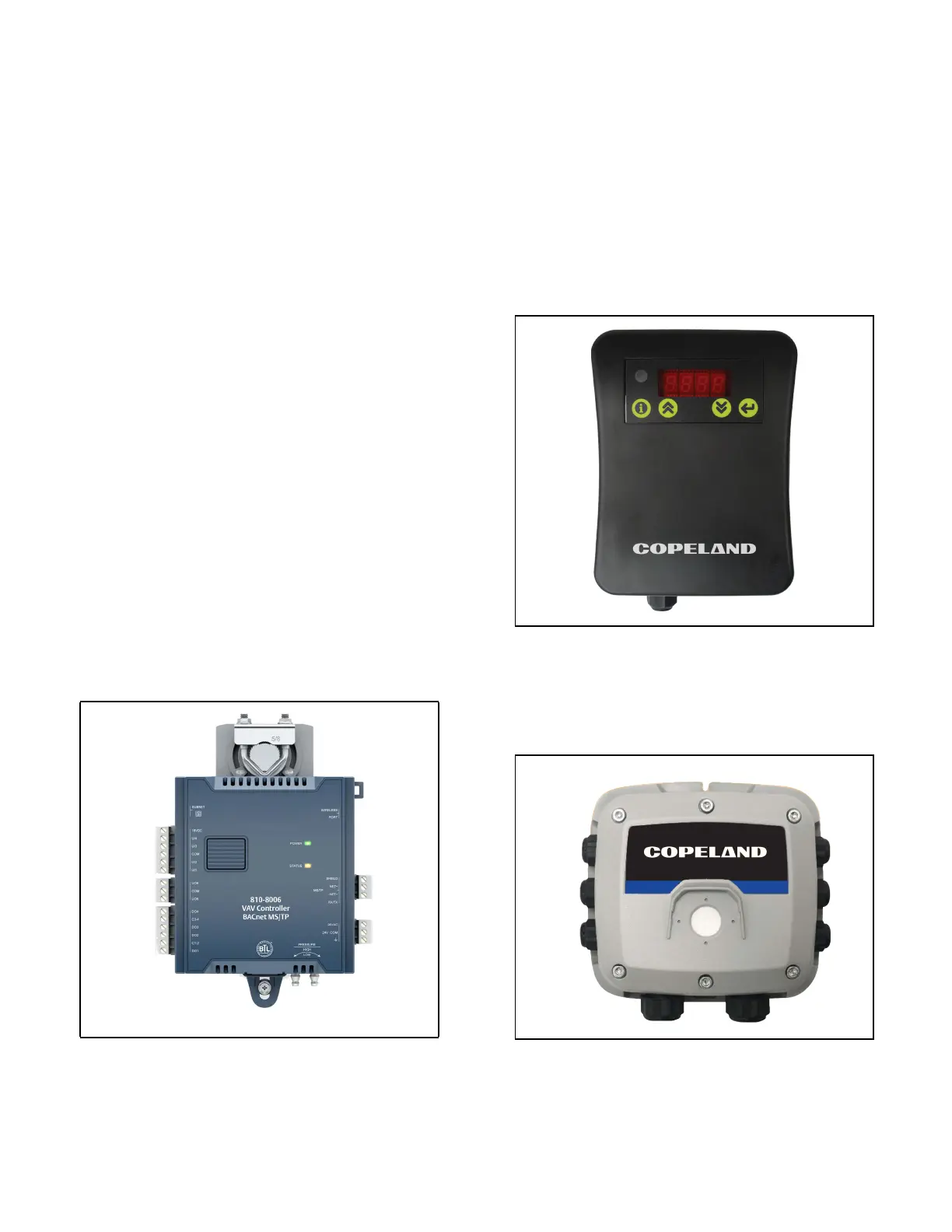
9.29 ECB VAV
The BACnet VAV (Variable Air Volume) Control Network
provides a complete building energy control and
conservation solution for HVAC systems using VAV
components. The VAV Control Network comprises the
Discharge Air Controller (DAC), BACnet MS/TP IP VAV
Controller, and VAV Smart Thermostat to supply a variable
amount of conditioned airflow to different zones of a building.
See the BACnet VAV user manual P/N 026-1221 for more
information.
9.30 MRLDS (Modular Refrigerant Leak
Detector Sensors)
The MRLDS-250 NDIR (non-dispersive infrared) is a state-of-
the-art fixed gas detector that can detect a wide range of
refrigerant gases. The MRLDS-250 can be used on a stand-
alone basis or integrated into controls or a Building
Management System (BMS). The MRLDS-250 can be used in
locations that require continuous monitoring and to add gas
detection solutions to an existing system. The MRLDS-250
NDIR refrigerant gas detectors are available in two versions:
broadband and gas-specific. See the MRLDS-250 user
manual P/N 026-1315 for more information.
MRLDS-450 Gas Detection Series of instruments
continuously monitor ambient air (indoor or outdoor) for the
following gas types: refrigerants, oxygen, and toxic and
combustible gases.
Figure 9-16 - BACnet VAV
Figure 9-17 - The MRLDS-250
Figure 9-18 - The MRLDS-450


 To Next Page