©2025 Copeland LP.
026-1803 R13 Supervisor I&O User Guide 7 - 1
7 RS485 I/O Network Boards and Peripherals
Site Supervisor has up to two RS485 network ports, each of which may be configured as an I/O network or MODBUS port.
7.1 The I/O Network
Most of the general purpose input and output
communications devices required by the Supervisory
Controller to control refrigeration systems are connected via
the I/O Network. The I/O Network is a simple RS485 three-wire
connection that allows data interchange between input
boards, which read sensor values and digital closures, output
boards, which carry out commands from Supervisory
Controller applications, and the Supervisory Controller itself.
All boards and controllers manufactured by Copeland for
communication with the Supervisory Controller via RS485 are
generally referred to as I/O boards, and the network they are
connected to is referred to as the I/O Network (or I/O Net).
A COM port configured as I/O Net may connect with up to
127 I/O boards. This network is used by the Supervisory
Controller to read data from the input boards and to send
commands to the analog and digital output boards. Some
unit controllers, such as CCB case controllers and MultiFlex
RCBs, also communicate with the Supervisory Controller via
the I/O Network.
7.2 I/O Board Names and Terminology
There are many input, relay output, analog output, and
combination I/O boards available from Copeland for use with
the Supervisory Controller. However, separate from the
various MultiFlex unit controller models, the Supervisory
Controller only recognizes four different types of I/O boards:
16AI, 8RO, 4AO, and 8DO. All Site Supervisor-compatible I/O
boards communicate with the Site Supervisor as if they are
one or more of these types of boards.
7.2.1 MultiFlex Boards
The MultiFlex line of control system boards provides a wide
variety of input, output, and smart control solutions, all of
which are based on a single universal hardware platform. The
board design uses flash-uploadable firmware and plug-in
expansion boards to configure the base platform board and
apply it for use as an input board, relay output board, analog
output board, or a combination I/O board.
7.2.1.1 MultiFlex 16 Input Board
The MultiFlex 16 input board offers sixteen combination
analog/digital input points for use by Site Supervisor, Einstein,
and REFLECS control systems. The MultiFlex 16 may be used
in retrofits with no additional hardware or software setup or
upgrades.
The MultiFlex 16 is designed to be 100% compatible with the
previous generation of input boards (the 16AI),
communicates with the site controller via an RS485
connection to a REFLECS COM A&D Network or a Site
Supervisor I/O Network. Dip switches on the board set the
network ID (board number) and baud rate.
The board also provides both +5VDC and +12VDC output
voltage points for use in powering transducers or other input
devices that require power.
The MultiFlex 16 has a Hand-held Terminal interface
Section 7.2.8,Hand-held Terminal (P/N 814-3110) that may be
used by technicians to view the input voltage and
engineering unit values for each input point without need of a
voltmeter or front panel controller display.
Table 7-1 shows the part number of the MultiFlex 16.
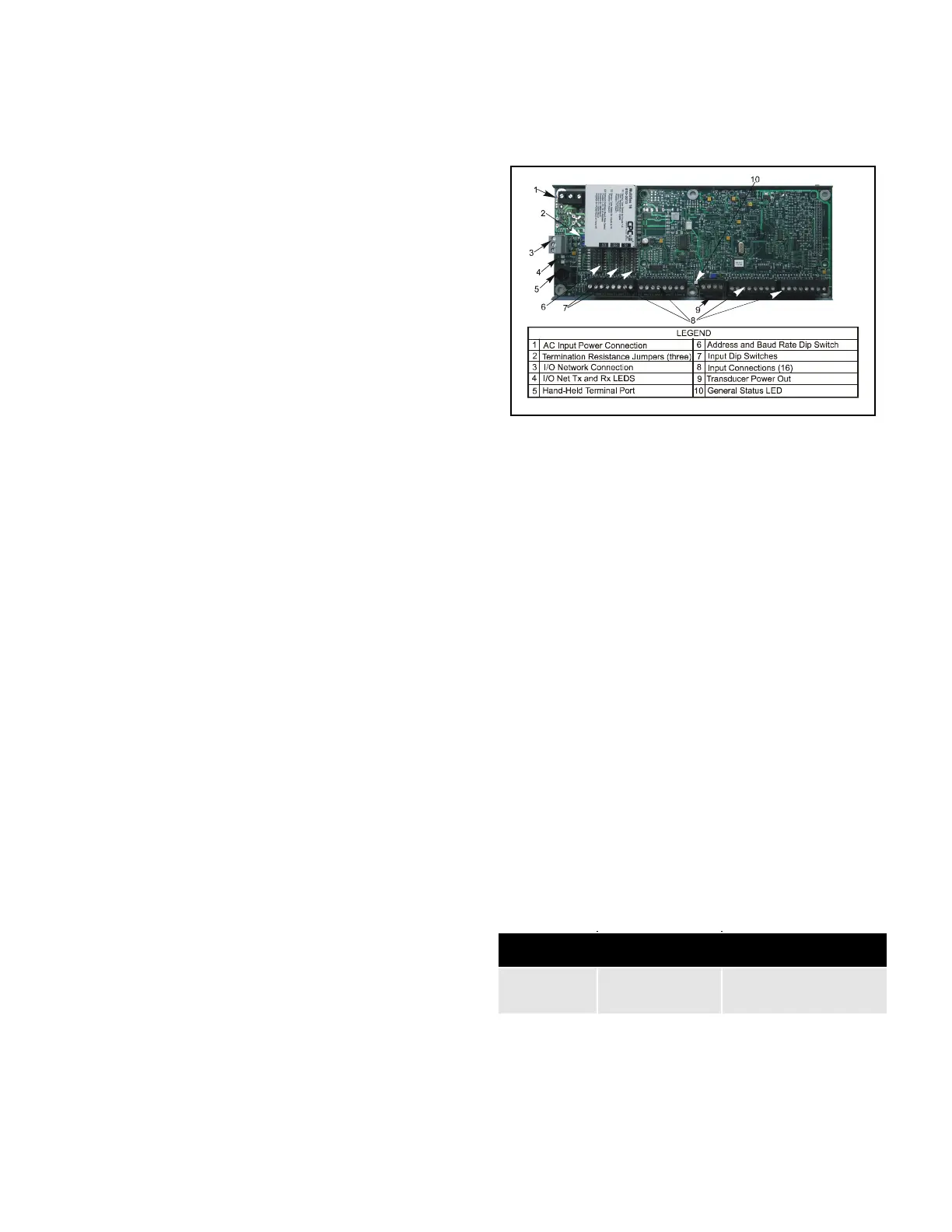
The MultiFlex 16 is designed with several features that make
it easy to install, wire, and configure. These main user
interface features are shown in Figure 7-1.
Figure 7-1 - MultiFlex 16 Input Board
Table 7-1 - MultiFlex 16 Input Board Model
P/N Model Name Description
810-3013 MultiFlex 16 16 analog/digital
inputs, no outputs


 To Next Page