©2025 Copeland LP.
026-1803 R13 Supervisor I&O User Guide 7 - 10
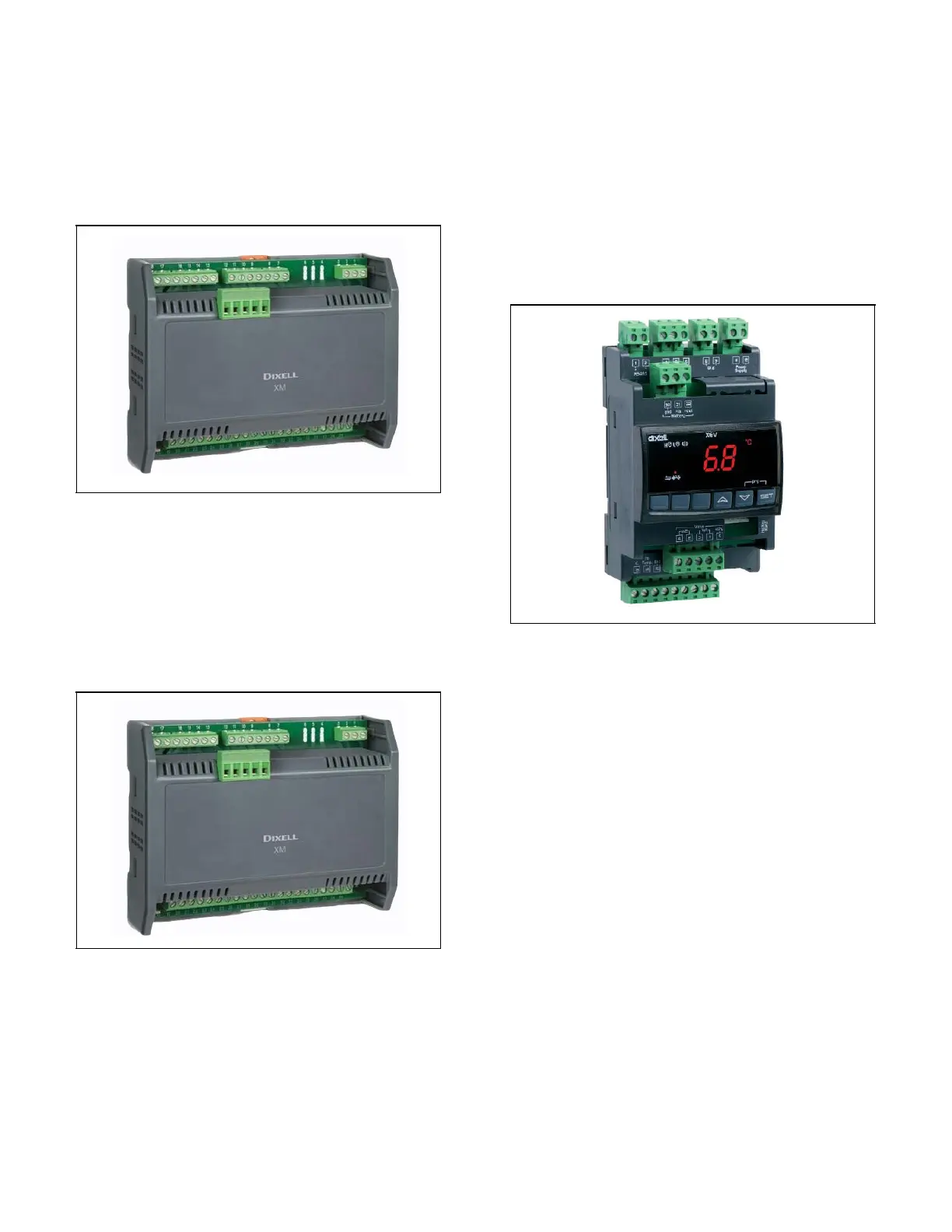
7.2.12.2 XM679K v3.4 and v4.2
The XM679 is similar to the XM670, but with one relay output
to drive pulsed electronic expansion valves. The XM679 also
contains two probes that are dedicated for superheat
measurement and regulation. Refer to the XM679 manual (P/
N 026-1218) for more information about the device.
7.2.12.3 XM678D v2.5 and v2.8
The XM678 is similar to the XM670, but with one stepper
valve output to drive an electronic expansion valve. The
XM678 also contains two probes that are dedicated for
superheat measurement and regulation. Refer to the XM678
manual (P/N 026-1219) for more information about the
device.
7.2.13 XEV22 v1.1 and v1.5
The XEV22D controller is capable of driving a wide
variety of stepper electronic expansion valves. XEV22D
regulates the superheat (SH) of the fluid that runs into
refrigerating unit in order to obtain optimized performance
and functioning of the evaporator independent by climatic or
load conditions. XEV22D modules are equipped with two (2)
probe inputs, one for a 4 to 20mA or 0 to 5V pressure
transducer and another one for a NTC-EU, NTC-US or PT100
temperature probe.
7.2.14 Wireless I/O
Wireless Module System provides refrigerated case
temperature monitoring and control for certain applications
without the time and expense required to wire multiple
temperature sensors from the case back to the Supervisory
Controller. All modules in the Wireless Module System family
are wireless, transmitting their values to Gateways in the store
area that pass them back to the Supervisory Controller. There
can be multiple Gateways at a site. The interface to the
supervisory controller determines the number of individual
modules that are supported (MODBUS or I/O Net). The
recommended number of modules is less than 200 within a
100-foot radius.
• Running MODBUS: supports a maximum of 297
individual modules.
• Running I/O Net: supports a maximum of 356
individual modules.
Figure 7-14 - XM679
Figure 7-15 - XM678
Figure 7-16 - XEV22D


 To Next Page