©2025 Copeland LP.
026-1803 R13 Supervisor I&O User Guide 9 - 47
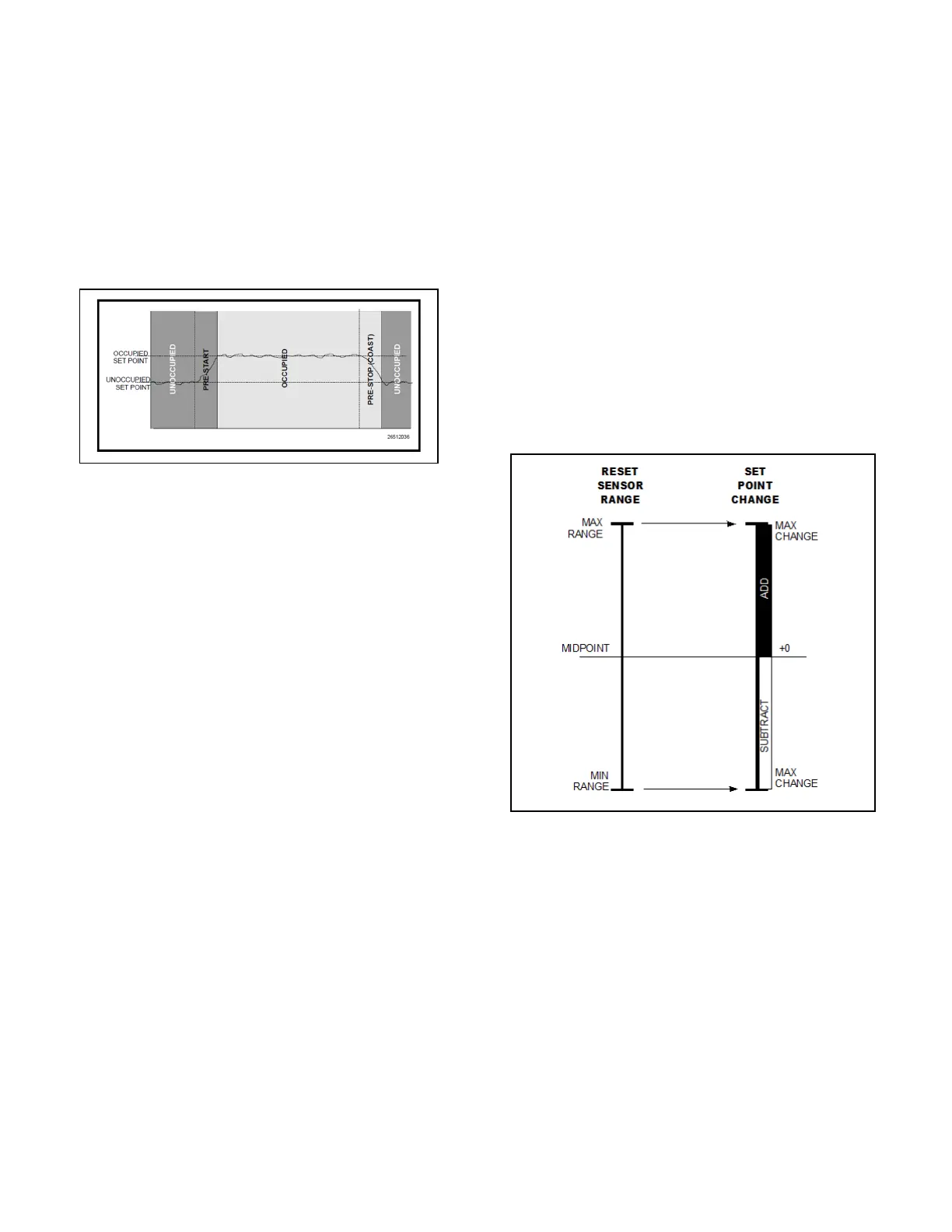
The figure below shows an example of how pre-starts and
pre-stops work in a heating application. From unoccupied
mode, the pre-start period slowly increase the temperature up
so that when the scheduled change from unoccupied to
occupied mode occurs, the temperature is already at or near
the occupied heating setpoint. During the pre-stop, which
occurs before the HVAC Zone application goes from
occupied to unoccupied mode, heating is suspended and
the temperature is allowed to “coast” down to the
unoccupied setpoint.
9.32.12 Intelligent Pre-Starts and Pre-
Stops
OSS is designed to handle pre-starts and pre-stops in the
most energy-efficient manner possible. Every time a pre-start
or pre-stop occurs, OSS measures the amount of time it takes
to bring the temperature from the previous setpoint to within
the “comfort zone” of the new setpoint (a user-defined range
of values above and below the setpoint within which the
temperature is considered acceptable). This duration is used
to determine the average rate of temperature change, called
the K-factor.
The K-factor is stored in the memory, along with the average
value of the outdoor air temperature during the pre-start or
pre-stop. Over time, collected K-factor data is sorted and
combined into a table. As a result, by constantly observing
and recording the results of previous pre-starts and pre-stops,
OSS is able to intelligently guess how much time a pre-start or
pre-stop mode should last based on the outside temperature.
AHU Control keeps track of three different kinds of K-factors:
• Heat K-factor - used to guess pre-start durations for
AHUs operating in heating mode.
• Cool K-factor - used to guess pre-start durations for
AHUs operating in cooling mode.
• Coast K-factor - a measurement of the change in
temperature when no heating or cooling is active. This is
used to determine pre-stop durations for both heating
and cooling AHUs.
9.32.13 Setpoint Reset
If desired, Heat/Cools may be configured with a Setpoint
Reset that varies the value of the heating and/or cooling
setpoints based on an analog value from a reset sensor. This
is most often used to vary the value of a heating or cooling
setpoint based on the outside air temperature.
To set up a setpoint reset for heating or cooling, the user must
specify the minimum and maximum range of reset sensor
values, and the maximum range of setpoint adjustment.
As the value of the reset sensor varies within the minimum
and maximum range, an equivalent portion of the maximum
setpoint adjustment will be added or subtracted from the
heating or cooling setpoint. When the reset sensor value is
directly in between the minimum and maximum range
values, nothing will be added or subtracted from the setpoint.
Between the halfway point and the minimum value, part of
the setpoint adjustment will be subtracted from the setpoint.
Between the halfway point and the maximum value, part of
the setpoint adjustment will be added to the setpoint. An
example of this is shown in Figure 9-21.
Figure 9-20 - Optimum Start/Stop (OSS)
Figure 9-21 - Setpoint Reset Diagram


 To Next Page