©2025 Copeland LP.
026-1803 R13 Supervisor I&O User Guide 9 - 49
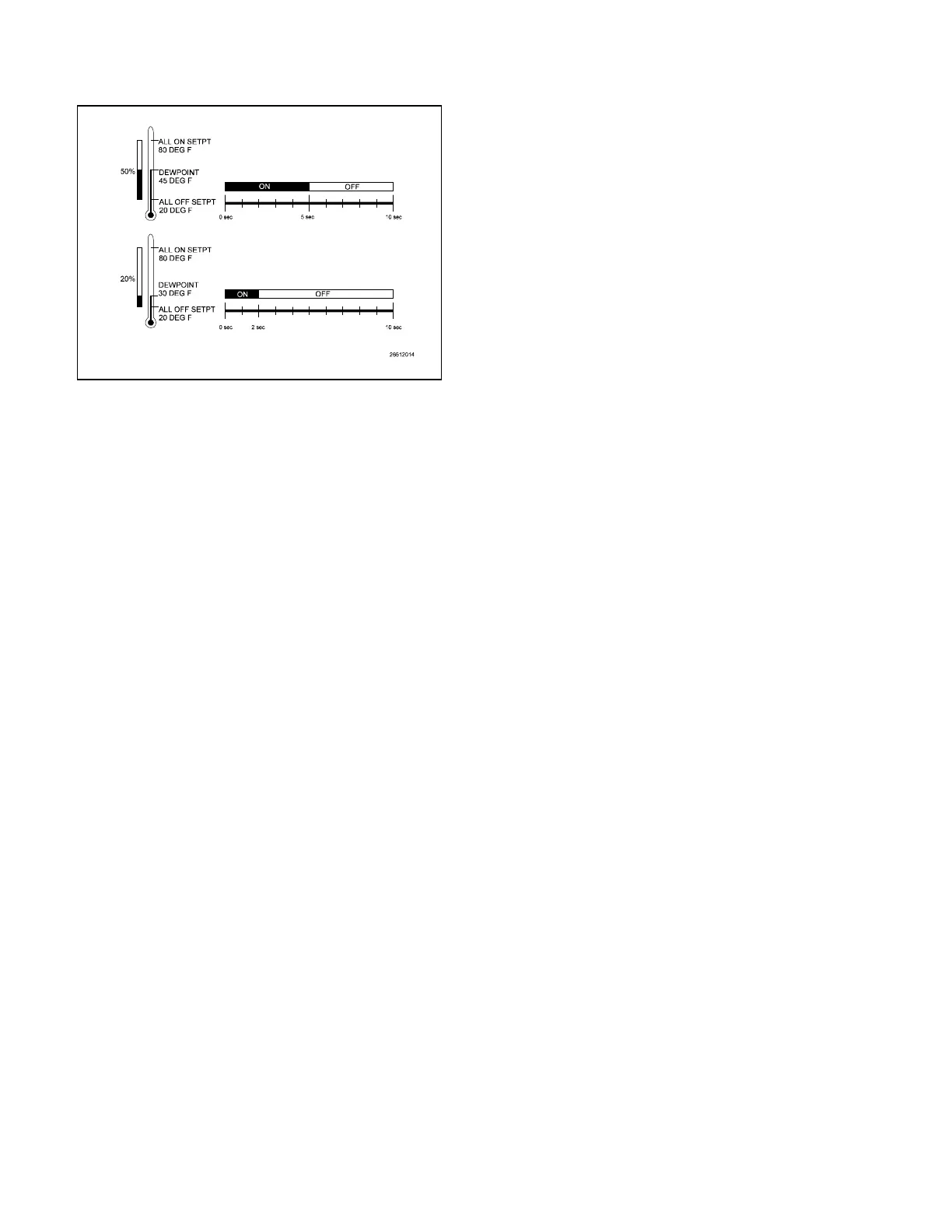
the percentage will lower to 20%, and the heaters will be on
only 2 seconds out of every 10.
9.36 Condenser Control
An air-cooled condenser consists of one or more fans that
blow air across a manifold of tubing to cool heated refrigerant
and condense it into a liquid. In an evaporative condenser,
water is sprayed across a condenser coil, which cools the
refrigerant as water is evaporated. Control of the evaporative
condenser is similar in ways to the air cooled strategy in that
the Condenser Control application uses PID control to
activate or deactivate fans (thus increasing or decreasing the
amount of evaporative cooling).
Air Cooled Condensers
An air-cooled condenser consists of one or more fans that
blow air across a manifold of tubing to cool heated refrigerant
and condense it into a liquid. The Site Supervisor controls
condensers by activating or deactivating fans in order to
maintain discharge pressure or temperature at or below a
chosen setpoint.
A Condenser Control application may use either of two
strategies to operate air cooled condensers: an air-cooled
strategy, or a temperature differential (T-D) strategy.
9.36.0.1 Air Cooled Strategy
The air cooled strategy uses a simple PID control loop that
compares a single Control In input to a PID setpoint. The
resulting percentage is used to activate the condenser fan(s)
necessary to bring the input value down below the setpoint.
Control inputs for air cooled strategies most commonly come
from a pressure transducer mounted on either the discharge
line, the condenser inlet, or the condenser outlet. However,
temperature sensor values will also be accepted.
9.36.0.2 Temperature Differential
Strategy
The temperature differential strategy attempts to keep a
minimum amount of difference between the temperature of
the refrigerant and the ambient outside temperature.
This strategy begins by determining the temperature of the
refrigerant coming into the condenser. This can be supplied
by either a temperature sensor or pressure transducer located
near the condenser inlet; if it is a pressure transducer, its value
will automatically be converted to a temperature value based
upon the type of refrigerant.
The refrigerant temperature is subtracted from the value of an
ambient air temperature sensor. The result is the temperature
differential. It is this differential value that is compared to the
PID setpoint for the purpose of determining the amount of
total fan capacity to activate.
9.36.1 Evaporative Condensers
In an evaporative condenser, water is sprayed across a
condenser coil, which cools the refrigerant as water is
evaporated. Control of the evaporative condenser is similar in
ways to the air cooled strategy in that the Condenser Control
application uses PID control to activate or deactivate fans
(thus increasing or decreasing the amount of evaporative
cooling).
Like air-cooled condensers, evaporative condensers may be
controlled by discharge pressure or temperature. They may
also be controlled by water sump temperature. In addition,
each evaporative condenser may have up to 16 “override”
sensors (either temperature or pressure) that allow the
condenser to be overridden to fast recovery mode.
9.36.2 Fan Control
Condenser Control applications can control three different
kinds of fans: single-speed fans (up to 12 stages), two-speed
fans, and variable-speed fans. All fan types are controlled by
PID control; in other words, the Condenser Control
application generates a percentage from 0% to 100% that
corresponds to the amount of total fan power that should be
active.
Single-speed fans translate the PID percentage into a
percentage of total fan capacity. For example, if the PID
percentage is 75%, then 75% of all condenser fan stages will
be ON.
Two-speed fans use Cut In/Cut Out setpoints to translate the
percentage into an OFF, LO, or HI fan state.
Figure 9-22 - Illustration of Anti-Sweat Control


 To Next Page