©2025 Copeland LP.
026-1803 R13 Supervisor I&O User Guide 7 - 12
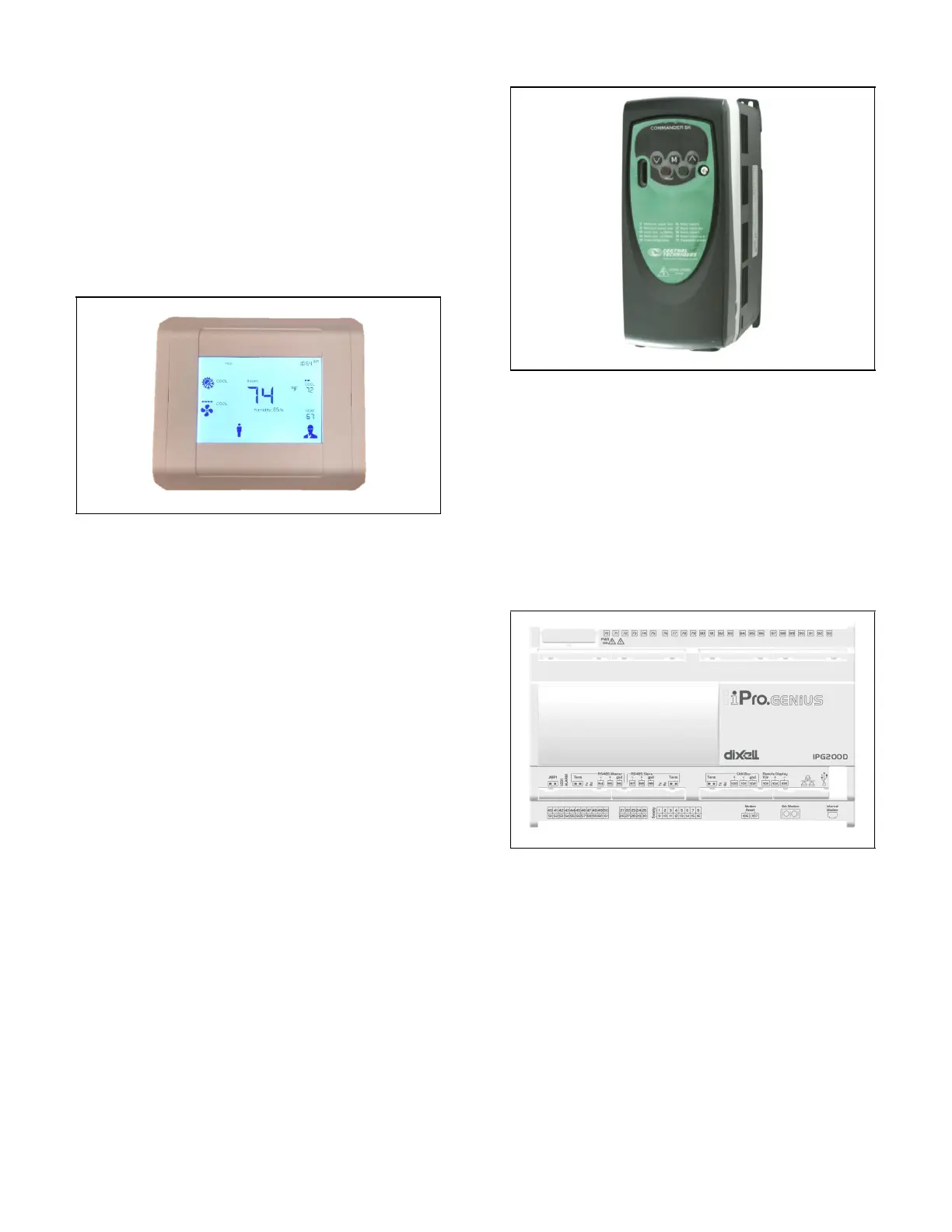
7.2.16 Programmable Touchscreen
Thermostat
The Programmable Touchscreen Thermostat
(P/N 810-1600) is a configurable device intended for light
commercial applications. The thermostat is a communicating,
intelligent sensor and controller combination with built-in
temperature and humidity sensors used to control systems
such as conventional Rooftop Units (RTU) and Heat Pumps
(HP). The thermostat communicates over a Modbus RTU
network that easily integrates with a building management
system (BMS).
7.2.17 Control Techniques Drive (VSD)
Using the MODBUS network type, supervisory controllers can
communicate with the Control Techniques variable-speed
drive (VSD). There are three different VSD models the
Supervisory Controller communicates with: Commander SE,
Commander SK, and Unidrive SP drive types.
Note that all CT drives are 2 stop bits, with no parity. Since
ECT MODBUS specifies 1 stop bit, CT drives will configure the
General Services setting for stop bits and always
communicate with the drives using 2 stop bits. The
Supervisory Controller calculates the difference and adjusts
for the additional stop bit.
Configure the COM port the CT drive will connect to by
pressing Alt + M to open the serial configuration manager.
Set the COM port to MODBUS and the baud rate (match the
baud rate on the CT drive).
The installation and operation manual explaining the VSD is
maintained by Control Techniques. Contact your Control
Techniques representative for a copy of the Control
Techniques manual.
7.2.18 DAC
The DAC is a packaged HVAC control board for use either as
a stand-alone controller or in zone control applications using
a Copeland building control system. The DAC is capable of
controlling heat and cool stages, fans, humidification and
dehumidification devices and economizers using on-board I/
O and control algorithms, as well as monitor and interact with
other building control systems and peripherals (such as
smoke alarms and CO2 sensors).
Figure 7-19 - Programmable Touchscreen Thermostat
Figure 7-20 - Control Techniques Drive
Figure 7-21 - DAC


 To Next Page