187
DE
• Be sure to familiarize yourself with the
brake lever assignment before your first
ride; i.e. memorize which brake lever
operates the front brake and which oper-
ates the rear brake.
The brake lever assignment is
recorded by your FLYER specialist dealer
in the service booklet.
Important: On regular bicycles and
pedelecs, the left brake lever usu-
ally operates the front brake and the
right brake lever operates the rear
brake. In contrast, the classification
for S-pedelecs in the EU is exactly
the opposite for legal reasons: The
left brake lever operates the rear
brake and the right brake lever
operates the front brake.
Adjusting the brake lever
The brake levers must be adjusted so that
the hands, as a straight extension of the
arms, can operate the brake levers safely
and without fatigue.
The distance between the pulled brake
lever and the handlebar must be at least 1 cm.
In order to be able to grip the brake levers
securely even with smaller hands, the grip
width can also be adjusted on some brake
models.
Important: Always have the brake
lever adjusted by a FLYER special-
ist dealer.
14.2 Disc brakes
Important: In addition to the infor-
mation in this chapter, be sure to
observe the associated manufac-
turer's instructions for your disc
brake.
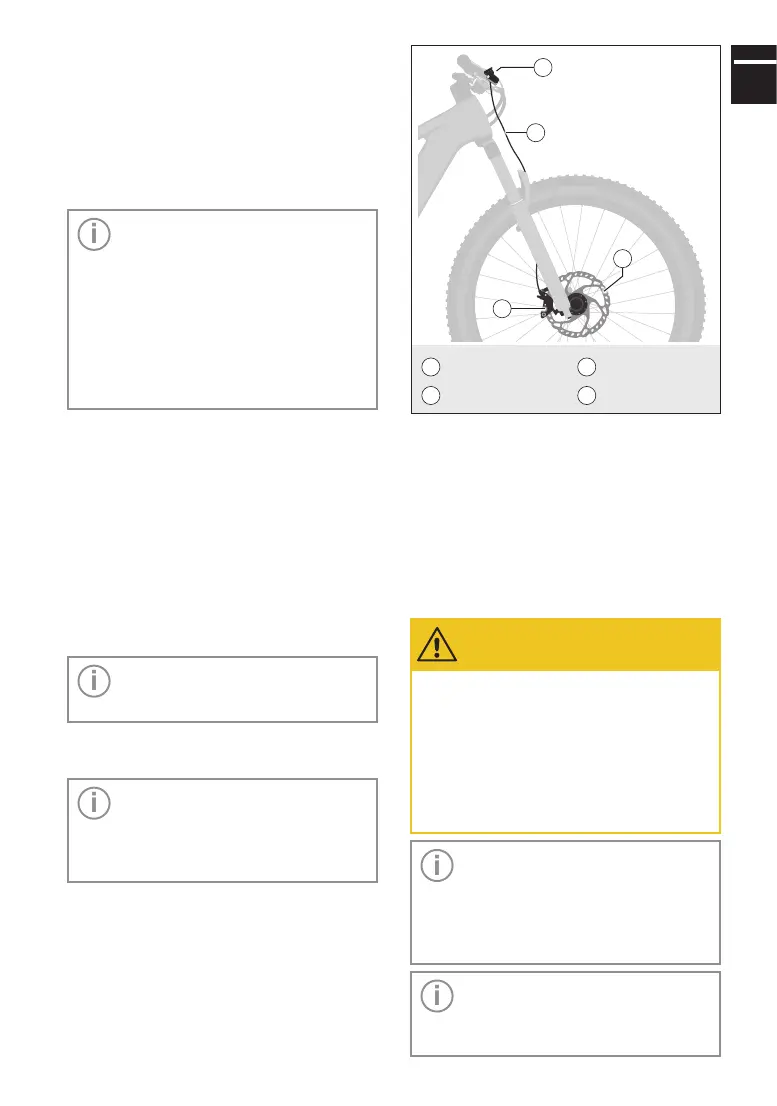
14.2.1 Functionality of disc brakes
When you pull the brake lever, brake pads
are pressed onto the brake disc from both
sides by means of hydraulic brake lines.
This slows down the respective wheel set.
12
Brake disc
43
Brake caliper
(with brake pads)
41
Brake lever
44
Brake line
41
44
12
43
Fig.15: Disc brake components
14.2.2 Use of disc brakes
• Pull the brake lever toward the handle-
bars to brake.
The harder you pull the brake lever,
the stronger the braking force.
• Release the pulled brake lever or reduce the
tensile force to stop braking more or less.
CAUTION!
Risk of burns
When braking (especially when driving
downhill or carrying out an emergency
braking procedure), the brake disc can
heat up. You can burn yourself on a hot
brake disc.
• Always allow the brake disc to cool
down before handling the brake disc
or performing tasks in its vicinity.
Important: New disc brakes need
to be braked in. They only gradually
develop their full capabilities. After
replacing the brake pads or brake
discs, the disc brake must be
braked in again.
Important: Contact your FLYER
specialist dealer if you have the
impression that the braking force of
your disc brake is too weak.



 To Next Page