191
DE
Important: Note that suspension
components may need to be read-
justed if you drive with a higher
load, for example, during a ride.
You can adjust the resistance of the spring to
compression via the yield (spring tension).
25
The yield is the distance by which the sus-
pension element is compressed when the
cyclist is located on the center of the bicycle.
The yield preloads the suspension element
and keeps the rear wheel on the ground in
case of low loads and slight bumps, improv-
ing grip and traction in rough terrain. The
compliance is usually 25% of the total avail-
able spring travel.
To tune the compliance of your suspension
element, you need to adjust the spring rate/
air pressure. When you adjust the air pres-
sure, the overall rigidity of the suspension
fork also changes. The more you inflate the
suspension element, the harder it becomes.
By means of the rebound and compres-
sion stage of the hydraulic damper, you
can set the speed at which the spring com-
presses or decompresses.
26
Important: If you want to adjust the
rebound stage of the damping, you
must have already adjusted the
yield of the suspension beforehand.
The so-called sag (= negative spring travel)
describes the compression caused solely by
the rider's weight. The optimum sag is about
15-30% of the total spring travel. When the
rider sits on the saddle, the suspension
should therefore only compress slightly (a
few millimeters).
25 The weaker the spring tension (i.e. the resistance to
compression) is set, the easier/the further the spring
can be compressed.
26 The weaker the compression or rebound damping is
set, the easier/the faster the spring moves back to its
original position.
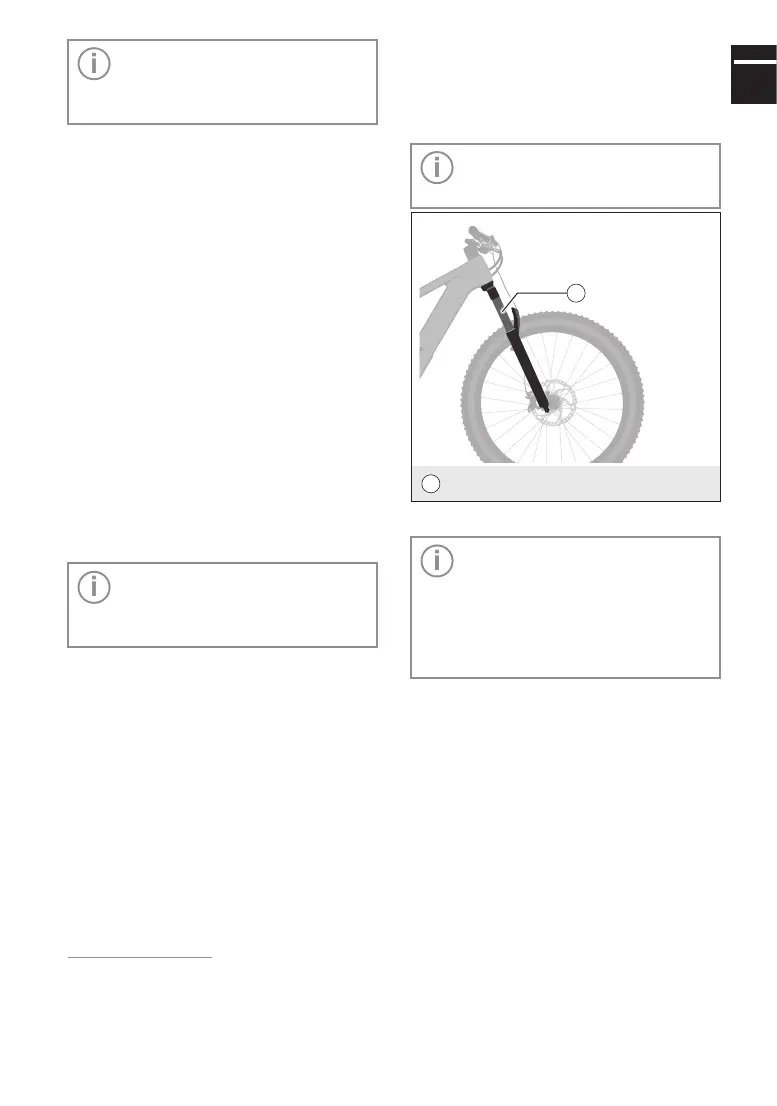
16.2 Suspension forks
Suspension forks are installed instead of
rigid front forks and absorb road irregulari-
ties/shocks at the front wheel.
Important: Have your FLYER spe-
cialist dealer instruct you on how to
adjust and use the suspension fork.
9
9
Suspension fork
Fig.20: Suspension fork
Important: Suspension forks usu-
ally have a lockout function that can
be used to suppress compression
or bobbing when required, e.g. on
steep asphalt climbs. Adjustments
can only be made with the lockout
open.
Depending on the model, the lockout func-
tion is controlled by means of a rotary knob
on the top of the suspension fork or using a
control element on the handlebar.
Activating the lockout function:
• Turn the rotary knob clockwise by a quar-
ter turn or use the associated control ele-
ment (if available).
Deactivating the lockout function:
• Turn the rotary knob a quarter turn coun-
terclockwise or use the associated control
element (if available).



 To Next Page