188
14.2.3 Braking in disc brakes
Important: To brake in your disc brake,
follow the corresponding manufactur-
er's instructions for your disc brake.
• Go to an area without road traffic to slow
down.
• Accelerate your e-bike and then abruptly
brake hard: From a speed of about 25
km/h to walking speed.
Make sure that the wheel set does not
lock when braking.
• Repeat the whole process several times
(about 50×).
With repeated braking, the braking
effect should increase noticeably.
• Then allow the brake discs and the brake
pads to cool down.
• Check the grip width of the operating levers.
If the grip width has changed due to
braking in, adjust it correctly.
21
• If the braking power is too weak after brak-
ing in or if you hear unusual noises when
braking, have the disc brake checked by
a FLYER specialist dealer.
14.3 Rim brakes
14.3.1 Functionality of rim brakes
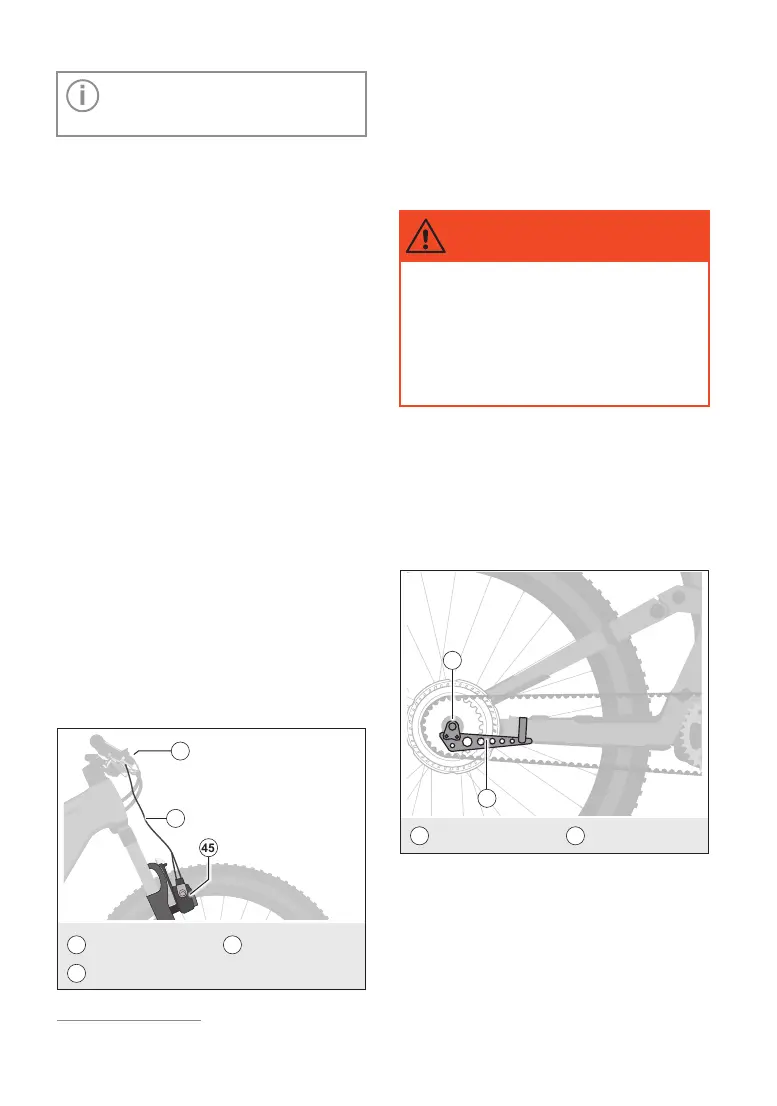
When you pull the brake lever, the brake
pads are pressed onto the rim from both
sides with the help of hydraulic brake lines.
This slows down the respective wheel set.
41
Brake lever
45
Brake shoes
(with brake pads)
44
Brake line
41
45
44
Fig.16: Rim brake components
21 Notes on setting the grip width can be found in chapter
14.1 “Brake lever assignment and adjustment of the
brakes”.
14.3.2 Use of rim brakes
• Pull the brake lever toward the handle-
bars to brake.
The harder you pull the brake lever,
the stronger the braking force.
• Release the pulled brake lever or reduce the
tensile force to stop braking more or less.
WARNING!
Risk of accident and injury
Wet, dirty and oily brake pads and/or
rims can lead to a reduced braking
effect of the rim brake, which increases
your braking distance.
• Take the reduced braking force in
wet conditions (e.g. when cycling in
the rain) into consideration.
14.4 Coaster brakes
14.4.1 Functionality of coaster brakes
When you pedal backwards, the brake unit
in the rear hub brakes the rear wheel set.
The torque arm transfers the motive force
from the wheel set to the bicycle frame.
22
46
22
Rear hub
46
Torque support
Fig.17: Coaster brake components
14.4.2 Use of coaster brakes
• Pedal backwards (against the direction of
the drive) to brake. The harder you pedal
backwards, the stronger the braking force.
• Pedal forward again or reduce the pres-
sure on the pedals pedaled backward to
stop braking more or less.



 To Next Page