Chapter 6: Receiver Configuration Modules Satellite Receiver Configuration
© Harmonic Inc. Manual p/n 101543/Ver 1.0 6-7 ProView 2900 Series/SW Version 1.94
6.2.1.7. Freq Drift Compensation
The ProView 2900 uses Freq Drift Compensation to automatically correct inaccurate
frequencies set by the operator.
When the operator sets the receiver frequency, the ProView 2900 checks whether it is set to
the optimum frequency. When a deviation is detected, the ProView 2900 calculates the offset
from the original setting and enables correcting it.
Turning on the Freq Drift Compensation activates the automatic frequency adjustment. When
Drift compensation is turned off, the device uses the original frequency setting that was
inserted by the operator.
This feature also enables the receiver to follow the drifts of the LNB.
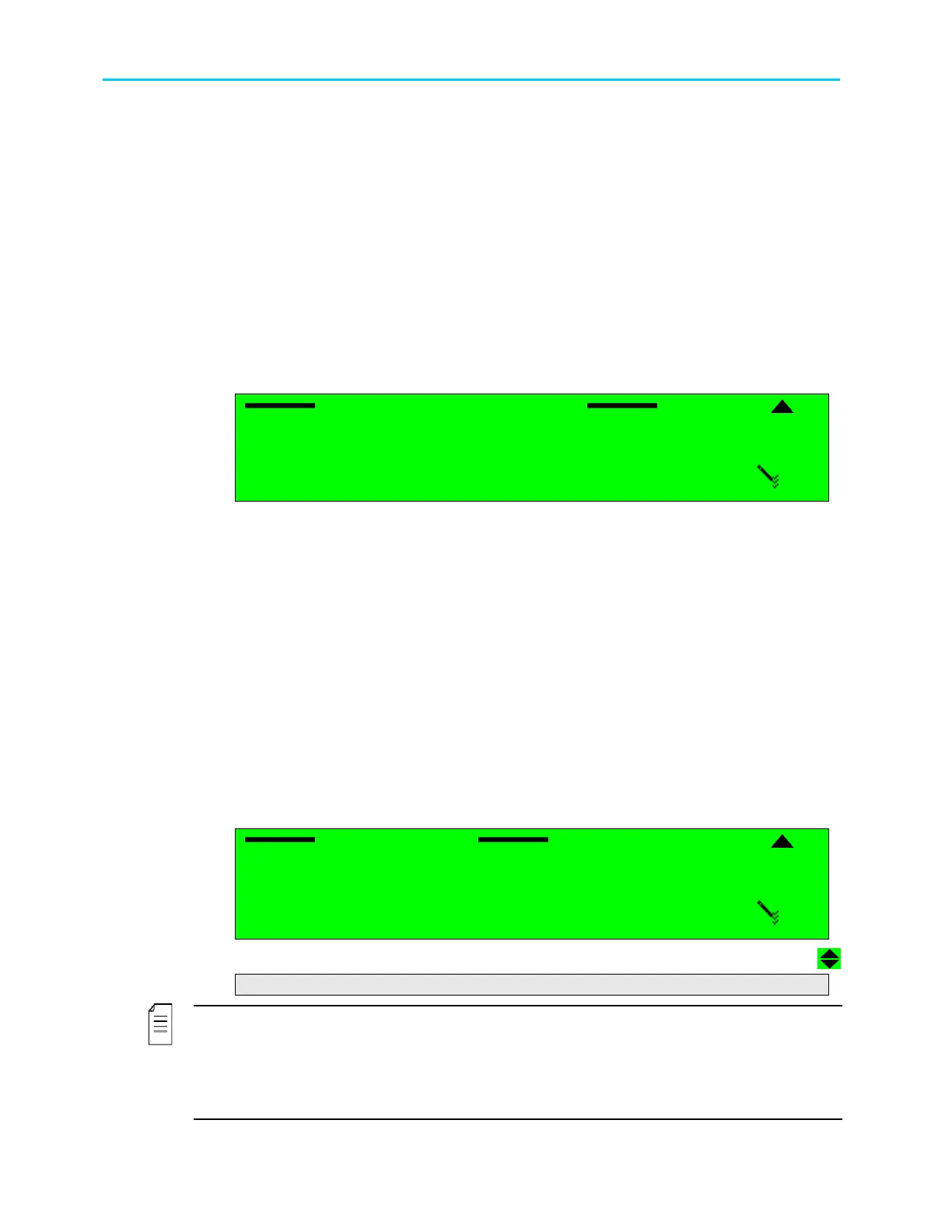
The following figure illustrates the Freq Drift Compensation screen.
Freq Drift Compensation
Freq Drift Compensation Freq Drift Compensation
Freq Drift Compensation
1
11
1
OFF
OFF OFF
OFF
2
22
2
ON
ON ON
ON
The available options are:
• OFF – Drift Compensation is off; the receiver remains with the configured frequency.
• ON - Drift Compensation is on; the receiver adjusts its optimal frequency.
6.2.1.8. LNB L.O. Type
The LNB L.O. Type parameter defines the LNB oscillator type in use.
Two standards are generally used:
• LNB ‘Universal’ standard, in the 9.75 to 10.6 GHz, or the LNB Universal 'Wide Band’, in
the 9.75 to 10.75 GHz range.
• Digital Sattelite Equipment Control (DiSEqC) standard, in the 9.75 to 10.6 GHz range.
In addition, the oscillator value can set to Ku Band or C Band and be manually configured
(using the .
The following figure illustrates the LNB L.O. Type screen.
LNB L.O. Type
LNB L.O. Type LNB L.O. Type
LNB L.O. Type
1
11
1
UNIVERSAL (9.75,10.6)
UNIVERSAL (9.75,10.6) UNIVERSAL (9.75,10.6)
UNIVERSAL (9.75,10.6)
2
22
2
WIDE BAND (9.75,10.75
WIDE BAND (9.75,10.75 WIDE BAND (9.75,10.75
WIDE BAND (9.75,10.75)
))
)
3
33
3
Ku BAND
Ku BAND Ku BAND
Ku BAND
4
44
4
C BAND
C BAND C BAND
C BAND
5
55
5
DiSEqC (9.75, 10.6)
DiSEqC (9.75, 10.6) DiSEqC (9.75, 10.6)
DiSEqC (9.75, 10.6)
NOTEs
The LNB L.O. type can be acquired from satellite transponder information. Most satellites use
the ‘Universal’ type of L.O. unless otherwise specified.
Manual configuration of the oscillator frequency is rarely used and is intended only for
advanced users.



 To Next Page