GAPS - User Guide
3.4.3 IDENTIFYING THE GPS LEVER ARMS
Even though it is designed to work in the vertical position, GAPS acoustic array can be tilted if
necessary and also be placed in the horizontal position or even upside down.
To calculate the absolute position of a transponder, GAPS needs to know its own absolute
position. The GPS provide an absolute position. The offsets between the GPS antenna and
the GAPS acoustic array allow the computation of the absolute position of GAPS.
If no misalignment offsets are entered, the reference axes are linked to the GAPS.
When GAPS is tilted, the three offsets between the GPS antenna and the acoustic array have
to be entered accurately. When GAPS is in horizontal position, the axes are inverted and the
attitude outputs are irrelevant.
There are 2 different solutions to install the GPS antenna with different implications on the
mounting of the acoustic array:
● GPS antenna right above GAPS
● GPS antenna not above GAPS
3.4.3.1 GPS Antenna above GAPS
Rigid Link
This is typically when GAPS is mounted on a mast or held by a rigid pole with the GPS
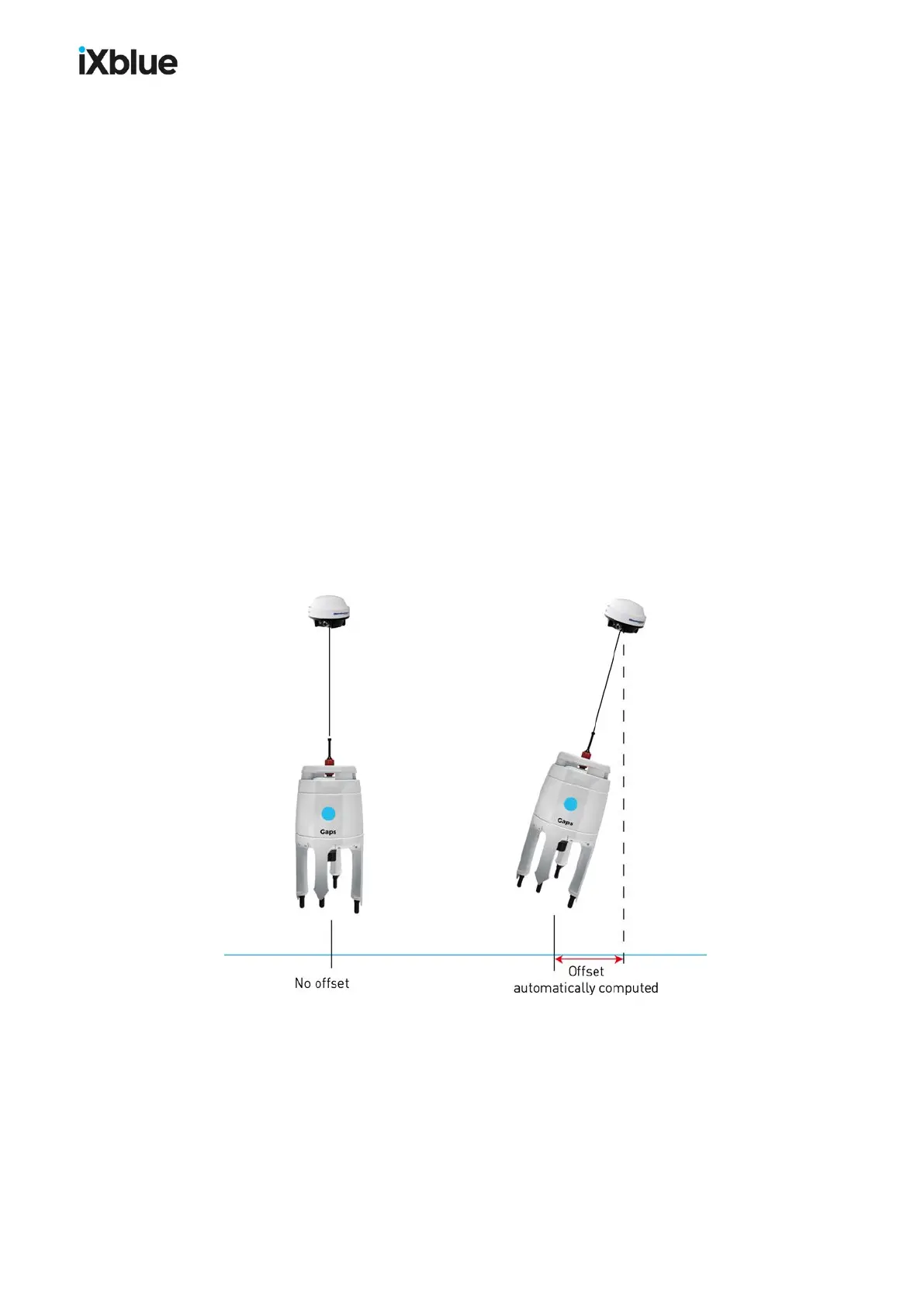
antenna installed on top of the mast. When GAPS is vertical, all the offsets between the GPS
antenna and the acoustic array are set to 0 except the height (h) which must be entered
accurately in order to calculate the position offset when the system attitude changes.
Figure 26 - Vertical GPS antenna lever arm
44 MU-GAPS-AN-005-H - November 2019


 To Next Page