GAPS - User Guide
5.1.2 RECURRENCE AND BLANKING TIME
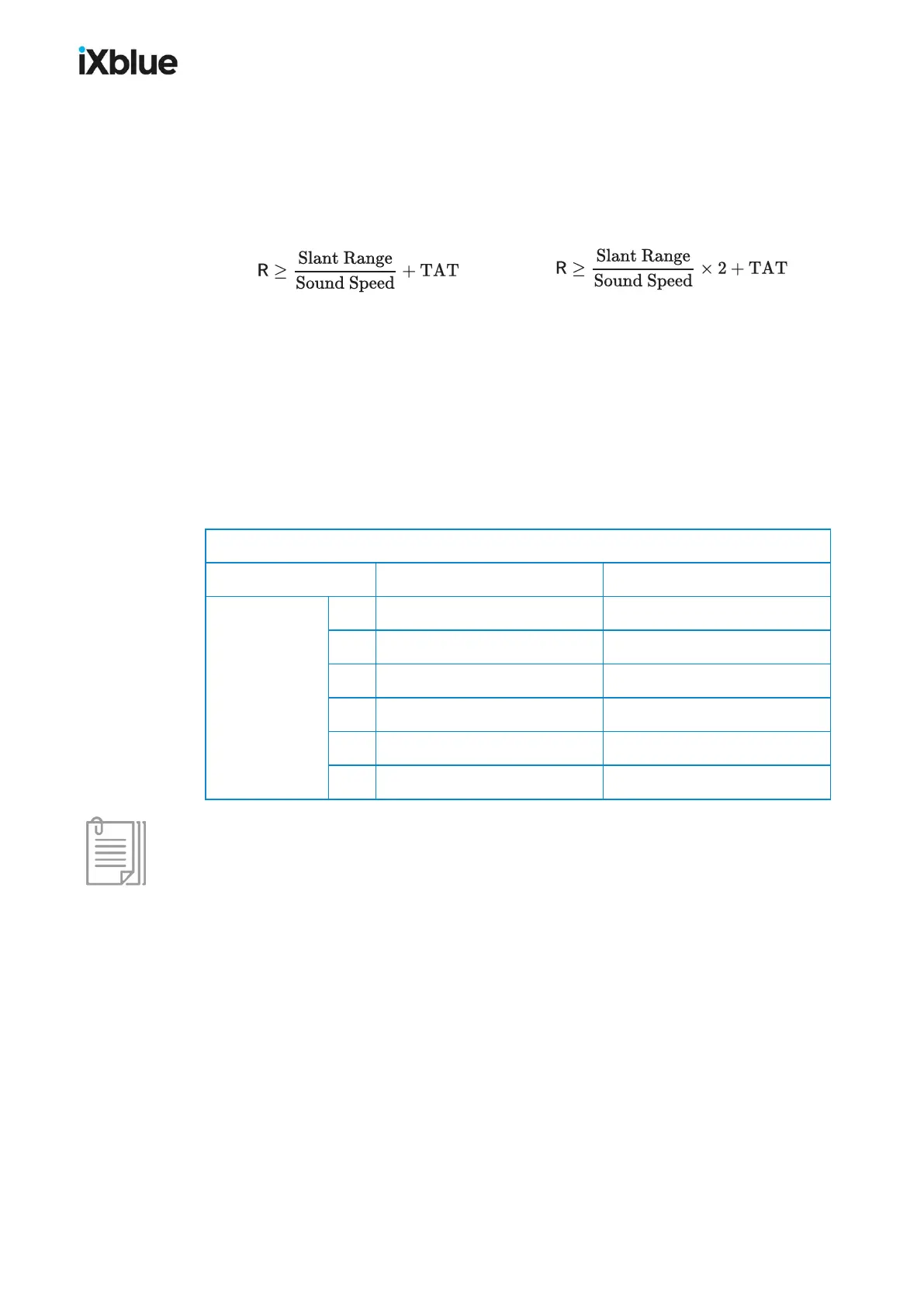
The recurrence of GAPS sets the update rate of the transponders positions. The recurrence
may be chosen in order to have approximately one second for each 750 meters traveled by the
signal. The recurrence obeys the inequalities:
In responder mode: In transponder mode:
R is the recurrence. TAT is the turn around time (90 ms most of the time, 20 ms in deep water).
The blanking time of the transponders sets the transponders acoustic reception window.
These windows must be as short as possible in order to avoid multipath detections and long
enough to allow the motion of the transponder between two interrogations of GAPS.
The recurrence is to be defined before the blanking time.
Choice of the recurrence:
The choice for the recurrence is mainly made upon the maximal travel distance.
Table 9 - Maximum working distance versus recurrence with a TAT = 90 ms
Maximum working distance (m)
Responder Mode Transponder Mode
Recurrence (s)
1 1,365 682
2 2,865 1,432
3 4,365 2,182
4 5,865 2,932
5 7,365 3,682
6 8,865 4,432
When telemetry data is received during the positioning cycle, keep in mind that the decoding
of the telemetry data takes approximately three seconds. The choice of the recurrence must
take this time into account.
Choice of the blanking time
The choice of the blanking time depends on
● Recurrence of GAPS
● Number of different interrogation frequencies used for the active transponders
● Repetition factor
One rule might be to remove 200 ms to the interrogating rate of each transponder in order to
find the blanking time. A series of examples is given in appendix E.
MU-GAPS-AN-005-H - November 2019 75


 To Next Page