Library of Function Blocks
4.23
BIAS (ABIA)
In this parameter, it is possible to adjust an initial value for the output signal when the control is
transferred from Manual to Automatic. This may be done only if the input Feedback is not
connected (LID=0).
For bumpless Manual to Automatic transfer, the input D must be connected to the output of the A/M
block and the track FB input E must be connected to the status indication of the A/M block. In this
case, parameter ABIA is used to change the block output during automatic operation. The output
signal is subjected to a step type variation whenever the ABIA value is modified. Amplitude and
direction of this step are equivalent to the difference between the previous and the new ABIA value.
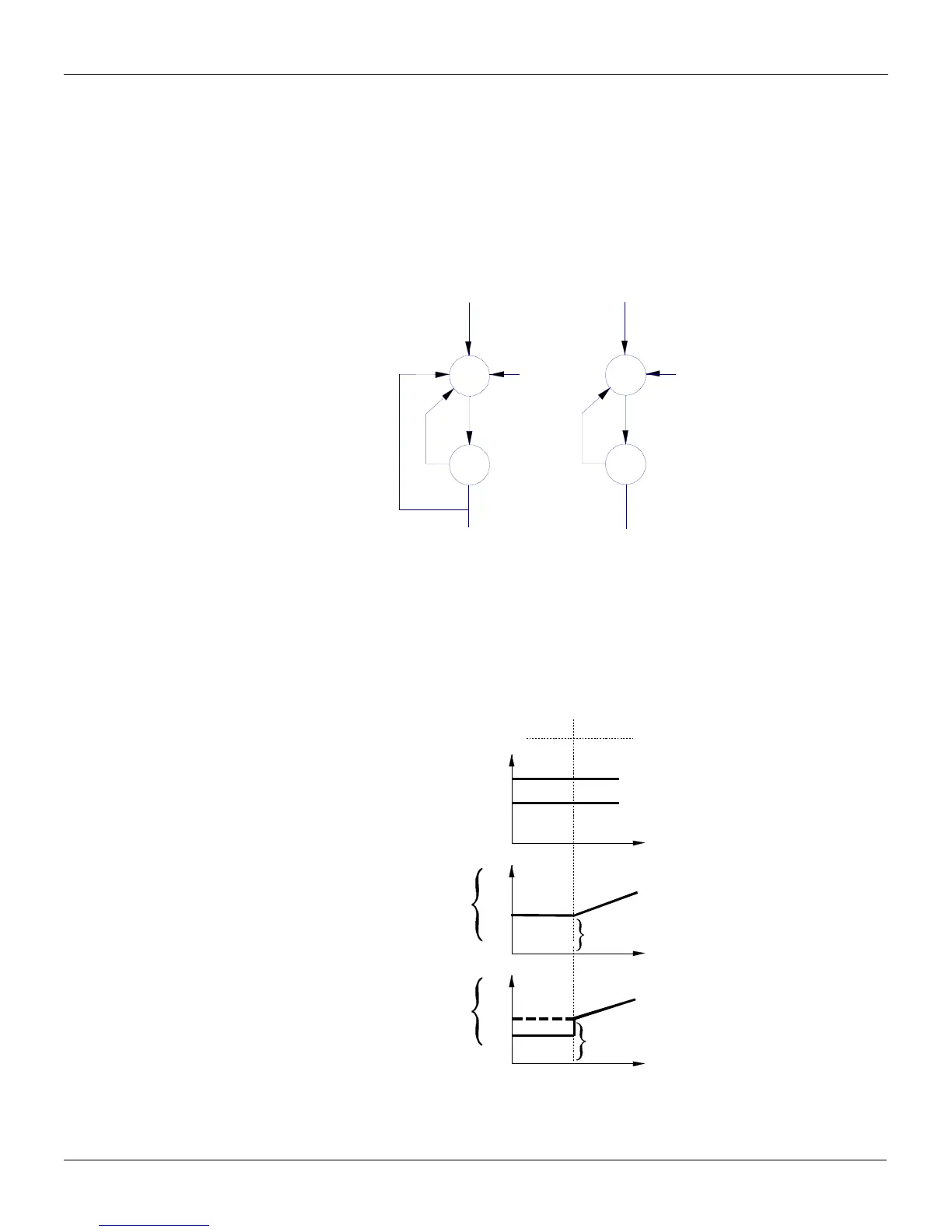
The connection diagram for both cases are shown on the following figures:
Fig 4.9.8 - Configuration less b) The Automatic
t time. This is a
ansfer type HARD. It can be obtained with the parameter CTYP equal to 4, 5 or 6.
Fig. 4.9.9 - Manual to Auto Transfer. Output starts with the Last Manual
Output Value
a
APID
039
Akp =1
ATr =1
CACT = 0 OR 2
Akp =1
ATr =1
ABIA = 20%
A
T =
R 2
APID
039
OUT
S
SP
39
39
40
40
47
47
E
E
B
B
OUT
A/M
035
A/M
035
b)
D
AA
A
A
for Manual to Auto Transfer. a) Bump
Output Starts with the Bias Value
During the Manual to Auto transfer, it is possible to add, to the initial output value (in both cases
above), a value equal to the proportional gain (AK
P
) multiplied by the error at tha
tr
MANUAL
50
OUT
CTYP = 0,1,2 OR 3
(BUMPLESS)
CTYP = 4,5 OR 6
(HARD)
OUT
50
60
SP
40
50
t
t
PV
INPUT D
INPUT D + Kp .
The Automatic
AUTOMATIC


 To Next Page