CD600 Plus - User's Manual
4.40
Function 15 – Derivative / Lead-Lag (LL)
Operation
This is a dynamic compensation block that may operate with a derivative function as well as with a
lead-lag compensation function. Selection of either function is done with parameter
CDLL.
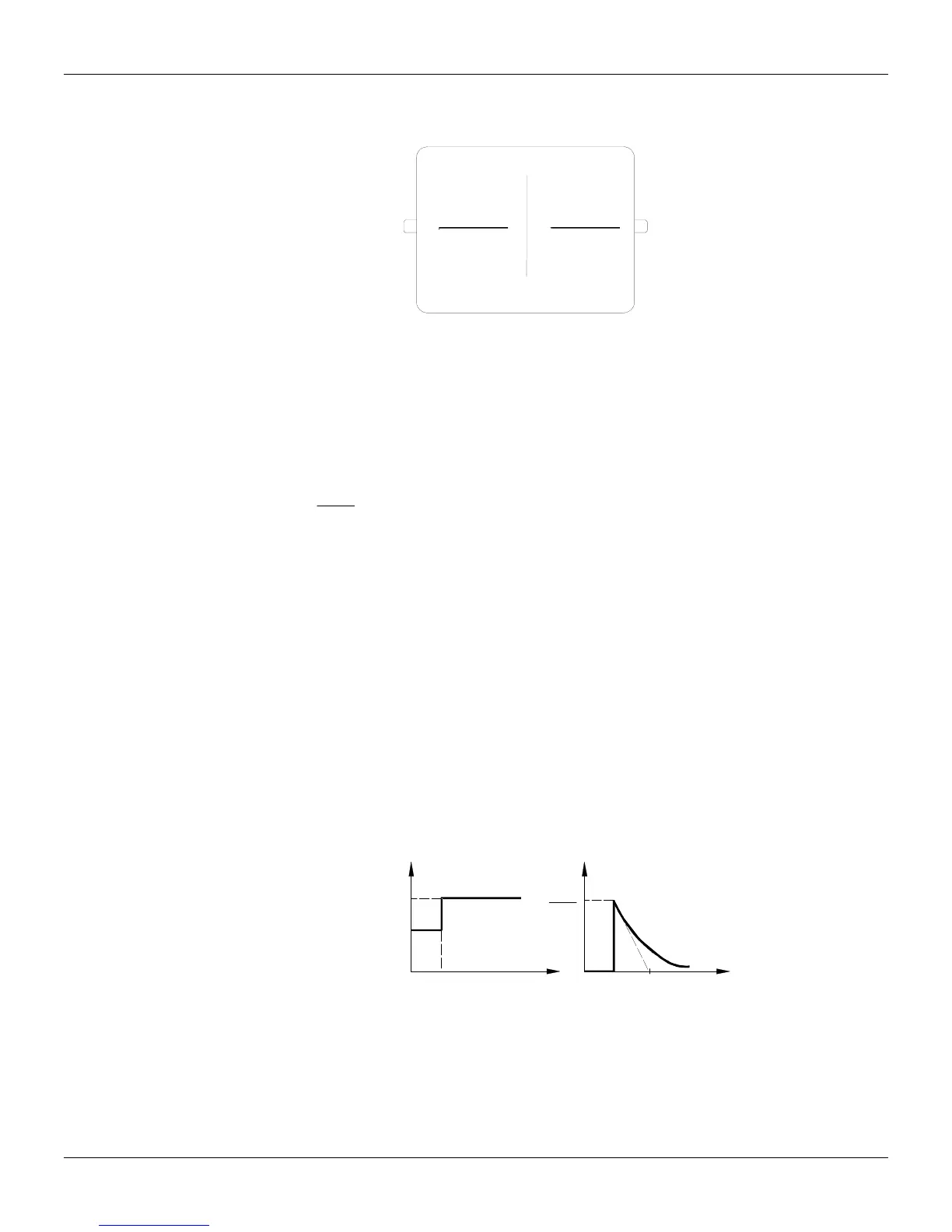
BLK 061/062
77/78
1 + T s
1 + T s
T
D
s
T
D
s
1+
This block reads inputs from -2 to 102% and provides output signals from -102 to +102%.
DERIVATIVE FUNCTION
While operating in the derivative mode, the block performs the following transfer function:
) (s I
Ts + 1
s
T
= ) (s O
D
Where,
O(s) and I(s) - are the Laplace transform of input and output functions, respectively.
T
D
- derivative constant, adjusted by parameter ATLE (min.)
T - lag constant, adjusted by parameter
ATLA (min.)
When
T=0, the output signal represents the input variation rate in the period determined by T
D
. For
example, if the input signal increases according to a slope of 15% per second and
TD=6 s (0.1
min.), the output signal will be 15. 6=90% while the slope lasts, returning to zero when there is a
constant input value.
When
T=0, the output signal is submitted to a lag. The response to a step function with amplitude A
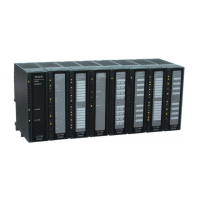
is shown in Figure 4.15.1.
This function is used when the rate of change of a variable is desired.
t
0
0
0
t
T
+T
tt
t
T
OUTPUT
Fig 4.15.1 - Response of Derivative Function with a Lag to an Input Step


 To Next Page