14215700-IG, Edition 8.0
April 2018, Original document
197
Handset Sharing
Note:
Not relevant to the Spectralink IP-DECT Server 200.
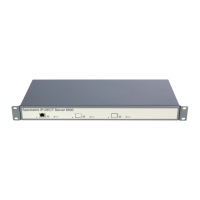
The traditional concept of a communication device is to have a device (phone) assigned to a number
(SIP user).
The basic concept of handset sharing is to break the link between the device and the user, and make
it possible for any user to sign-in to any device.
This is typically done for one of two reasons.
l The scenario requires more handsets than users.
One such scenario could be a certain user, which is required to have 24/7 operation, and
where there is no or very little possibility for charging the handset while in use. Imagine a hos-
pital with a nurse on duty. When the shift of the nurse on duty ends it is possible to let the next
nurse use a different handset (fully charged because it was not used by the previous nurse).
This way several nurses can share a line/number without sharing a device. Normally 30
minutes of charging of the handset will be sufficient every 24 hours, thus under normal con-
ditions it is not necessary to have extra devices only for the purpose of charging while not in
use.
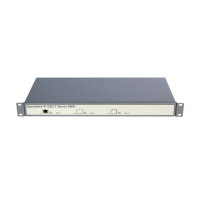
l The scenario requires more users than handsets.
An example of this scenario can be that several users, each with their own number, need to
use a phone on a site but not at the same time. E.g. a site with 10 different users working at the
same site but only 4 users at any given time. The traditional approach would require 10
devices. With handset sharing it is possible to let the 10 users share 4 devices for cost-saving
Spectralink IP-DECT Server 200/400/6500 Installation and Configuration Guide


 To Next Page