6-2 Printing via PostScript
PostScript printing technology was developed to provide consistent,
predictable printing from every major computer platform to any
printing device that supports it.
PostScript is software that tells an output device, such as a printer,
how to print fonts and graphic elements on a page. As such, it acts
as a translation program between a workstation application and the
printer.
The basic workflow of a PostScript print job is as follows:
1. When you execute the Print function from within your
workstation application, a PostScript print driver creates a
PostScript language file.
This file contains PostScript commands that describe the page to
be printed, the size and style of fonts and graphics, where they
should be placed on the page, and color information.
2. The PostScript language file is sent to the output device.
3. A raster image processor (RIP) in the output device processes
the file, translating the commands into an array of pixels—
referred to as a
raster image
—that recreate the intended image
of the entire page.
4. The raster image data is sent to the device’s print engine, which
in turn prints the pixels on the page media.
There have been three PostScript technologies released since its
inception—levels 1, 2, and, the most recent version, 3. The Horizon
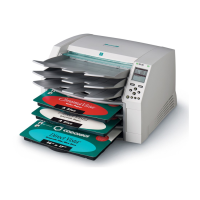
imager supports all three levels.
fåíêçÇìÅíáçå=íç=mçëíp Åêáéí


 To Next Page