Chapter 6 Fault Code Information and Maintenance
6-3
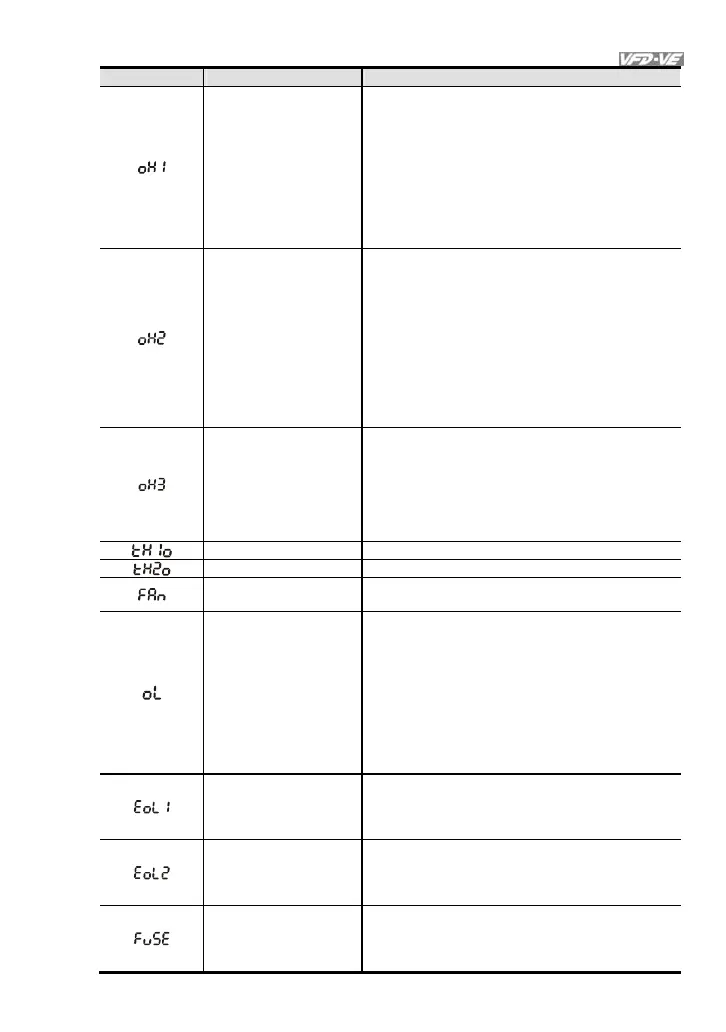
Fault Name Fault Descriptions Corrective Actions
IGBT overheating
IGBT temperature
exceeds protection
level
1 to15HP: 90
o
C
20 to 100HP: 100
o
C
1. Ensure that the ambient temperature falls
within the specified temperature range.
2. Make sure that the ventilation holes are
not obstructed.
3. Remove any foreign objects from the
heatsinks and check for possible dirty
heat sink fins.
4. Check the fan and clean it.
5. Provide enough spacing for adequate
ventilation.
Heatsink
overheating
Heat sink
temperature exceeds
90
o
C
1. Ensure that the ambient temperature
falls within the specified temperature
range.
2. Make sure that the ventilation holes are
not obstructed.
3. Remove any foreign objects from the
heatsinks and check for possible dirty
heat sink fins.
4. Check the fan and clean it.
5. Provide enough spacing for adequate
ventilation.
Motor overheating
The AC motor drive
detects that the
internal temperature
exceeds Pr.06-30
(PTC level)
1. Make sure that the motor is not
obstructed.
2. Ensure that the ambient temperature
falls within the specified temperature
range.
3. Take the next higher power AC motor
drive model.
OH1 hardware failure Return to the factory
OH2 hardware failure Return to the factory
Fan failure
1. Make sure that the fan is not obstructed.
2. Return to the factory
Overload
The AC motor drive
detects excessive
drive output current.
NOTE: The AC motor
drive can withstand
up to 150% of the
rated current for a
maximum of 60
seconds.
1. Check whether the motor is overloaded.
2. Take the next higher power AC motor
drive model.
Electronics thermal
relay 1 protection
1. Check the setting of electronics thermal
relay (Pr.06-14)
2. Take the next higher power AC motor
drive model
Electronics thermal
relay 2 protection
1. Check the setting of electronics thermal
relay (Pr.06-28)
2. Take the next higher power AC motor
drive model
Broken fuse
The fuse at DC side
is broken for 30hp
and below
1. Check whether the fuse of the transistor
module is functioning well
2. Check whether the loading side is short-
circuit


 To Next Page