394 Eos Family v2.9.0 Operations Manual
Overview
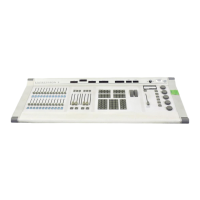
This chapter outlines the procedures required to use multiple control devices (such as an
Element, ETCnomad, ETCnomad Puck, or Remote Video Interface (RVI)) simultaneously on a
network. It outlines the setup, configuration, and behavior that is entailed in a multi-console
scenario.
Note: Only Intel-based Macs can connect as a client.
Multi-console functionality is also used to provide synchronized backup of your show while
running multiple devices on the network.
Definition of terms
Familiarize yourself with these terms prior to setting up a multi-console system.
Note: Element consoles, RVIs, ETCnomad, and ETCnomad Pucks may all be
considered active units on an Eos Family network. For the sake of brevity, the term Eos
is used to represent any /all of these options in the following descriptions.
Note: Net3 RVIs can not be configured to be a primary or a backup.
Primary - When an Eos is configured as a primary, other Eos devices can connect and
synchronize with it. If using a backup processor, the primary is the Eos that will be backed
up. By default, all Eos Family consoles will start up as a primary.
Backup - The Eos capable of taking control of the system if the primary fails. You may
input data and run your show from a backup. There can only be one backup in an Eos
network and you must specify which primary it is backing up.
Client - Any online Eos that is not the primary or backup is a client. Client data is sent and
received over the network, and clients will synchronize with a designated primary.
Offline - Any Eos controller that is disconnected from the Eos network. Changes to show
data performed on an offline Eos will not affect the rest of the Eos network or the lighting
system.
Master - The Eos that is currently sending control data to the lighting system is the master.
In most circumstances this is also the primary. Should a primary fail and a backup takes
control, then the backup will be acting as the master.
Tracking - Any device that is synchronized with a master is tracking. Once a backup takes
control it becomes a master and is no longer tracking.
User - A user is an Eos defined by a user ID. If it has a unique user ID, the Eos will operate
separate from other Eos devices on the network, but still track show data. If it shares a
user ID, Eos will synchronize with like IDs. See
About User ID (on page396)
System - One primary Eos, one backup Eos, and (if available) multiple clients synchronized
together.
Mirror Mode - A mode for mirroring the displays of another device. See
Mirror Mode (on
page400)
Multi-console Setup
When using multiple Eos devices on the network, you should adjust some of the settings to
ensure optimal functionality.
Additional requirements for multi-console setup include:



 To Next Page