Using Fan 187
[1] [Thru] [5] [At] [1] <0> [Thru] [3] <0> {Fan} {Mirror} [Enter] - sets channel 1 to 30%, 2 to
20%, 3 to 10%, 4 to 20%, and 5 to 30%.
Fanning References
When fanning references, such as palettes, if there are more than 2 reference lists are used then
the data will be referenced data. The fan will be repeated if there are more channels than
references.
[1] [Thru] [5] [Int Palette] [1] [Thru] [3] [Enter] - sets channel 1 to IP1, 2 to IP2, 3 to IP3, 4
to IP1, and 5 to IP2.
If the list contains 2 or less references, fan will be set to the levels between the references as
absolute data.
[1] [Thru] [5] [Int Palette] [1] [Thru] [2] [Enter] - (Intensity palette 1 is all channels at 0%
and Intensity palette 2 is all channels set to 100%.) sets channel 1 to 0%, 2 to 25%, 3 to
50%, 4 to 75%, and 5 to 100% as absolute data.
Fanning Timing and Delays
Fanning timing and delays work exactly like fanning parameters.
[1] [Thru] [5] [Time] [6] [Thru] [1] [0] [Enter] - sets the discrete times for channel 1 to 6
seconds, 2 to 7 seconds, 3 to 8 seconds, 4 to 9 seconds, and 5 to 10 seconds.
[Cue] [1] [Thru] [5] [Time] [6] [Thru] [1] [0] [Enter] - sets the times for cue 1 to 6 seconds,
2 to 7 seconds, 3 to 8 seconds, 4 to 9 seconds, and 5 to 10 seconds.
[Cue] [1] [Part] [1] [Thru] [3] [Time] [6] [Thru] [8] [Enter] - sets the times for cue 1's parts
to part 1 to 6 seconds, part 2 to 7 seconds, and part 3 to 8.
[1] [Thru] [5] [Delay] [6] [Thru] [8] {Fan} {Mirror} [Enter] - sets the discrete delays of
channel 1 to 8 seconds, 2 to 7 seconds, 3 to 6 seconds, 4 to 7 seconds, and 5 to 8 seconds.
Using Subgroups with Fan
Subgroups (on page179)
can be used with the Fan feature. Channels in the same subgroup will
act as a single channel when fanned.
Example:
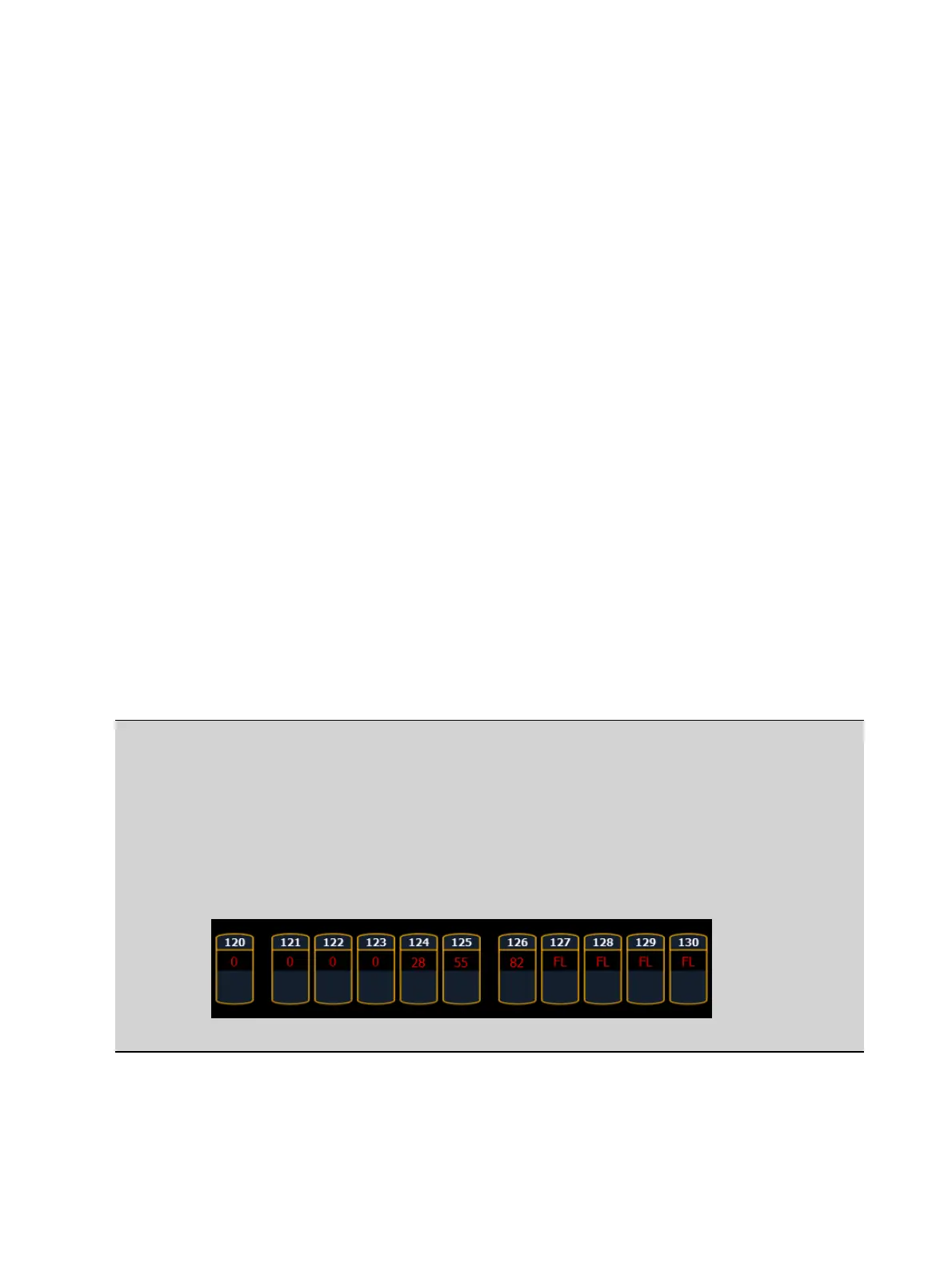
Group 1 is made up of channels 120 thru 130. Channels 120 thru 123 are one subgroup,
channels 124 thru 126 are not in any subgroup, and channels 125 thru 130 are another
subgroup.
[Group] [1] {Fan} [Enter]
Selects group 1 and puts it into fan mode. Rolling up the level wheel creates the
following result. Channels 120 thru 123 share an intensity, channels 124 thru 126 each
have different intensities, and channels 127 thru 130 share an intensity.



 To Next Page