APPENDIX
Page 511
2. Multiply the dial reading times the Quotient
found above to determine the torque at the
end of the adapter.
Example:
— Dial Reading = 50 lb-ft
— Quotient = 1.1
— Torque at End of Adapter =
50 lb-ft x 1.1 = 55 lb-ft
3. If the required torque is known, divide by the
Quotient to determine what the torque
reading should be.
Example:
— Required Torque = 55 lb-ft
— Quotient = 1.1
— Desired Torque Reading =
55 lb-ft ÷ 1.1 = 50 lb-ft
It is recommended that torque wrenches be
checked on a regular basis for correct calibration.
TURBOCHARGER FAILURE
AND ACTIONS REQUIRED TO
AVOID REPEAT FAILURE
A turbocharger failure can introduce a volume of
oil and other debris into the charge air cooler and
other components of the inlet air system.
Additionally, engine oil can also become
contaminated with soot and other debris due to a
turbocharger failure. To avoid a repeat failure, the
following procedures should be followed
whenever a failed turbocharger is replaced.
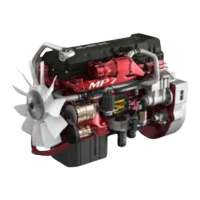
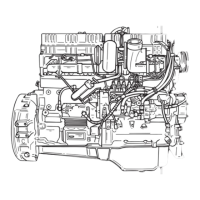
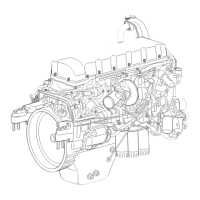
Early E-Tech™ engines utilized a two-piece inlet
manifold, whereas later E-Tech™ and all ASET™
engines utilize a one-piece manifold. With the
two-piece manifold, the bottom of the manifold is
approximately the same level as the port floor of
the cylinder head. Therefore, any oil which may
be introduced into the inlet air system due to a
turbocharger failure will accumulate in the charge
air cooler, but very little oil can accumulate in the
inlet manifold.
On engines having the one-piece manifold, the
bottom of the manifold is more than 2″ lower than
the port floor of the cylinder head. In the event of
a turbocharger failure, this area of the inlet
manifold can become a reservoir for oil. If
accumulated oil is not removed from the inlet
manifold, the engine may experience “diesel
engine run-away” when the engine is first started
after the replacement turbocharger has been
installed.
Whenever a turbocharger failure has introduced a
volume of oil into the charge air cooler, the cooler
must be thoroughly cleaned or replaced before
the engine is started. Additionally, on engines
having the one-piece inlet manifold, the manifold
must be checked for the presence of oil and
cleaned as necessary. The manifold can be
checked without removing it from the engine by
removing the inlet hose from the manifold and
using a flashlight to look inside.
On ASET™ AC engines, it will be necessary to
remove the mixer tube to view the inside of the
manifold.
5-111.bk Page 511 Monday, July 10, 2006 2:26 PM



 To Next Page