M A E D A Mini-Crawler Crane Section 4 –
TRAILERING
1/2019 MC285C-3 4-141
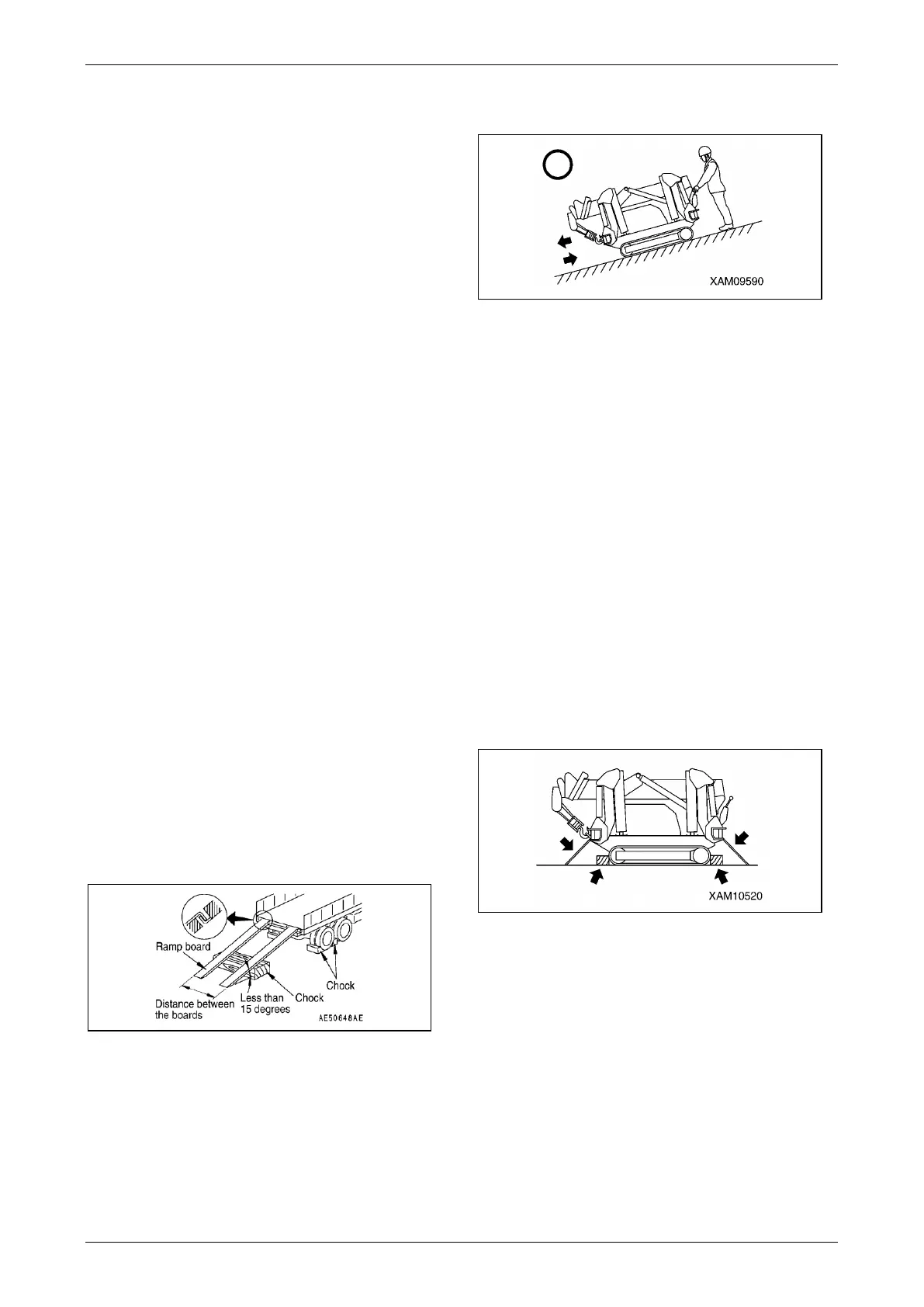
Ramp Planks
NOTICE: Ramp planks must be of adequate
length (wider than the rubber tracks) and not
exceed 15 degrees, when loading the machine.
• Ramp planks must be of adequate thickness
and strength to withstand the weight and mass
of the machine.
• Place ramp planks perpendicular to the truck
box.
• Match the centre of each rubber track with the
centre of the corresponding ramp plank.
Misaligned ramp planks may cause the machine
to slip off the ramp planks and cause machine
damage.
• Reinforce with blocks or other support if the
ramp planks deflect.
• Remove mud and other substances from the
footing to prevent the machine from skidding
over the ramp planks. Remove substances
stuck to the ramp planks such as grease, oil or
ice, and keep clean. Be especially careful during
rain to avoid slipping.
• Never change direction on the ramp planks.
Move completely off the ramp planks before
changing direction.
Loading / Unloading Procedure
WARNING! Overturn Hazard. Always load the
machine moving backward onto the trailer.
Moving forward onto the trailer could result in
an unstable condition.
1. Place wheel blocks under the wheels of the
trailer to secure the trailer.
Fig. 4-378
2. Secure the ramp planks to the trailer and
align the machine with the ramp planks and
trailer.
3. Verify the two ramp planks are at the same
height.
4. Move the accelerator lever to keep the engine
at low speed.
Fig. 4-379
5. Travel slowly toward the ramp planks, and
load/unload the machine while keeping the
boom from hitting the trailer. WARNING!
Sudden Movement Hazard. Only move the
travelling levers while loading or unloading
the machine. Moving other levers could result
in unaccepted sudden movement of the
machine.
6. Load the machine to the desired position on
the trailer.
7. Stop the engine and remove the key from the
Starter Switch.
8. Install a square timber block in front and back
of the rubber tracks to prevent the machine
from moving during transportation. Secure
the machine, using the four tie-down points,
with chain or wire rope to prevent movement
or slipping.
Fig. 4-380


 To Next Page