M A E D A Mini-Crawler Crane Section 4 – CRANE OPERATION
1/2019 MC285C-3 4-59
Hook Raising / Lowering Procedure
The volume of the hydraulic oil in each of the
cylinders changes depending on the temperature.
When left in idle with a hoisted load, the oil
temperature and hydraulic oil volume will
incrementally drop, and may cause the loaded
boom angle and boom length to decrease. If this
happens, perform boom lift and boom extension
operations as appropriate to correct.
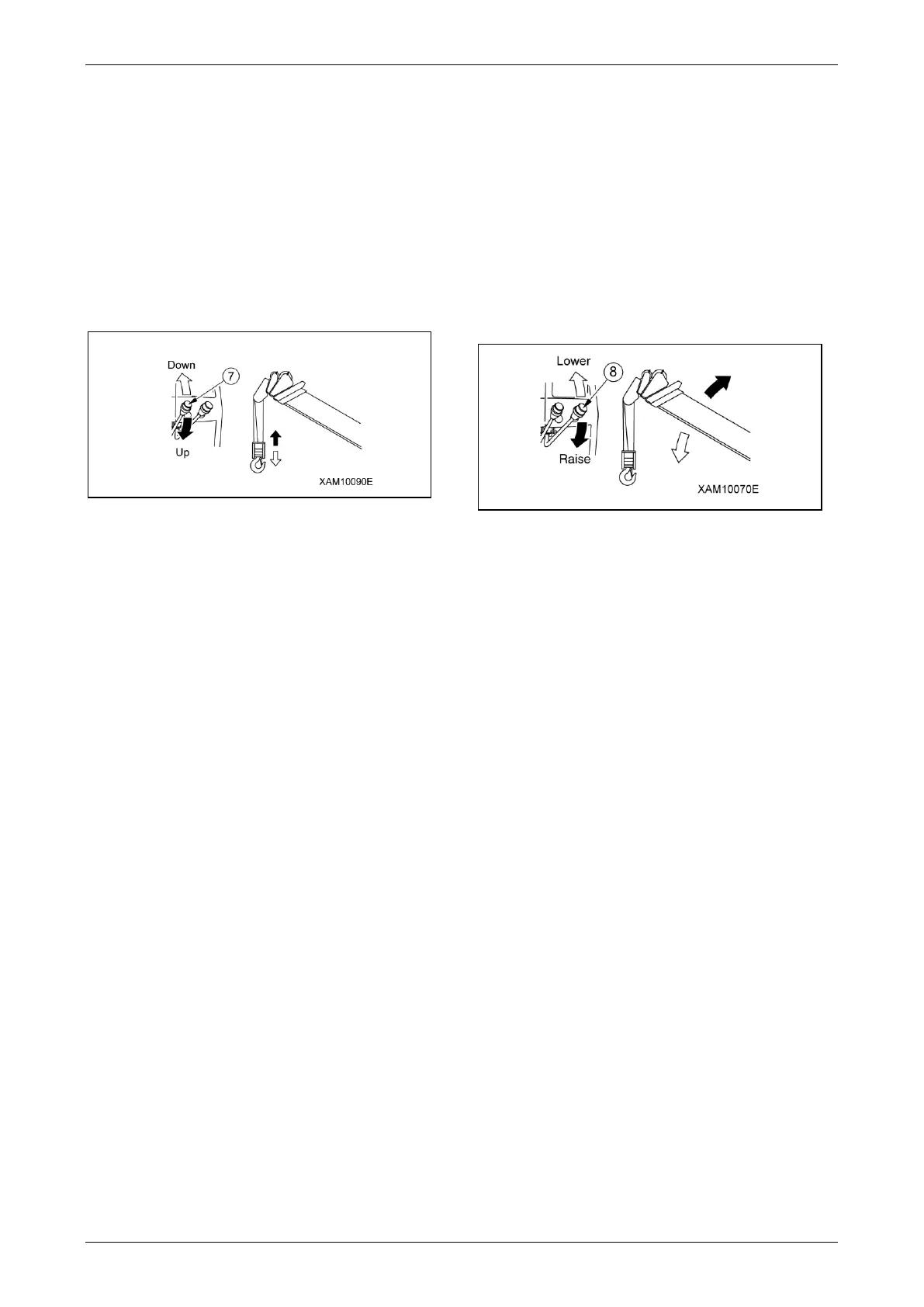
Move the winch lever (7) as follows:
Fig. 4-163
• Lower: Push the lever forward to DOWN.
• Neutral: Release the lever. The lever will return
to the NEUTRAL position and stop the raising
and lowering of the hook block.
• Raise: Pull the lever toward you to UP.
Adjust the winch raising and lowering speed with
the winch lever and travel of the accelerator
levers.
While lowering the hook block, do not allow the
hook block to hit the ground.
The machine is equipped with a stop
alarm/automatic stop safety device. When only a
few windings of the wire rope cable remain on the
winch drum the alarm sounds and the
Over-Unwinding Stop Display flashes in red.
Boom Lifting Operation
Safety Precautions
WARNING! Tip Hazard. Always move the
boom lift lever slowly while hoisting a load.
Sudden movement of the lever may cause the
load to sway.
Boom Lifting / Lowering Procedure
To operate the boom lift lever (8):
Fig. 4-164
• Lower: Push the lever forward to LOWER.
• Neutral: Release the lever. The lever returns to
the NEUTRAL position and the boom stops.
• Raise: Pull the lever toward you to RAISE.
Adjust the boom lifting speed with the boom lift
lever and the travel of the accelerator levers.
Boom Telescoping Operation
Safety Precautions
WARNING! Tip Hazard. Always move the
boom telescoping lever slowly while hoisting
a load. Sudden movement of the lever may
cause the load to sway.
WARNING! Sudden Movement Hazard. Verify
the weight of the load before extending the
boom. As the boom extends, the working
radius increases and the rated total load
decreases. Do not pull a load sideways or
draw it in while telescoping the boom. These
conditions may cause unreasonable force on
the machine and uncontrollable movement of
the load.


 To Next Page