Radioddity Extended manual for Radioddity DB25-D, DB40-D & GD-88 v3.0
© Radioddity 2023 page 61 of 252
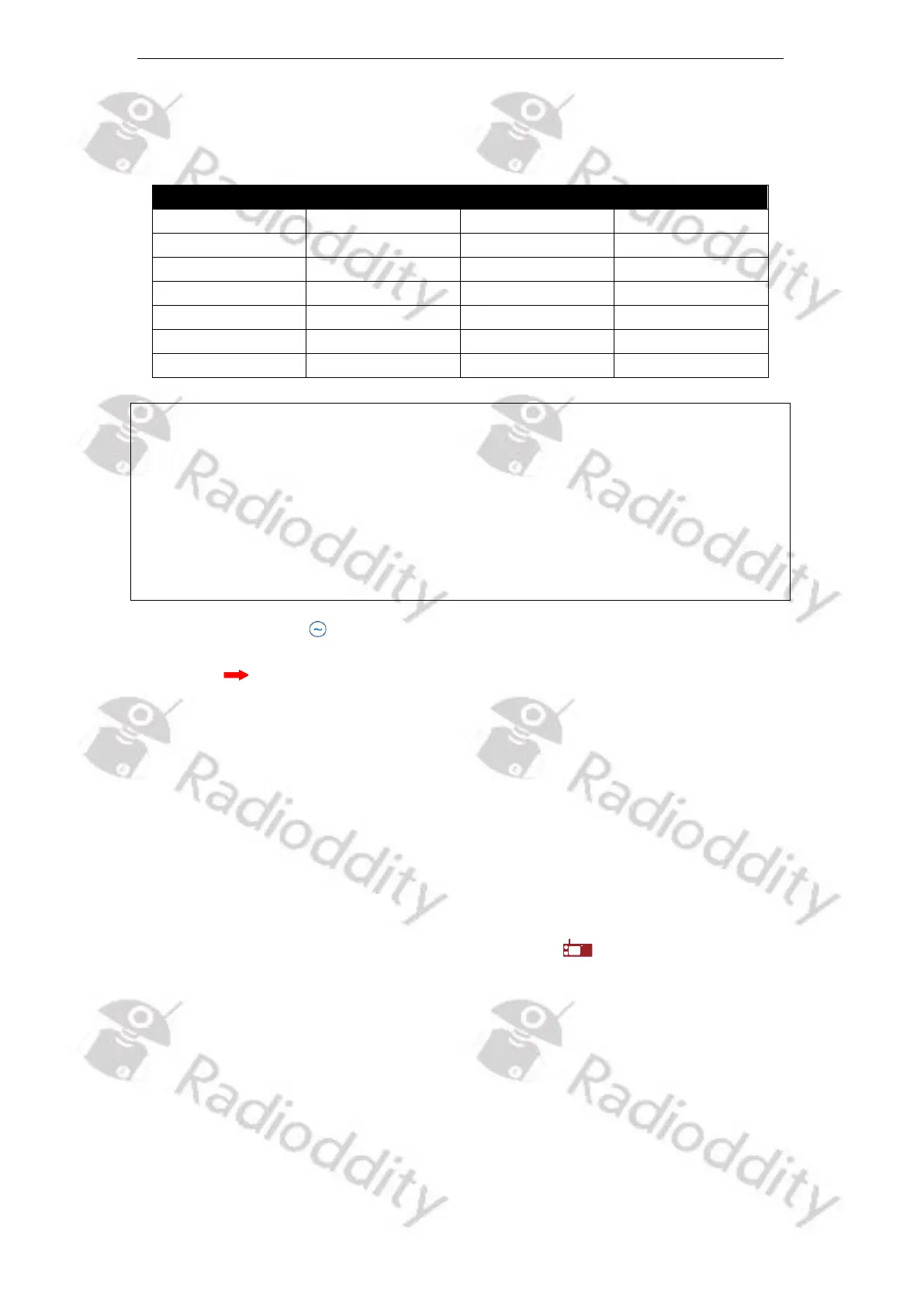
It is also possible to transmit DTMF-codes without prior activation of the DTMF-
mode. Just press the PTT-key and keep it depressed whilst additionally pressing
one of the below listed keys. The assignment of the keys is as follows:
Notes: The programmable keys P4, P5, P6 and P7 are not available as long as DTMF-
mode is active on a Radioddity DB25-D.
The programmable keys P5, P6, P7 and P8 are not available as long as DTMF-
mode is active on a Radioddity DB40-D.
The programmable keys P1 and P2 are not available as long as DTMF-mode
is active on a Radioddity GD-88.
Firmware versions released prior to 2023 do not support DTMF for analog
mode.
6.8 CTCSS / DCS
When the ‘ ’ icon, ‘PTT’ or ‘CTRL’ is shown left to the channel name you may set
the CTCSS and DCS signaling of the currently selected VFO A or B separately by
accessing the menu.
1. In standby, press the [Menu]-key to access the menu and choose ‘Parameters’
→ ‘Signaling’.
2. In standby, long press the [B/E]-key (DB25-D), [ENC] (DB40-D) or [A/B]-key (GD-
88) to access the Channel-Attributes, and choose ‘RX/TX signaling’ /
‘Rx/Tx SubType’.
3. In standby, press the [TONE/T.SEL]-key, and then choose the required
signaling. This is only possible with the Radioddity DB25-D .
(1) Choose the signaling type: single click the [TONE/T.SEL]-key to choose
from QT , DQT, DQI or none. The signaling icon will display at the upper right
of the current VFOs channel.
(2) Choose the signaling code / frequency: long press the [TONE/T.SEL]-key
to display the current signaling code/frequency at the upper right of current
VFOs channel, rotate the [ENC] button to choose the desired signaling
code/frequency and press the [Menu]-key to confirm your selection. Or
press the [TONE/T.SET]-key to set RX (R:XXXX) or TX (T:XXXX) signaling code/
frequency.



 To Next Page