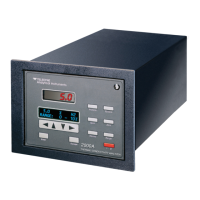
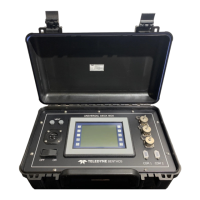
Operating Instructions Model 100E Instruction Manual
120 045150102 Rev XB1
X [ID] COMMAND <CR>
Where
X is the command type (one letter) that defines the type of command.
Allowed designators are listed in Table 6-23 and Appendix A-6.
[ID] is the analyzer identification number (Section 6.9.1.). Example: the
Command “? 200” followed by a carriage return would print the list of
available commands for the revision of software currently installed in the
instrument assigned ID Number 200.
COMMAND is the command designator: This string is the name of the command
being issued (LIST, ABORT, NAME, EXIT, etc.). Some commands may
have additional arguments that define how the command is to be
executed. Press ? <CR> or refer to Appendix A-6 for a list of available
command designators.
<CR> is a carriage return. All commands must be terminated by a carriage
return (usually achieved by pressing the ENTER key on a computer).
Table 6-23: Command Types
Command Command Type
C Calibration
D Diagnostic
L Logon
T Test measurement
V Variable
W Warning
6.11.1.4. Data Types
Data types consist of integers, hexadecimal integers, floating-point numbers, Boolean
expressions and text strings.
• Integer data are used to indicate integral quantities such as a number of records,
a filter length, etc. They consist of an optional plus or minus sign, followed by one
or more digits. For example, +1, -12, 123 are all valid integers.
• Hexadecimal integer data are used for the same purposes as integers. They
consist of the two characters “0x,” followed by one or more hexadecimal digits (0-
9, A-F, a-f), which is the ‘C’ programming language convention. No plus or minus
sign is permitted. For example, 0x1, 0x12, 0x1234abcd are all valid hexadecimal
integers.
• Floating-point numbers are used to specify continuously variable values such as
temperature set points, time intervals, warning limits, voltages, etc. They consist
of an optional plus or minus sign, followed by zero or more digits, an optional
decimal point, and zero or more digits. (At least one digit must appear before or



 To Next Page