Theory Of Operation Model 100E Instruction Manual
194 045150102 Rev XB1
10.7. Software Operation
The M100E SO
2
analyzer is at its heart a high performance, 386-based microcomputer
running MS-DOS. Inside the DOS shell, special software developed by T-API interprets
user commands vie the various interfaces, performs procedures and tasks, stores data in
the CPU’s various memory devices and calculates the concentration of the sample gas.
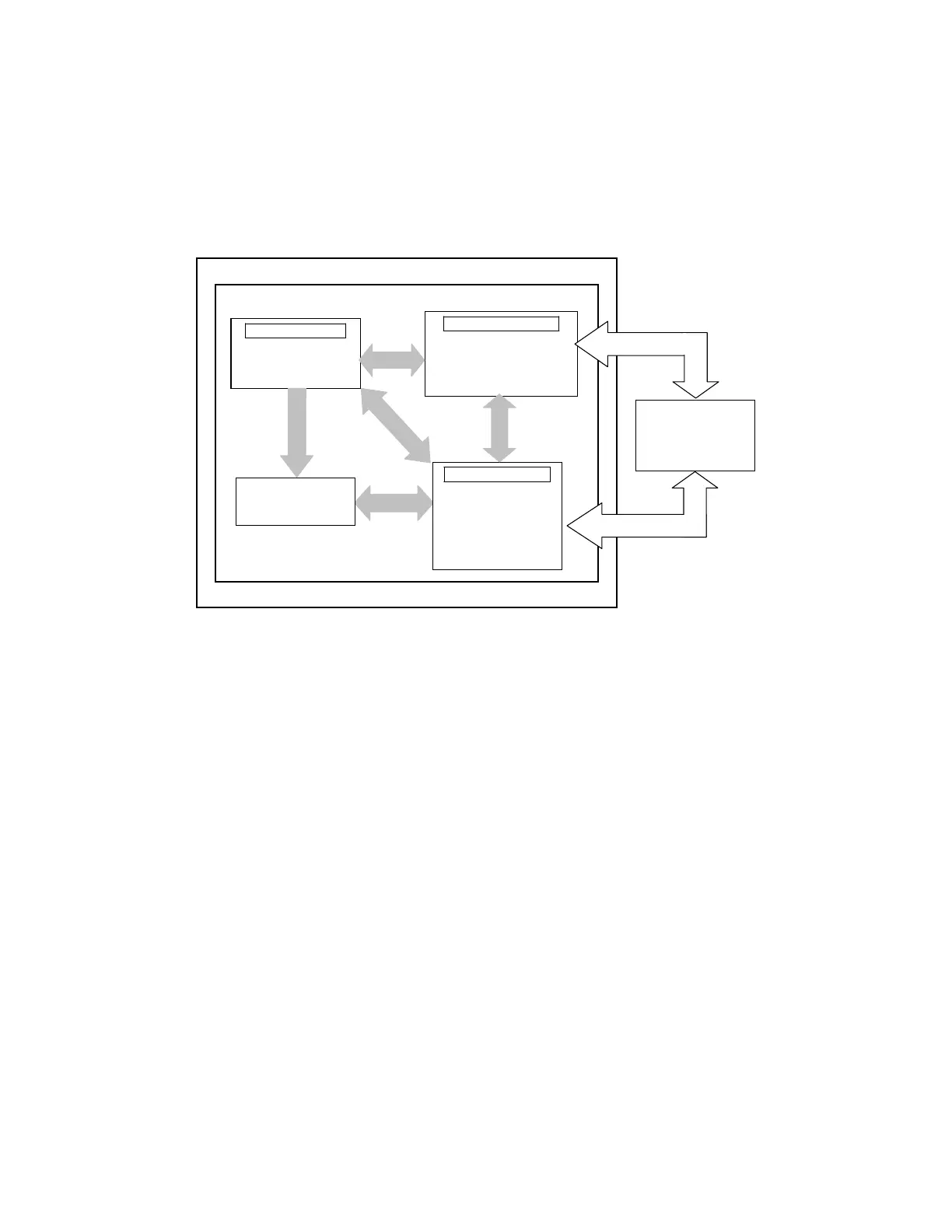
DOS Shell
API FIRMWARE
Analyzer Operations
Calibration Procedures
Configuration Procedures
Autonomic Systems
Diagnostic Routines
Memory Handling
IDAS Records
Calibration Data
System Status Data
Interface Handling
Sensor input Data
Display Messages
Keypad
Analog Output Data
RS232 & RS485
External Digital I/O
Measurement
Algorithm
ANALYZER
HARDWARE
PC/104 BUS
PC/104 BUS
Figure 10-22: Basic Software Operation
10.7.1. Adaptive Filter
The M100E SO
2
analyzer software processes sample gas measurement and reference
data through a built-in adaptive filter built into the software. Unlike other analyzers that
average the sensor output signal over a fixed time period, the M100E calculates averages
over a set number of samples. During operation, the software automatically switches
between two filters of different lengths based on the conditions at hand.
During conditions of constant or nearly constant concentration the software computes an
average of the last 240 samples. This provides the calculation portion of the software
with smooth stable readings. If a rapid change in concentration is detected, the adaptive
filter switches modes and only averages the last 48 samples. This allows the analyzer to
respond to the rapidly changing concentration more quickly. Once triggered, the short
filter remains engaged for a fixed time period to prevent chattering.
Two conditions must be simultaneously met to switch to the short filter. First the
instantaneous concentration must exceed the average in the long filter by a fixed
amount. Second, the instantaneous concentration must exceed the average in the long
filter by a portion, or percentage, of the average in the long filter.
If necessary, these filter lengths of these two modes may be changed to any value
between 1 and 1000 samples. Long sample lengths provide better signal to noise



 To Next Page