CHASSIS
3-27
▲▲▲▲▲▲▲▲▲ ▲ ▲▲▲▲▲▲▲▲▲ ▲ ▲▲▲▲ ▲ ▲▲▲▲ ▲▲▲
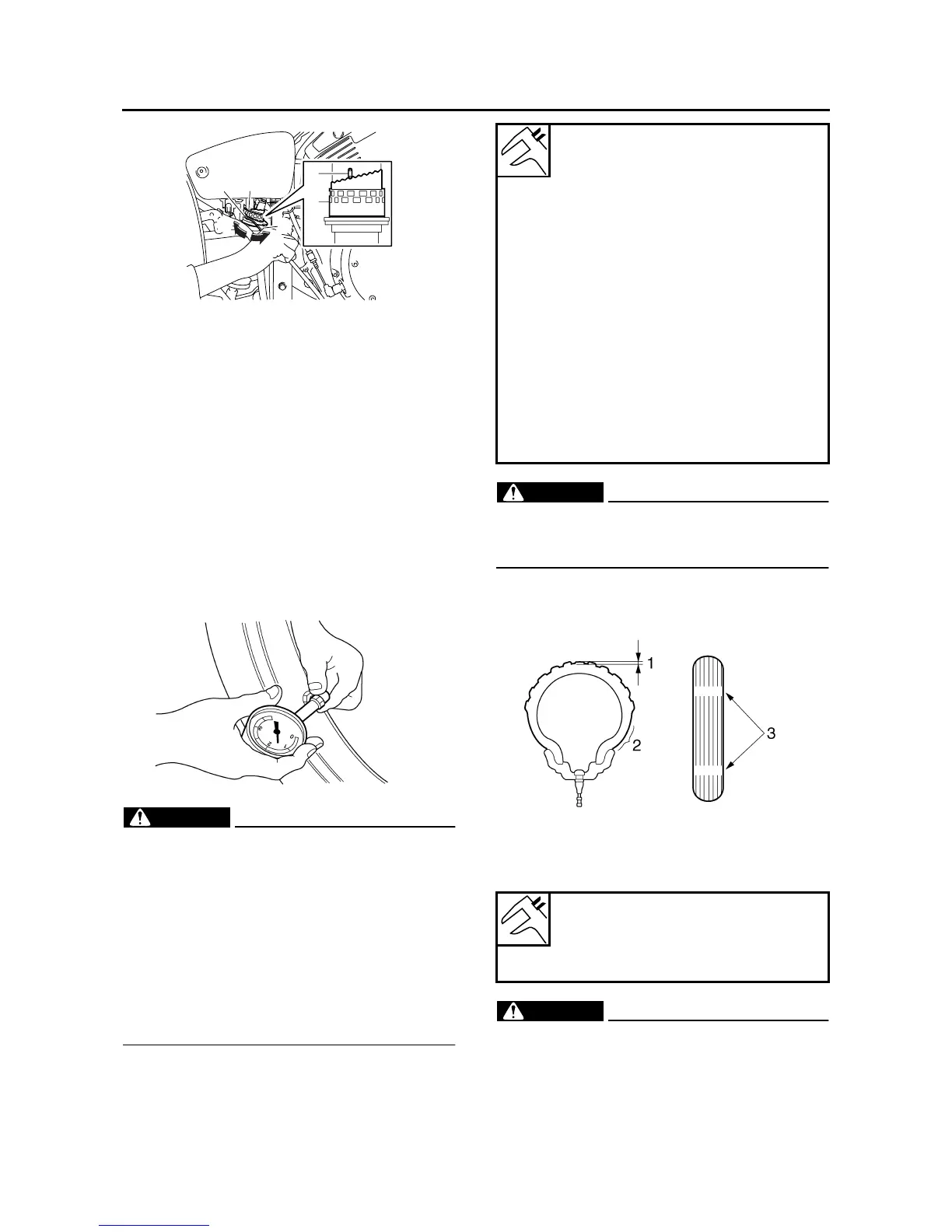
4. Connect:
• Fuel hose
Refer to “FUEL TANK” on page 7-1.
5. Install:
• Rear cylinder exhaust pipe
• Coolant reservoir cover
Refer to “ENGINE REMOVAL” on page 5-1.
EAS21650
CHECKING THE TIRES
The following procedure applies to both of the
tires.
1. Check:
• Tire pressure
Out of specification → Regulate.
WARNING
EWA13180
• The tire pressure should only be checked
and regulated when the tire temperature
equals the ambient air temperature.
• The tire pressure and the suspension must
be adjusted according to the total weight
(including cargo, rider, passenger and ac-
cessories) and the anticipated riding
speed.
• Operation of an overloaded vehicle could
cause tire damage, an accident or an injury.
NEVER OVERLOAD THE VEHICLE.
WARNING
EWA13190
It is dangerous to ride with a worn-out tire.
When the tire tread reaches the wear limit, re-
place the tire immediately.
2. Check:
• Tire surfaces
Damage/wear → Replace the tire.
WARNING
EWA14080
• Do not use a tubeless tire on a wheel de-
signed only for tube tires to avoid tire fail-
ure and personal injury from sudden
deflation.
1
2
3
4
5
6
7
8
9
4
3
a
b
1
3
2
Tire air pressure (measured on
cold tires)
Loading condition
0–90 kg (0–198 lb)
Front
250 kPa (36 psi) (2.50 kgf/cm²)
Rear
280 kPa (41 psi) (2.80 kgf/cm²)
Loading condition
90–210 kg (198–463 lb)
Front
250 kPa (36 psi) (2.50 kgf/cm²)
Rear
280 kPa (41 psi) (2.80 kgf/cm²)
Maximum load
210 kg (463 lb)
* Total weight of rider, passenger, cargo
and accessories
1. Tire tread depth
2. Side wall
3. Wear indicator
Wear limit (front)
1.6 mm (0.06 in)
Wear limit (rear)
1.6 mm (0.06 in)



 To Next Page