REAR BRAKE
4-41
4. Fill:
• Brake fluid reservoir
(with the specified amount of the recom-
mended brake fluid)
WARNING
EWA13090
• Use only the designated brake fluid. Other
brake fluids may cause the rubber seals to
deteriorate, causing leakage and poor
brake performance.
• Refill with the same type of brake fluid that
is already in the system. Mixing brake fluids
may result in a harmful chemical reaction,
leading to poor brake performance.
• When refilling, be careful that water does
not enter the brake fluid reservoir. Water
will significantly lower the boiling point of
the brake fluid and could cause vapor lock.
CAUTION:
ECA13540
Brake fluid may damage painted surfaces
and plastic parts. Therefore, always clean up
any spilt brake fluid immediately.
5. Bleed:
• Brake system
Refer to “BLEEDING THE HYDRAULIC
BRAKE SYSTEM” on page 3-21.
6. Check:
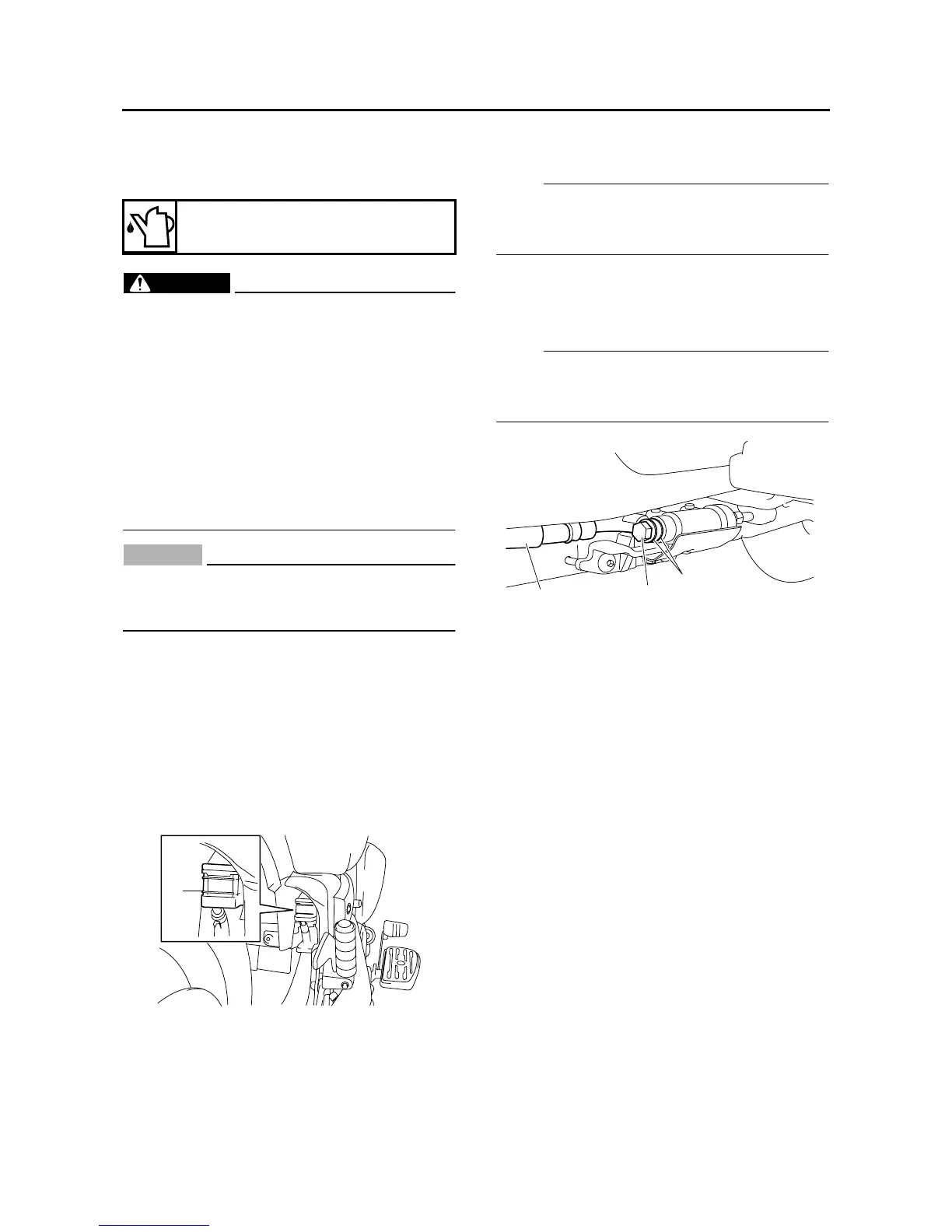
• Brake fluid level
Below the minimum level mark “a” → Add the
recommended brake fluid to the proper level.
Refer to “CHECKING THE BRAKE FLUID
LEVEL” on page 3-20.
7. Check:
• Brake pedal operation
Soft or spongy feeling → Bleed the brake sys-
tem.
Refer to “BLEEDING THE HYDRAULIC
BRAKE SYSTEM” on page 3-21.
EAS22700
REMOVING THE REAR BRAKE MASTER
CYLINDER
NOTE:
Before removing the rear brake master cylinder,
drain the brake fluid from the entire brake sys-
tem.
1. Remove:
• Rear brake hose union bolt “1”
• Copper washers “2”
• Rear brake hose “3”
NOTE:
To collect any remaining brake fluid, place a
container under the master cylinder and the end
of the brake hose.
EAS22720
CHECKING THE REAR BRAKE MASTER
CYLINDER
1. Check:
• Brake master cylinder
Damage/scratches/wear → Replace.
• Brake fluid delivery passages
(brake master cylinder body)
Obstruction → Blow out with compressed air.
2. Check:
• Brake master cylinder kit
Damage/scratches/wear → Replace.
3. Check:
• Brake fluid reservoir
Cracks/damage → Replace.
• Brake fluid reservoir diaphragm
Cracks/damage → Replace.
4. Check:
• Brake hoses
Cracks/damage/wear → Replace.
Recommended fluid
DOT 4
LOWER
UPPER
a
1
2
3









 To Next Page