User Manual UMN:CLI
V8102
573
SPT is established based on the existing unicast routing table by performing the RPF
check. It has a different distribution tree for every multicast source, allowing the efficient
network traffic flows, but more resources are needed for each multicast routers to main-
tain (S, G) states.
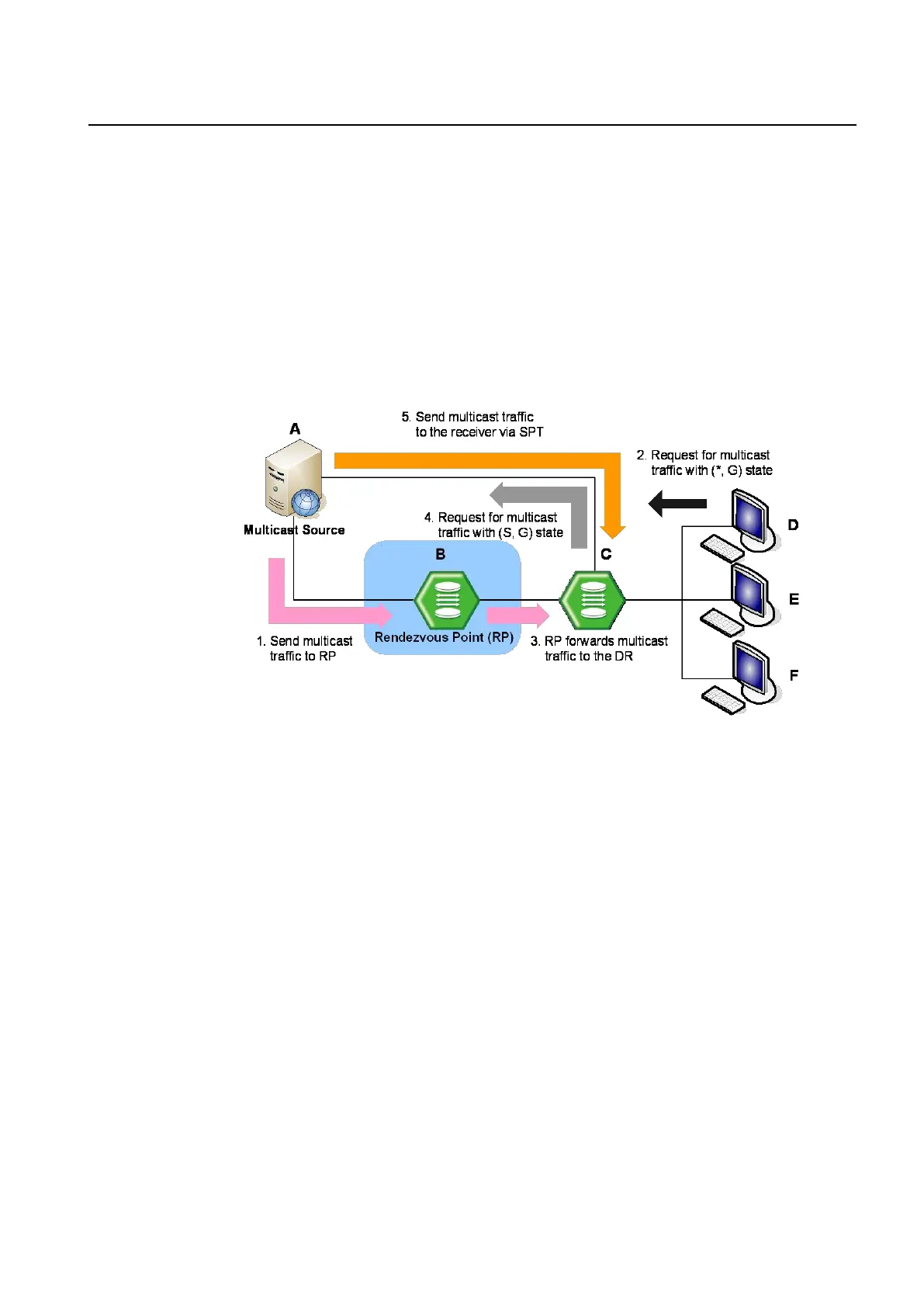
Fig. 11.5 shows an example of the SPT switchover. The multicast traffic from the source A
initially attempts to flow through the router B and C to the receiver D that indicates the in-
terest in the multicast group. Once the traffic arrives at the router C which is the DR, it
sends the join message with (S, G) state toward the source A to build the SPT between
the source and receiver. The source A then sends the multicast traffic to the receiver D
via the SPT by deleting unnecessary hops. Finally, the distribution tree (SPT) built by the
RPF check is A→C→D.
Fig. 11.5 Shortest Path Tree
PIM Messages
The followings are simple descriptions of PIM control messages:
• Hello
PIM routers periodically send hello messages on all interfaces to discover neighbor-
ing PIM routers and to determine which router will be the DR for each subnet.
• Register
Register messages are sent by the DR to the RP when a multicast packet needs to
be transmitted on the RPT. These messages may contain the encapsulated multicast
traffic. Both register and register-stop messages are unicast.
• Register-stop
When receiving the register-stop message, routers stop sending register messages.
These messages are sent from the RP to the sender of the register messages.
• Join/prune
Join/prune messages are sent by routers towards upstream sources or RPs. Join
messages are sent to receive the multicast traffic by building shared trees (RPT) or


 To Next Page